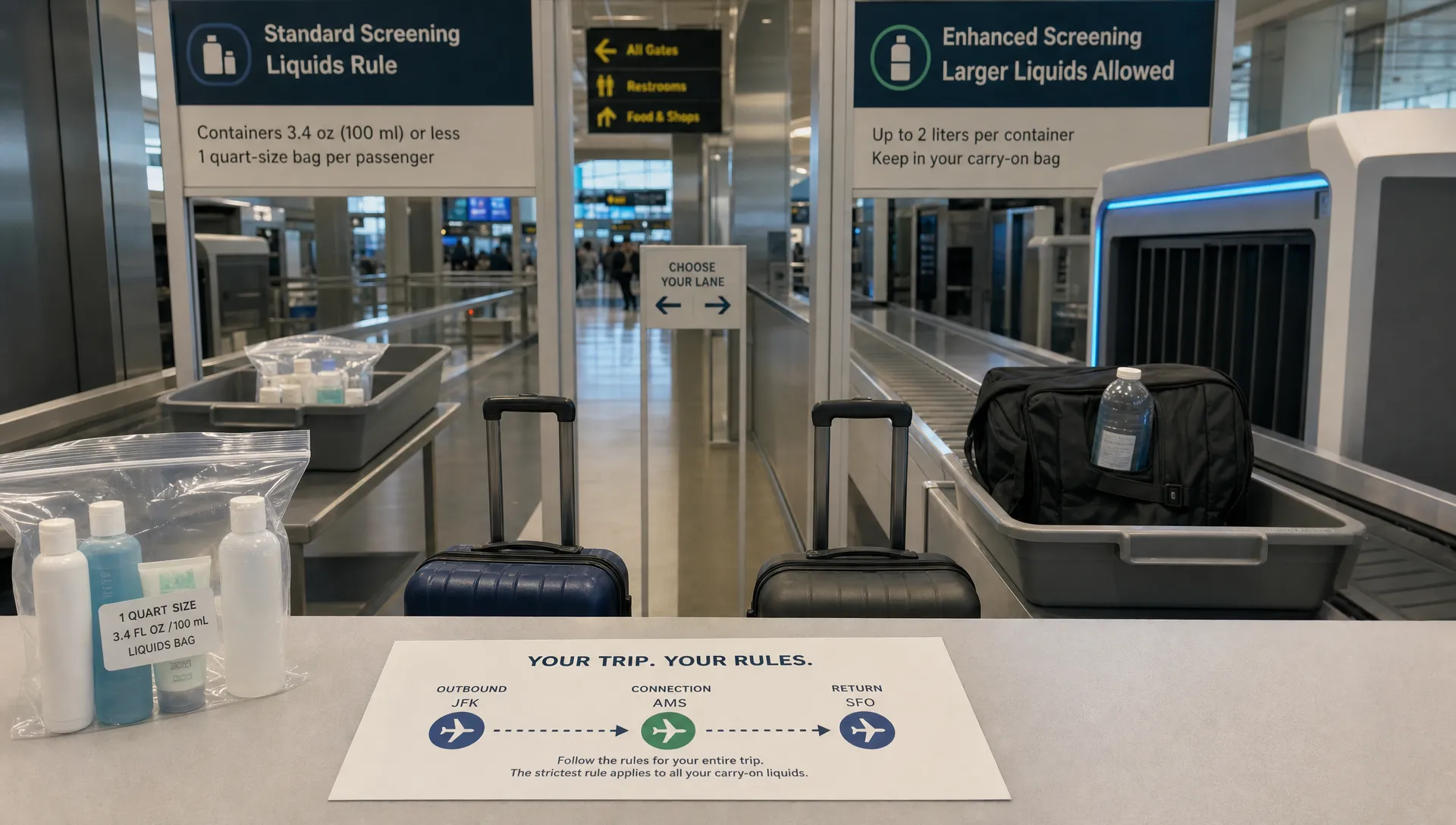
Liquid rules are easy to remember when your trip has one airport, one flight, and one security checkpoint. Most real itineraries are messier. You might fly out of an airport that still applies the 100ml rule, connect through a terminal with newer scanners, buy duty-free on the way, and return from a different country where the rules are stricter again.
That is why carry-on bag liquid rules should be checked by journey, not just by airline or destination. The liquid rule that matters is the one enforced at each security checkpoint where your cabin bag is screened. If one leg of your trip is stricter than the others, that stricter rule can decide what survives the whole journey.
This guide explains how to think about liquids across every leg of your trip, including outbound flights, connections, return flights, duty-free purchases, and the common exceptions that can keep necessary items with you.
Why every leg of your trip matters
Airport liquid rules are security rules, not standard airline baggage rules. Your airline decides things like cabin bag size, weight, and how many personal items you can bring. Airport security decides whether your shampoo, sunscreen, perfume, toothpaste, contact lens solution, or drink bottle can pass through the checkpoint.
For many travelers, the safest planning question is not, What does my departure airport allow? It is, What is the strictest liquid rule I will face before I get home?
You may face more than one checkpoint on a single trip. This can happen when you start your journey, transfer between certain international and domestic flights, pass through a connection airport that requires re-screening, or begin your return flight. If you are carrying the same liquid items throughout the trip, every one of those checkpoints matters.
| Trip point | Why it matters for liquids | What to check before packing |
|---|---|---|
| First departure airport | Your carry-on liquids are screened before the outbound flight | Container size limit, liquids bag rule, scanner policy |
| Connection airport | Some transfers require passengers to clear security again | Whether transit passengers are re-screened and what rule applies |
| Return airport | The return journey may use different national or airport rules | Whether the return airport follows 100ml, 2L, or another current policy |
| Multi-city stop | You may buy full-size liquids during the trip and then fly again | Whether those items must go in checked luggage for the next flight |
| Duty-free transfer | Sealed duty-free liquids may still be inspected during connections | Whether security tamper-evident bags are accepted on the next leg |
If you want a route-based view rather than checking airports one by one, Liquid Limits lets you check liquid rules for your trip, including return flights and route-specific differences. That is especially useful when your return airport is not the same as your arrival airport.
The baseline carry-on liquid rule most travelers should know
The most familiar carry-on bag liquid rule is the 100ml rule. In the United States, the Transportation Security Administration describes this as the 3-1-1 liquids rule: containers must be 3.4 ounces, or 100 milliliters, or less per item, and they must fit in a quart-size bag. In many other places, including the UK and much of Europe, the equivalent rule is usually described as 100ml containers in a transparent resealable plastic bag with a total capacity around 1 liter.
The key detail is container size. A 200ml bottle that is half empty is still a 200ml container. Under the 100ml rule, it is usually not allowed in your cabin bag because the container itself is too large.
Liquids also include more than obvious drinks. Security authorities commonly treat gels, aerosols, creams, pastes, lotions, foams, and spreadable items as liquids for screening. That means toothpaste, mascara, lip gloss, peanut butter, hair gel, shaving foam, sunscreen, liquid makeup, and deodorant sprays can all fall under the liquid rule.
If you need a broader refresher on the standard rule, the Liquid Limits guide to flying liquid requirements for carry-on bags covers the 100ml limit, liquids bags, and how newer scanners can change the process at some checkpoints.
Why some airports allow more than 100ml
Some airports have introduced newer computed tomography scanners that can screen cabin bags in more detail. At certain airports or checkpoints, that can mean passengers may be allowed to keep liquids inside their bags and carry larger containers, sometimes up to 2 liters.
But this is where many travelers get caught out. A more generous rule at one airport does not mean the same rule applies everywhere else on your itinerary. Scanner rollout can vary by country, airport, terminal, checkpoint, and even operational period. Government policies can also change while technology is being tested or updated.
The UK government still advises passengers to check current airport restrictions before travel through its hand luggage restrictions guidance. That advice is important because liquid screening rules can change faster than packing habits do.
For multi-leg travel, the practical takeaway is simple: if any security checkpoint on your route enforces the 100ml rule, pack your through-trip carry-on liquids as if the 100ml rule applies to the entire journey.
How to apply carry-on bag liquid rules to each leg
The cleanest way to pack is to map your trip by checkpoints, not by flights. A direct flight usually has one security screening before departure and another before the return flight. A connecting itinerary may involve more.
Outbound flight
Start with your first airport. If it follows the 100ml rule, your carry-on liquids should be in compliant containers before you leave home. If it allows larger containers, you still need to check the rest of your itinerary before deciding to bring full-size products.
For example, if your outbound airport allows larger liquids but your return airport follows 100ml, full-size sunscreen bought at home may be fine on the way out but not allowed in your cabin bag on the way back. You would need to use it up, place it in checked luggage, or replace it with a smaller container before your return flight.
Connections and transfers
Connections are the most overlooked part of liquid planning. Some airside transfers do not require another security screening. Others do, especially when changing countries, switching from international to domestic flights, changing terminals, or following airport-specific transit procedures.
If you must clear security again, the connection airport's liquid rule applies. That can affect liquids you packed at home, drinks bought after your first security checkpoint, and duty-free purchases from the first airport.
When in doubt, assume a connection may involve re-screening unless your airport or airline itinerary clearly says otherwise. This conservative approach prevents you from relying on a relaxed first checkpoint and losing items later.
Return trip
Return trips deserve their own check because travelers often buy toiletries, perfumes, cosmetics, local food items, and gifts during a vacation. If those items are liquids, gels, creams, pastes, or spreadables, they may not be allowed in your cabin bag for the return flight.
This is why return airport rules matter before you shop. A large bottle of olive oil, honey, lotion, hot sauce, or perfume may need checked luggage, even if it was easy to purchase after arrival. For a deeper look at this problem, Liquid Limits has a dedicated guide to rules for liquids on flights and return trips.
What counts as a liquid in a carry-on bag?
A useful rule of thumb is this: if it can be poured, sprayed, squeezed, smeared, spread, or is not fully solid at room temperature, treat it as a liquid for airport security.
| Item | Usually treated as a liquid? | Carry-on packing tip |
|---|---|---|
| Water, juice, coffee, soda | Yes | Bring an empty bottle and refill after security |
| Shampoo, conditioner, body wash | Yes | Use 100ml travel bottles if any leg is strict |
| Toothpaste and mouthwash | Yes | Choose a travel-size tube and small bottle |
| Sunscreen and lotion | Yes | Decant into compliant containers or check full-size bottles |
| Mascara, liquid foundation, lip gloss | Yes | Put them in the liquids bag where required |
| Peanut butter, jam, honey, dips | Usually yes | Pack in checked luggage unless in small compliant containers |
| Solid soap, solid shampoo bar | Usually no | A good alternative to reduce liquids |
| Empty reusable bottle | No liquid if empty | Carry it empty through security, then refill |
Borderline items should go in your liquids bag when space allows. If a security officer decides an item counts as a liquid and it is not compliant, you may have to surrender it.
Exceptions: medicine, baby items, and special needs
Most airport security systems have exceptions for medically necessary liquids and infant or child feeding items, but the exact process varies by country.
Medications, medically necessary creams, contact lens solution, baby formula, breast milk, baby food, and related items may be allowed in quantities larger than 100ml when needed for the trip. They may need to be declared, separated from your main liquids bag, and screened separately. Documentation, prescriptions, or labels can help, especially for international travel, but requirements differ.
Do not pack essential medication only in checked luggage. Checked bags can be delayed, lost, or exposed to temperature changes. If you need liquid medication during travel, keep it accessible in your cabin bag and check the relevant airport guidance before you fly.
Duty-free liquids are not a universal workaround
Duty-free purchases can be convenient, but they are not a free pass through every later checkpoint. Many airports use security tamper-evident bags for duty-free liquids. These sealed bags usually include the receipt and are designed to show whether the purchase has been opened.
However, acceptance can depend on where you bought the item, where you are connecting, whether the bag is still sealed, when the item was purchased, and whether the screening authority can clear it. If the next checkpoint does not accept the sealed duty-free bag or cannot screen the item, the liquid may be confiscated.
The safest approach is to buy duty-free liquids only when you are confident you will not face another restrictive security checkpoint, or when you can place the item in checked luggage before the next flight. If your trip includes a connection, verify the rules before buying expensive perfume, spirits, cosmetics, or food gifts.
A practical packing strategy for multi-leg trips
The best carry-on liquid strategy is not to maximize what you can get through the easiest airport. It is to minimize risk across the whole itinerary.
Start by identifying every airport where your carry-on bag could be screened. Include the outbound departure airport, connection airports where transfer security may apply, the return airport, and any airport used during a multi-city trip.
Then compare the rules. If one airport requires 100ml containers, build your cabin liquids around that rule. If all airports on your route clearly allow larger containers, you may have more flexibility, but still consider whether rules could change before your return date.
For most travelers, this packing plan works well:
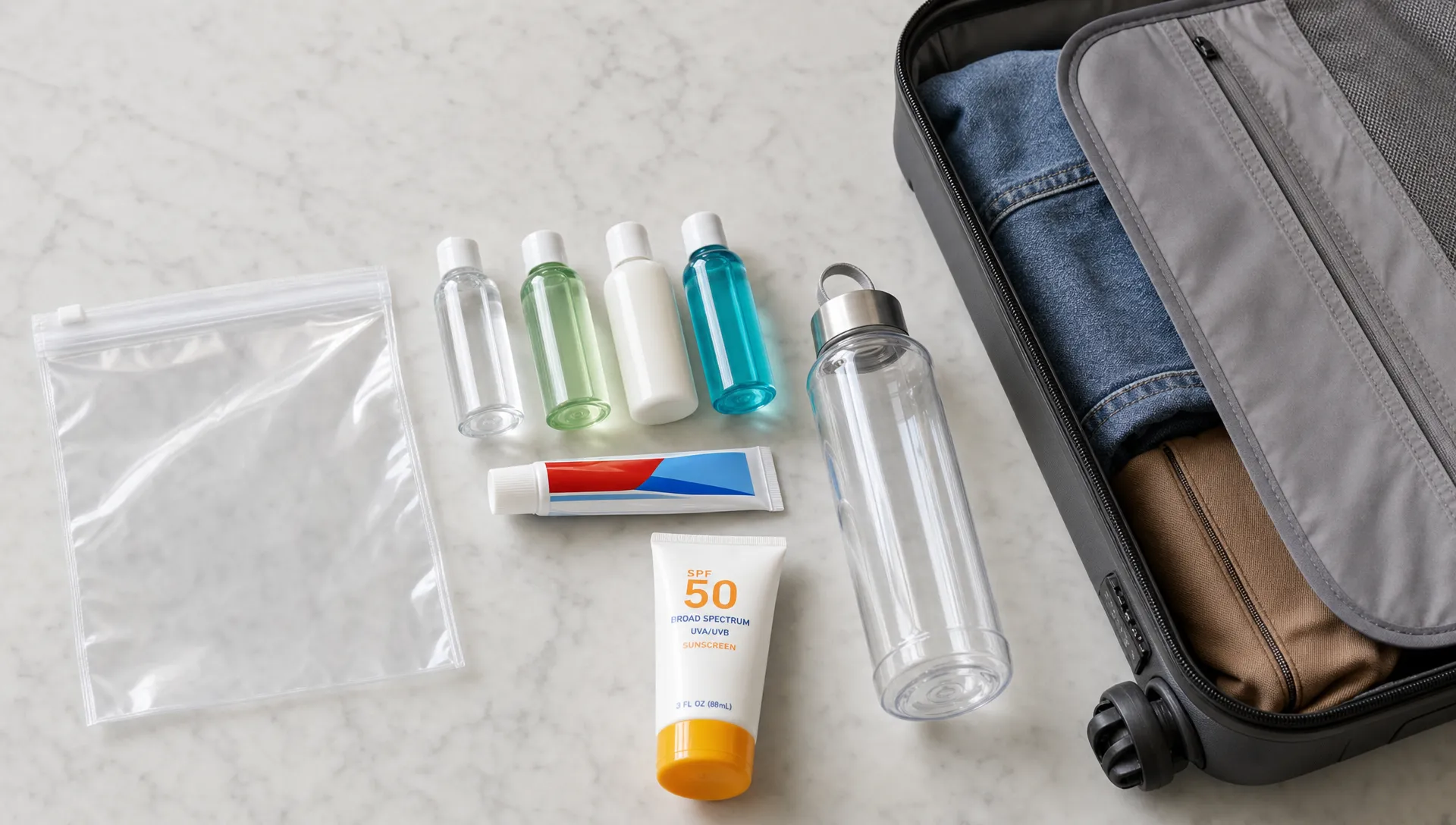
- Use 100ml or smaller containers for toiletries you must carry in the cabin.
- Put larger toiletries, sauces, oils, perfumes, and gifts in checked luggage when possible.
- Replace liquid products with solid alternatives, such as soap bars, shampoo bars, stick deodorant, and solid balm.
- Carry an empty reusable water bottle and fill it after security.
- Keep medicines and baby items separate and easy to present for screening.
- Check return rules before buying full-size liquids during the trip.
This approach may feel stricter than necessary at the first airport, but it protects you against the airport you have not reached yet.
When should you use the strictest rule?
Use the strictest rule whenever you are carrying liquids across multiple flight legs without access to checked luggage between them. That includes same-day connections, international transfers, round trips with carry-on only, and itineraries where you plan to bring the same toiletry kit home.
Also use the strictest rule when airport information is unclear. If you cannot confirm whether a checkpoint allows larger containers, packing to 100ml is the lower-risk choice. This is the same conservative principle Liquid Limits uses when rules are unclear: default to the stricter 100ml rule rather than assuming a relaxed policy.
The strictest-rule mindset is especially important for carry-on-only travelers. If you do not have checked luggage, there may be nowhere to move a non-compliant liquid once you reach security.
Frequently Asked Questions
Do carry-on bag liquid rules apply to both my suitcase and personal item? Yes. The rules apply to liquids in your cabin baggage, whether they are in a roller bag, backpack, handbag, or personal item. Security officers screen what you bring through the checkpoint, not just one specific bag.
Can I bring a 200ml bottle if it only has 50ml left inside? Usually no under the 100ml rule. Security normally looks at the container capacity, not the amount remaining. Use a container labeled 100ml or less if your route includes a strict checkpoint.
Are liquid rules based on my airline or airport? They are mainly based on airport security rules and national security regulations. Your airline may have separate cabin baggage rules, but the liquid screening decision is made at security.
What if my departure airport allows 2L liquids but my return airport does not? Pack your through-trip carry-on liquids for the stricter return airport, or plan to put larger liquids in checked luggage for the return flight. Otherwise, you may have to surrender them before flying home.
Can I bring food in my carry-on if it is spreadable? Spreadable foods such as jam, honey, peanut butter, dips, and some soft cheeses may be treated as liquids, gels, or pastes. If any leg follows the 100ml rule, pack these in checked luggage or use small compliant containers.
Do I need to remove liquids from my bag at every airport? Not always. Some airports with newer scanners may allow liquids to stay inside the bag, but others still require removal. Follow the instructions at the checkpoint you are using that day.
Check the full trip before you pack
Carry-on liquid mistakes usually happen because travelers check only one airport or rely on what happened on their last trip. The safer habit is to check every leg, including connections and the return flight, before you decide what goes in your cabin bag.
Liquid Limits helps you compare airport liquid rules by trip, route, airport, and item, with source links, daily updates, and last-checked dates. Before your next flight, use LiquidLimits.com to see whether your route points to 100ml, 2L, or the stricter fallback you should pack for.