
Flying liquid requirements for carry-on bags are not just about the bottle in your toiletry kit. They depend on the airport security checkpoint that screens you, the items you pack, your connections, and sometimes your return airport.
For most travelers, the safest rule is still simple: pack cabin liquids in containers of 100ml / 3.4oz or less and place them in a clear, resealable liquids bag. In 2026, some airports with newer scanners may allow larger containers, but the rollout is uneven. If one checkpoint on your trip still uses the standard rule, that checkpoint can decide what stays and what gets thrown away.
The short answer: pack for the strictest checkpoint
At standard airport security checkpoints, liquids in carry-on bags usually need to meet three basic requirements:
| Requirement | What it usually means | Packing move |
|---|---|---|
| Container size | Each liquid, gel, aerosol, cream, or paste is in a container of 100ml / 3.4oz or less | Use travel-size bottles or solid alternatives |
| Liquids bag | Containers fit inside one clear, resealable plastic bag, often around 1 liter or 1 quart | Do not overstuff it, and make sure it closes |
| Screening access | The liquids bag may need to be removed from your carry-on at security | Pack it near the top of your bag |
| Exceptions | Medicines, baby feeding items, and some special dietary items may be allowed in larger amounts | Keep them separate and be ready for extra screening |
| Route differences | Connecting and return airports may enforce different rules | Check each airport where you will pass security |
The U.S. Transportation Security Administration describes this as the TSA 3-1-1 liquids rule: 3.4oz containers, one quart-size bag, one bag per passenger. Many international airports use the same 100ml container limit, although bag size wording and screening procedures can vary.
The most important detail is that the container capacity matters. A 150ml shampoo bottle with only a small amount left inside can still be refused because the bottle itself is over the limit.
What counts as a liquid when flying?
Airport security uses a broad definition. If an item pours, spreads, sprays, squeezes, smears, or is not clearly solid, treat it as a liquid for cabin baggage.
| Category | Common examples | Carry-on approach |
|---|---|---|
| Toiletries | Shampoo, conditioner, shower gel, toothpaste, mouthwash, sunscreen | 100ml / 3.4oz containers in the liquids bag |
| Cosmetics | Mascara, liquid eyeliner, concealer, cream blush, liquid foundation | Usually treated as liquids, creams, or gels |
| Aerosols | Spray deodorant, hairspray, shaving foam, dry shampoo spray | Must meet liquid size rules and airline safety rules |
| Food and spreads | Yogurt, honey, jam, peanut butter, sauces, dips | Usually limited to 100ml in cabin bags unless exempt |
| Medical liquids | Prescription liquids, insulin, contact lens solution, liquid nutrition | May be exempt, but should be separated for screening |
| Drinks | Water, juice, coffee, alcohol | Empty before security unless purchased after screening or exempt |
Borderline items cause the most problems. Solid deodorant is usually easier than gel deodorant. Powder makeup is usually easier than cream makeup. Bar soap is easier than shower gel. If you do not want to think about a product at security, choose the solid version.
Scanner upgrades do not mean every airport has changed
New computed tomography scanners can allow officers to inspect baggage without the same bag-removal process, and some airports may permit larger liquid containers. In some places, travelers may see a 2L allowance instead of the traditional 100ml limit.
However, this does not mean you can assume a 2L rule everywhere. Scanner rollout is airport-specific, sometimes terminal-specific, and subject to regulatory changes. One airport on your outbound journey may allow larger liquids, while your return airport or connecting airport still applies the 100ml rule.
If you are comparing different airport policies, use a current airport-specific source rather than relying on a past trip. Liquid Limits keeps a dedicated overview of airport liquid limits for carry-ons in 2026 if you want more context on why the rules can differ.
Why your route matters as much as your destination
Flying liquid requirements are enforced at security checkpoints, not just by the airline or destination country. That matters in four common situations.
| Travel situation | What can happen | Best practice |
|---|---|---|
| Direct outbound flight | You pass security once at your departure airport | Follow that airport’s current cabin liquid rule |
| International connection | You may be screened again before your next flight | Pack to the strictest airport on the route |
| Return flight | Your return airport may have different scanner rules | Check the return airport before you leave home |
| Duty-free purchase | Large liquids may be allowed only if sealed correctly | Keep the receipt and tamper-evident bag intact |
This is why a round trip can be confusing. You might depart from an airport that allows larger containers, then come home from an airport that still enforces the 100ml rule. If you bought full-size toiletries during the trip, they may need to go in checked baggage for the return.
How to pack liquids so they pass security
A reliable packing system reduces last-minute decisions at the checkpoint. Start by separating your bag into three groups: liquids that must go in the cabin, liquids that can go in checked baggage, and products you can replace with solids.
A practical packing session starts before you touch your toiletry kit. Lay out outfits, shoes, chargers, and toiletries in one place so you can see what actually needs to travel. If closet clutter makes that difficult, space-saving closet organizers from MORALVE can make the pre-trip sort easier, especially when you are trying to avoid packing duplicate clothing and extra products.
Once your items are visible, build your carry-on liquids bag with restraint. Put must-have items in compliant travel containers, leave nice-to-have products at home, and avoid packing a liquids bag so full that it cannot close. If the bag looks forced, it may slow you down at security.
Use this simple order of priority:
- Pack essential medications and health items first, keeping exemptions separate from ordinary toiletries.
- Add small daily-use toiletries such as toothpaste, deodorant gel, sunscreen, and contact lens solution.
- Choose solid swaps for anything that is not essential, such as shampoo bars, bar soap, powder makeup, or solid perfume.
- Move full-size products to checked baggage when allowed, or buy them after arrival.
- Keep the liquids bag near the top of your carry-on so you can remove it quickly if asked.
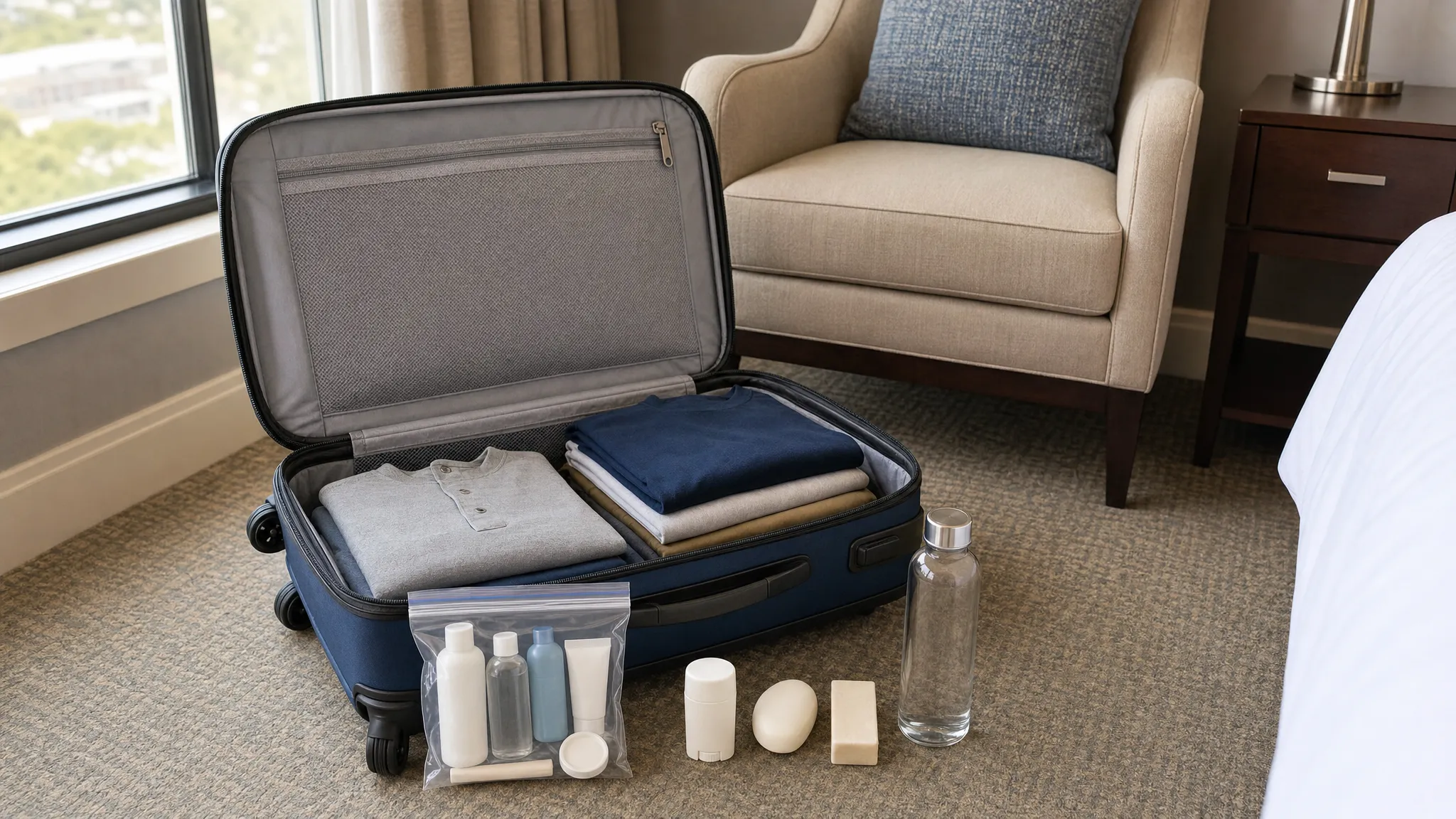
Exceptions: what can exceed the usual 100ml limit?
Some liquids are allowed in larger quantities because they are medically or practically necessary. These exceptions are real, but they are not a free pass to pack anything in full size.
Medicines and medical liquids
Prescription liquid medicines, insulin, injectable medications, liquid nutrition, and similar health-related items may be permitted above 100ml. Keep them separate from your standard liquids bag and allow extra screening time. Labels, prescriptions, or supporting documentation can help, especially on international trips, but requirements vary by country.
Baby and child feeding items
Breast milk, formula, baby food, and toddler drinks are commonly treated differently from ordinary liquids. They may be screened separately. If you are traveling with a child, pack these items where you can access them without unpacking the entire bag.
Duty-free liquids
Liquids bought after security, such as perfume or alcohol, may be allowed on board. The complication is transit. If you connect through another airport and must pass security again, the item may need to be in a sealed tamper-evident bag with a receipt. Do not open the sealed bag until you are finished with all security checks on your route.
Special dietary needs
Liquid foods required for medical or dietary reasons may be allowed in larger amounts, but they can require explanation and screening. Ordinary snacks such as yogurt, dips, sauces, and spreads should be treated as regular liquids unless an exemption clearly applies.
Common carry-on liquid decisions
The easiest way to avoid confusion is to decide item by item before you leave home. Here are common examples travelers often ask about.
| Item | Is it usually a liquid for carry-on screening? | Practical tip |
|---|---|---|
| Toothpaste | Yes | Use a travel-size tube under 100ml / 3.4oz |
| Roll-on deodorant | Usually yes | Solid stick deodorant is simpler |
| Aerosol deodorant | Yes | Keep it under the limit and check airline aerosol rules |
| Sunscreen | Yes | Pack a small bottle, stick sunscreen, or buy after security |
| Mascara | Yes | Put it in the liquids bag |
| Lip balm | Usually not a problem if solid | Liquid lip gloss is more likely to count |
| Liquid or cream foundation | Yes | Check the specific rule for liquid or cream foundation before packing makeup |
| Peanut butter | Yes, as a spread | Put large jars in checked baggage or leave them at home |
| Empty reusable bottle | No, if empty | Fill it after security |
| Contact lens solution | Usually liquid, sometimes medically necessary | Pack travel size or keep larger medical quantities separate |
When in doubt, ask whether the item behaves like a liquid, gel, cream, paste, spray, or spread. If it does, pack it under the liquid rules unless you have a clear exemption.
Mistakes that get liquids stopped at security
The most common mistake is packing a container over 100ml because it is almost empty. Security usually looks at the labeled container capacity, not the remaining amount.
Another mistake is assuming the rules at your home airport apply to the whole trip. A connecting airport can re-screen passengers, and a return airport may enforce a stricter standard than the one you departed from.
Travelers also get caught by food. Souvenirs such as jam, honey, sauces, olive oil, nut butter, and yogurt can be treated as liquids or spreads. If the container is over the cabin limit, put it in checked baggage when possible.
Finally, do not rely on social media anecdotes. Airport liquid rules can change with scanner upgrades, temporary policy changes, or local enforcement. A traveler’s smooth experience last month does not guarantee the same result for your route today.
Quick pre-flight carry-on liquid checklist
Use this checklist before you zip your bag:
- Check the liquid rule for every airport where you will pass security, including connections and the return flight.
- Pack ordinary cabin liquids in containers of 100ml / 3.4oz or less when any rule is unclear.
- Make sure all standard liquids fit in one clear, resealable bag if that rule applies.
- Keep medicines, baby feeding items, and special dietary liquids separate for screening.
- Put full-size toiletries, sauces, and souvenirs in checked baggage when allowed.
- Keep duty-free liquids sealed with the receipt until all security screening is complete.
- Empty reusable water bottles before security and refill them after the checkpoint.
Frequently Asked Questions
What are the flying liquid requirements for carry-on bags? At standard checkpoints, carry-on liquids, gels, aerosols, creams, and pastes usually need to be in containers of 100ml / 3.4oz or less and fit inside a clear resealable liquids bag. Some airports may allow more with newer scanners, but you should verify the exact airport rule.
Does the 100ml rule apply to the amount inside the bottle or the bottle size? It usually applies to the container size. A bottle labeled 150ml can be refused even if it contains less than 100ml of product.
Can I bring a full-size shampoo bottle in my carry-on? Usually no, unless the airport checkpoint specifically allows larger liquids. If any checkpoint on your route uses the standard rule, pack shampoo in a 100ml / 3.4oz container or put the full-size bottle in checked baggage.
Do medicines have to fit in the liquids bag? Medically necessary liquids may be allowed in larger quantities and may not need to fit in the standard liquids bag. Keep them separate and be ready for additional screening.
Can I buy a drink after security and bring it on the plane? Usually yes for a direct flight, but be careful with connections. If you pass through security again, that drink may be subject to the next airport’s liquid rules.
Should I follow the outbound airport rule or the return airport rule? Follow the strictest rule for the entire trip. Your return airport can have different requirements, so check it before packing products you plan to bring home.
Check the rule before you pack
The safest packing decision is the one based on your actual trip, not a general memory of the rules. Before you fly, use Liquid Limits to check airport, item, and route liquid rules, including the return flight. You can compare restrictions side by side, review source links and last-checked dates, and default to the stricter 100ml rule when guidance is unclear.