
Packing liquids should not feel like a guessing game. Yet hand luggage liquids are one of the most common reasons travelers get stopped at airport security, especially when they are carrying toiletries, cosmetics, medicines, baby supplies, duty-free purchases, or food that sits in the gray area between solid and liquid.
The good news: the rules become much easier when you use one simple principle. Pack for the strictest security checkpoint on your trip, not the most relaxed one. That includes your outbound flight, connections, and return airport.
Below is a practical, plain-English guide to help you decide what can go in your cabin bag, what belongs in checked luggage, and what deserves a rule check before you leave home.
The simple version of the hand luggage liquids rule
In many airports, the standard cabin rule is still the familiar 100ml limit: liquids, aerosols, gels, creams, and pastes must be in containers of 100ml or less, usually placed inside a transparent resealable liquids bag.
In the United States, the TSA’s 3-1-1 liquids rule allows containers of 3.4oz, equivalent to 100ml, in one quart-sized bag. In the UK, official hand luggage restrictions also explain the 100ml container rule and common exemptions.
The key detail many travelers miss is this: the container size matters, not how much product is left inside. A 200ml shampoo bottle that is half empty may still be refused because the container is larger than 100ml.
Some airports with newer security scanners may allow larger liquids in cabin bags, but this is not universal. Rules can change by airport, terminal, route, and date. If one airport on your journey still applies the 100ml rule, you need to pack for that stricter checkpoint.
What counts as a liquid in hand luggage?
Airport security usually treats more items as liquids than travelers expect. The category often includes anything that can be poured, sprayed, spread, squeezed, smeared, or applied as a gel.
Common examples include:
- Water, soft drinks, coffee, tea, and other beverages
- Shampoo, conditioner, shower gel, and body wash
- Toothpaste, mouthwash, and liquid dental products
- Perfume, aftershave, deodorant sprays, and roll-on deodorant
- Sunscreen, moisturizer, foundation, mascara, lip gloss, and creams
- Hair gel, shaving foam, mousse, and styling products
- Contact lens solution and eye drops
- Soups, sauces, honey, jam, peanut butter, yogurt, and soft cheese
That last group catches people out. Many foods are fine in cabin baggage if they are solid, but spreadable or semi-liquid foods may fall under the liquids rule. If you would spread it with a knife, squeeze it from a pouch, or pour it from a jar, treat it as a liquid unless your airport says otherwise.
For a broader item-by-item view, Liquid Limits also has a guide to what liquids are allowed in carry-on luggage, including common exemptions and duty-free considerations.
The easiest packing method: sort, shrink, separate
Instead of trying to memorize every rule, use a three-step method: sort, shrink, separate.
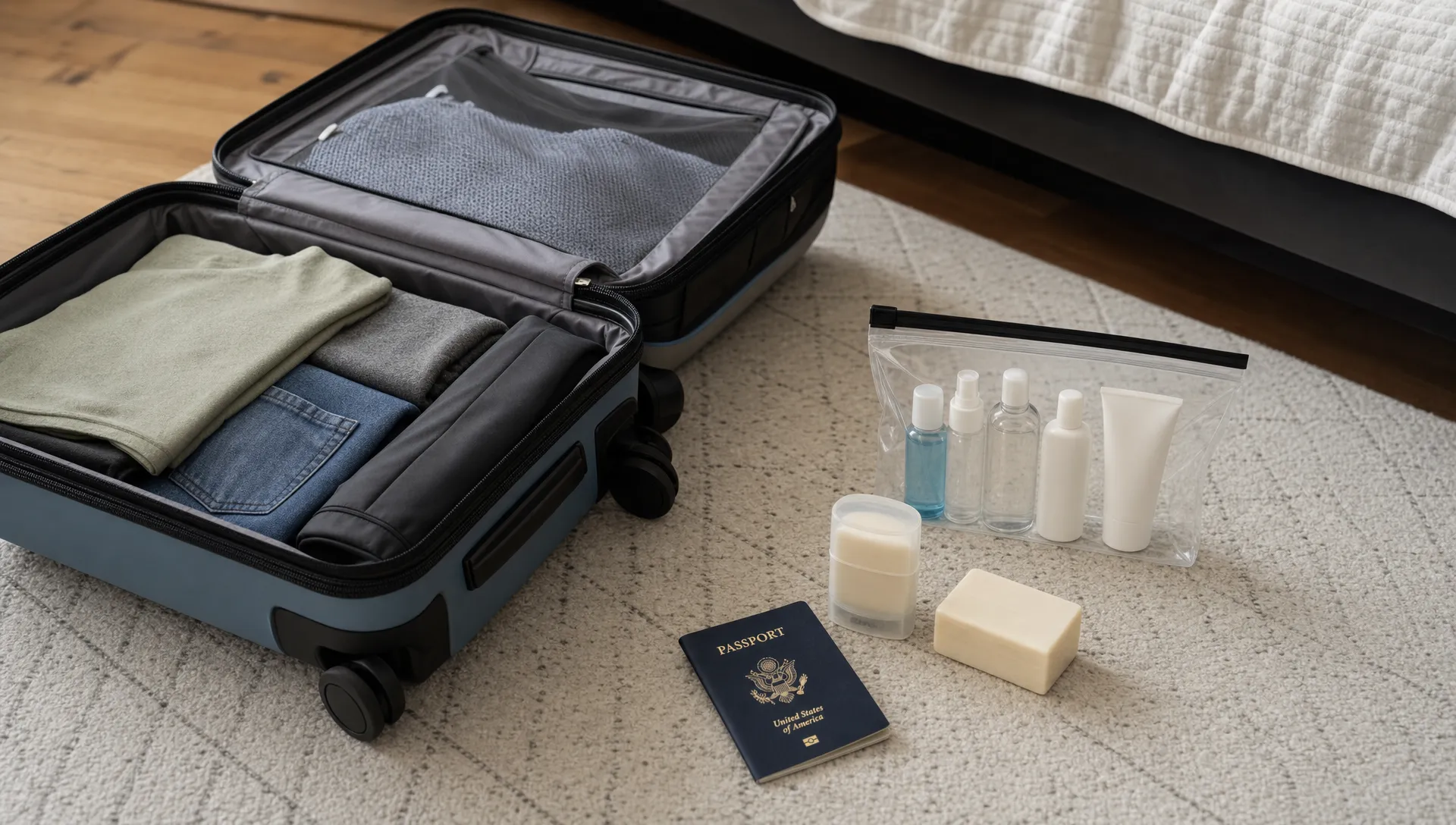
First, sort your items into three categories: definitely solid, clearly liquid, and borderline. Solid items like bar soap, powder makeup, solid deodorant, and some stick balms are usually easier to travel with than liquid versions. Clearly liquid items include toiletries, drinks, sprays, gels, and creams. Borderline items include soft foods, cosmetic balms, gels, and anything in a squeezable tube.
Second, shrink anything you want to carry through security. Use containers of 100ml or less where the strict rule applies. Do not rely on a larger bottle being partly empty. Travel-sized containers, sample sizes, and solid alternatives reduce the chance of losing items at the checkpoint.
Third, separate the liquids bag before you reach security if the airport requires it. Even where newer scanners mean you can keep liquids inside your bag, it is still useful to have them easy to remove. If the lane, terminal, or return airport uses older procedures, you will not be unpacking under pressure.
| Packing question | Safer choice |
|---|---|
| Is the container over 100ml? | Put it in checked luggage or replace it with a 100ml container |
| Is the item spreadable, squeezable, sprayable, or gel-like? | Treat it as a liquid |
| Does one airport on your route still use the 100ml rule? | Pack to the 100ml rule for the whole trip |
| Is it medicine or baby food? | Keep it accessible and check the exemption rules before travel |
| Is it duty-free liquid? | Keep it sealed with the receipt and check transfer rules |
Medicines, baby supplies, and special dietary items
Medicines and baby supplies are often treated differently from ordinary toiletries, but they are not a free-for-all. Airports usually allow reasonable quantities of essential liquid medicines, baby milk, baby food, and special dietary liquids, especially when needed during the journey.
Still, the exact process can vary. You may need to declare the item at security, remove it for screening, or show supporting documentation for prescription medicine. If you are carrying a medically necessary liquid above 100ml, keep it in its original packaging when possible and bring a prescription, doctor’s note, or pharmacy label if relevant.
Parents should also check the rule at every airport on the route, not just the departure airport. Baby milk that is accepted at your home airport may still be screened differently on a connection or return flight.
Why your return flight matters
One of the easiest mistakes is checking the liquid rule only for the outbound flight. But if you buy a full-size sunscreen, perfume, shampoo, or local food product during your trip, your return airport may apply a stricter rule than the airport you flew from.
This is especially important in regions where some airports have upgraded scanners and others have not. A route can be relaxed in one direction and strict in the other. A connection can also change everything because you may need to pass through security again before your next flight.
If you want to avoid repacking at the airport, check whether rules can differ on your return journey before you shop. When in doubt, assume the 100ml rule applies for cabin baggage and put larger items in checked luggage.
What about airports with newer scanners?
Newer CT scanners can make security screening faster and may allow larger liquids in some places. But travelers should be careful about assuming that a modern scanner means relaxed liquid limits.
There are three reasons:
- Not every airport has the same equipment in every terminal.
- Some airports with newer scanners may still enforce 100ml limits because of local policy or temporary restrictions.
- Your destination, connection, or return airport may apply a different rule.
This is why the strictest-rule approach is so useful. If every security checkpoint on your journey clearly allows larger liquids, you may be able to pack differently. If any checkpoint is unclear, plan for 100ml containers in your cabin bag.
Liquid Limits is designed for exactly this situation. You can check the strictest liquid rule for your route before you pack, including airports on a round trip, item-specific guidance, last-checked dates, and source links where available.
Duty-free liquids: allowed, but not always simple
Duty-free liquids such as perfume, alcohol, skincare, and cosmetics are often allowed in cabin baggage when they are packed in a sealed, tamper-evident security bag with proof of purchase. The problem is that duty-free rules can become complicated when you have a connection or need to clear security again.
If you buy duty-free liquids before a connecting flight, do not open the sealed bag before your final destination. Keep the receipt visible inside the bag. If the bag is opened, damaged, or not recognized by a transfer airport, security may refuse the item.
For expensive liquids, it is worth checking the rule before you buy. A bottle that is fine on a direct flight may become a problem on a multi-stop itinerary.
Common mistakes that slow travelers down
Most liquid problems at airport security are avoidable. The biggest issue is not that travelers are careless, but that the rules are more detailed than the phrase “liquids limit” suggests.
Watch out for these common mistakes:
- Packing a 150ml or 200ml container that is only partly full
- Forgetting that gels, creams, pastes, sprays, and aerosols count
- Carrying full-size toiletries because the departure airport has newer scanners
- Buying liquids abroad without checking the return airport rule
- Assuming duty-free liquids are always accepted on connecting flights
- Leaving liquids buried deep in a cabin bag when they need to be removed
A good rule of thumb: if losing the item would be annoying or expensive, do not guess. Check the route, check the airport, or pack it in checked baggage if it is allowed there.
A quick pre-flight liquids checklist
Use this before you zip your bag:
- Are all ordinary cabin liquids in containers of 100ml or less?
- Are the containers packed in a transparent resealable bag if required?
- Have you checked the rule for your departure, connection, and return airports?
- Are medicines, baby supplies, or special dietary liquids easy to declare?
- Are full-size toiletries, alcohol, and large cosmetics in checked baggage if needed?
- Have you checked whether any aerosols or flammable items have airline restrictions?
This checklist may feel conservative, but it is the safest way to avoid surprises when rules vary between airports.
Frequently Asked Questions
Can I bring a 200ml bottle if it is half empty? Usually no. Under the standard 100ml rule, the container itself must be 100ml or less. A larger container can be refused even if it contains only a small amount of liquid.
Does toothpaste count as a liquid in hand luggage? Yes. Toothpaste is normally treated as a paste or gel, so it belongs with your other liquids and should be in a 100ml container or smaller where the strict rule applies.
Can I take perfume in hand luggage? Yes, if it follows the liquid rules at your airport. Under the common 100ml rule, perfume must be in a container of 100ml or less and packed with your other liquids if a liquids bag is required.
Are medicines exempt from the 100ml rule? Essential liquid medicines may be allowed above 100ml, but you may need to declare them and provide supporting evidence. Check the airport’s current guidance before you travel.
Do liquid rules apply to checked luggage? The 100ml cabin liquids rule does not apply in the same way to checked baggage, but some liquids, aerosols, alcohol, and flammable products may still have airline or safety restrictions.
Should I follow the rule at my departure airport or return airport? Follow the strictest security checkpoint on your whole trip. If your return airport or connection applies the 100ml rule, pack your cabin liquids accordingly.
Make hand luggage liquids one less thing to worry about
You do not need to memorize every airport policy before every trip. You just need to know the strictest rule that applies to your journey.
Before you pack, use Liquid Limits to check airport liquid rules for your route, including return flights, item-specific guidance, verified source links, and last-checked dates. If a rule is unclear, Liquid Limits defaults to the safer 100ml guidance so you can pack with confidence and avoid last-minute security stress.