
Packing liquids in carry-on luggage is not just a question of size. It is a question of where you depart, where you connect, what item you are carrying, whether it is medically necessary, and sometimes whether your return airport follows the same rule as your outbound airport.
For most travelers, the safest assumption is still simple: liquids, gels, creams, pastes, and aerosols in cabin bags should be in containers of 100ml or 3.4oz or less, placed in a clear resealable liquids bag. Some airports have newer scanners and may allow larger containers in certain situations, but that does not mean every checkpoint on your trip will accept them.
This guide explains what is usually allowed, what needs special handling, and how to pack liquids so you do not lose expensive toiletries, medicine, baby supplies, or duty-free purchases at security.
Quick answer: what liquids are allowed in carry-on luggage?
In general, you can bring liquids in carry-on luggage if they fit one of these categories:
- Small containers within the airport security limit, commonly 100ml or 3.4oz each
- Toiletries, cosmetics, gels, pastes, creams, and aerosols that fit in your clear liquids bag
- Medically necessary liquids, usually allowed in larger reasonable quantities after screening
- Baby milk, formula, toddler drinks, and baby food, usually allowed in reasonable quantities when traveling with a child
- Duty-free liquids sealed in an approved tamper-evident bag with proof of purchase, subject to connection and destination rules
- Liquids bought after security, provided you can carry them onto the aircraft and through any later security checks
The important word is usually. Airport liquid rules are not identical worldwide, and even airports in the same region may apply different procedures depending on scanner technology, terminal, lane, or temporary policy changes. If you want a broader airport security overview, the Liquid Limits guide to flying liquid requirements for carry-on bags explains the standard cabin bag framework in more detail.
What counts as a liquid at airport security?
Airport security uses a broader definition of liquid than many travelers expect. It is not limited to water, shampoo, or perfume. If the item can be poured, sprayed, spread, squeezed, smeared, or has a gel-like texture, security may treat it as a liquid.
Common liquid items include:
| Item type | Common examples | Usually allowed in carry-on? |
|---|---|---|
| Toiletries | Shampoo, conditioner, body wash, lotion, toothpaste | Yes, if containers meet the local cabin liquid limit |
| Cosmetics | Foundation, mascara, lip gloss, liquid eyeliner, setting spray | Yes, if within the limit and packed correctly |
| Food spreads | Peanut butter, jam, honey, hummus, cream cheese | Yes, if within the limit, unless exempt for baby or medical needs |
| Drinks | Water, juice, coffee, soda | Usually only if bought after security or within the liquid limit |
| Aerosols | Deodorant, shaving foam, hair spray | Yes, if permitted as toiletries and within the limit |
| Gels and pastes | Hair gel, skincare balm, toothpaste, ointment | Yes, if within the limit or medically exempt |
| Liquid medicines | Syrups, insulin, eye drops, saline solution | Often allowed in larger reasonable quantities, but must be screened |
A product label can be misleading. A jar of face cream may not look like a liquid, but it still counts. A half-empty 200ml bottle also counts as a 200ml container, even if only 50ml remains inside. Security normally checks the container size, not the amount left in it.
The standard 100ml rule, and why it still matters
The most widely recognized rule for liquids in carry-on luggage is the 100ml rule. In the United States, this is often described as the TSA 3-1-1 liquids rule. In many other countries, the concept is similar: each container must be no larger than 100ml, and the containers must fit into a clear, resealable plastic bag.
A typical strict-rule setup looks like this:
| Rule element | What it usually means |
|---|---|
| Container size | Each liquid container is 100ml or 3.4oz maximum |
| Bag type | Clear, resealable plastic bag |
| Bag capacity | Often around 1 liter or 1 quart, depending on the country |
| Passenger limit | Usually one liquids bag per passenger |
| Screening | The bag may need to be removed from your carry-on at security |
Some airports advertise relaxed limits because of advanced CT scanners. In those airports, travelers may be allowed to keep liquids in their bags or carry containers larger than 100ml. The problem is that these relaxed rules are not universal. You may depart from a relaxed airport, connect through a strict airport, then return from another strict airport.
For that reason, the practical answer is: pack to the strictest liquid rule on your route unless you have confirmed every security checkpoint on the trip.
What toiletries and cosmetics are allowed?
Most toiletries and cosmetics are allowed in carry-on luggage when they comply with the container limit. This includes everyday items such as shampoo, toothpaste, moisturizer, sunscreen, liquid foundation, perfume, deodorant, shaving gel, and contact lens solution.
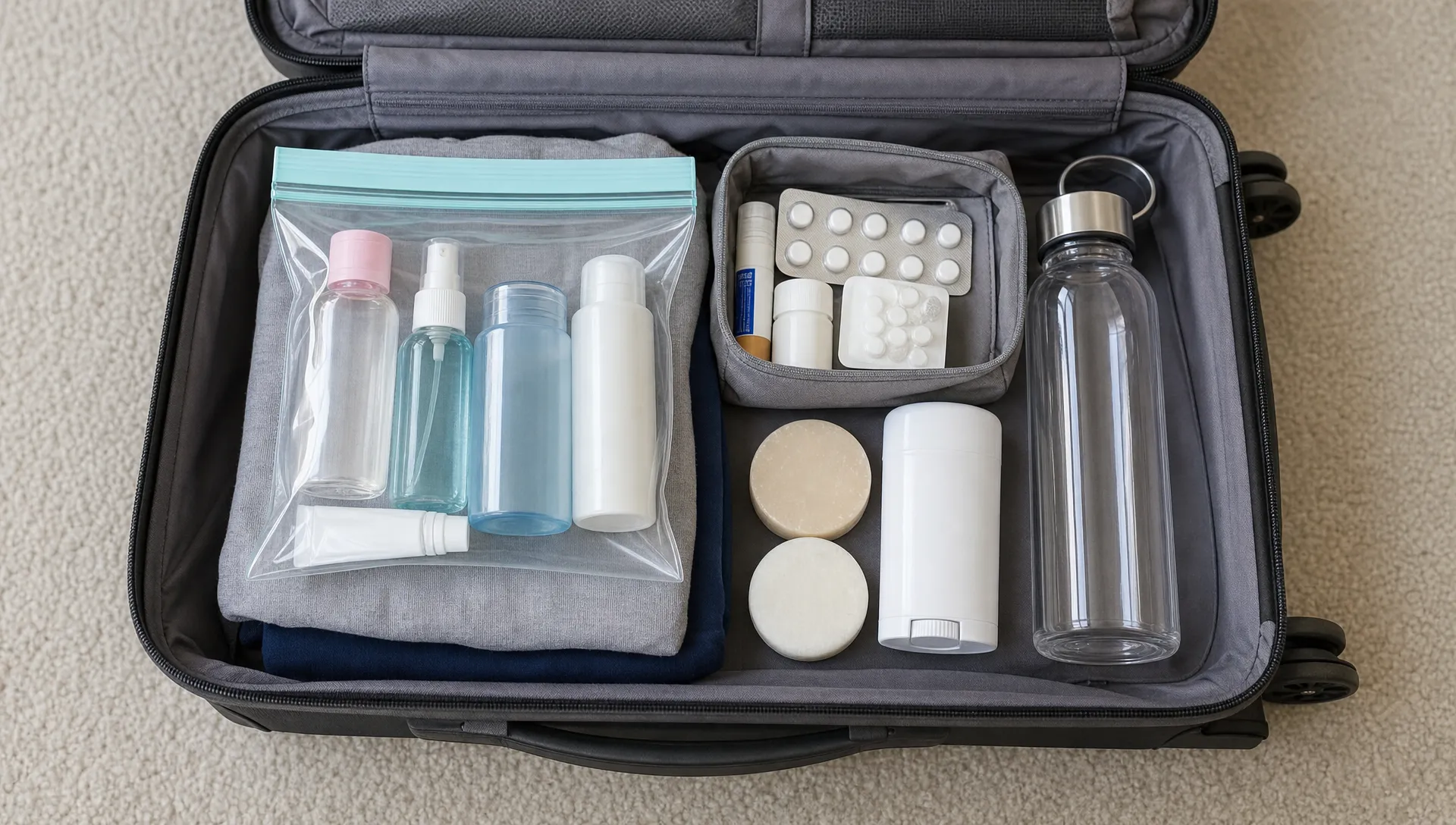
For a short trip, travel-size containers are usually the easiest choice. For a longer trip, consider solid alternatives where they work for you: bar soap, solid shampoo, powder cleanser, stick deodorant, solid perfume, and toothpaste tablets. Solid items are less likely to trigger liquid restrictions, although airport officers can still inspect any item if they need to.
Be careful with makeup bags. Travelers often remember shampoo and toothpaste but forget that mascara, lip gloss, liquid concealer, nail polish, cuticle oil, and setting spray may count toward the liquids allowance. If your cosmetics are spread across multiple pouches, consolidate them before you reach security.
What food and drinks are allowed?
Food is one of the most confusing categories because solid food is usually fine, while spreadable or pourable food may be treated as a liquid. A sandwich is normally not a liquid. A jar of salsa, yogurt, soup, honey, or peanut butter usually is.
Drinks are usually not allowed through security in containers larger than the limit unless they qualify for an exemption. An empty refillable bottle is a better choice. Take it through security empty, then fill it at an airside water fountain or buy a drink after the checkpoint.
For food gifts, think about texture. Chocolate bars, cookies, dry spices, tea, coffee beans, and sealed dry snacks are usually easier to travel with than sauces, jams, syrups, oils, or creamy spreads. If the item is precious, expensive, or hard to replace, check the route before you pack it in your cabin bag.
Medicines, baby supplies, and other exemptions
Many security systems make exceptions for medically necessary liquids and baby supplies. These exceptions are important, but they are not a free pass to pack any quantity in any way.
Liquid medicines are often allowed in reasonable quantities above the standard liquid limit. Examples may include prescription syrups, insulin, liquid nutrition, eye drops, sterile water for medical equipment, and saline. You should separate them from your regular liquids, declare them if required, and allow extra time for screening. Keeping labels, prescriptions, or a doctor’s note can help, especially on international trips.
Baby formula, breast milk, toddler drinks, baby food, and sterilized water may also be allowed in larger reasonable quantities when traveling with an infant or young child. Security may screen the containers separately and may ask you to open them depending on local procedures.
There are also accessibility-related liquids, such as gel packs or cooling packs for medication. These may be accepted when medically necessary, but they should be packed with the related medicine and presented clearly at screening.
Duty-free liquids: allowed, but not risk-free
Duty-free liquids can be allowed in carry-on luggage even when they exceed 100ml, but only under specific conditions. In many cases, the item must be sealed in a security tamper-evident bag, often called a STEB, with the receipt visible or available. You should not open the sealed bag before you complete all security checks on your journey.
The risk appears when you have a connection. A bottle of perfume or alcohol bought after security at one airport may need to pass through another security checkpoint during a transfer. If the bag is not sealed correctly, the receipt is missing, or the connecting airport applies stricter rules, the item may be confiscated.
Alcohol also has separate safety restrictions, especially for high-strength alcohol. Even if a bottle is sold duty-free, airline and dangerous goods rules may still apply. If you plan to buy duty-free liquids before a connection, check the rules for the transfer airport, not just the airport where you make the purchase.
Why your route can change what is allowed
The biggest mistake travelers make is checking only the departure airport. Liquid rules can matter at every security checkpoint, including return flights and connections. If your outbound airport allows larger liquids but your return airport applies the 100ml rule, you may be forced to leave full-size toiletries behind before flying home.
Rules can also change quickly. Airports, regulators, and airlines update pages when scanner policies, trial programs, and security procedures change. In other industries, teams use tools such as web change monitoring alerts to know the moment a policy page changes. For travel, the same lesson applies: outdated advice can be expensive, so check current airport-specific guidance before you pack.
Liquid Limits is built around that exact problem. Instead of assuming one universal rule, you can check airports, items, and routes, including the return flight. If a rule is unclear, Liquid Limits defaults to the stricter 100ml approach so you can pack conservatively. For more on why the return journey matters, see this guide to rules for liquids on flights and return trips.
Carry-on liquids vs checked baggage
If you need to bring larger quantities, checked baggage may be the better option. The 100ml cabin rule usually applies to carry-on screening, not to ordinary toiletries in checked luggage. Full-size shampoo, sunscreen, perfume, and liquid cosmetics can often go in checked bags.
That does not mean checked baggage has no restrictions. Airlines and aviation safety rules can limit or prohibit hazardous materials, flammable products, large aerosol quantities, certain chemicals, fuel, corrosives, and very high-proof alcohol. Containers can also leak because of pressure and handling, so pack liquids in sealed bags and protect them with clothing.
A practical packing split looks like this:
| Pack in carry-on | Pack in checked baggage |
|---|---|
| Travel-size essentials needed during the journey | Full-size toiletries and backup products |
| Prescription or essential medicine | Nonessential liquids you can afford to lose temporarily |
| Baby milk or food needed in transit | Extra baby supplies not needed during the flight |
| Small cosmetics needed on arrival | Large bottles, sprays, and liquid gifts |
| Empty water bottle | Liquids that are not needed until your destination |
If you are traveling with only a carry-on, prioritize what you truly need. Most travelers can reduce liquids by switching a few products to solid formats and buying bulky items after arrival.
Items that may not be allowed in carry-on luggage
Some liquid-like items are not just restricted by size. They may be prohibited because they are hazardous, flammable, corrosive, or capable of causing harm. Rules vary by country, but you should be cautious with items such as fuels, paint thinners, solvents, bleach, strong chemicals, self-defense sprays, and industrial aerosols.
You should also avoid packing unlabeled liquids. A small unmarked bottle may be technically within the size limit, but it can still slow screening if officers cannot identify it. Use labeled travel bottles when possible, especially for medicine, skincare actives, or anything that looks unusual.
If an item is expensive or essential, do not rely on a guess. Use an airport liquid checker before you pack, or put the item in checked baggage if it is permitted there.
A simple pre-flight liquid checklist
Before you close your carry-on, run through this quick check:
- Are all regular liquids in containers no larger than the strictest limit on your route?
- Do the containers fit comfortably in one clear resealable bag if your airport requires it?
- Have you separated medicines, baby supplies, and medically necessary items for screening?
- Are duty-free liquids sealed, with receipts kept accessible?
- Have you checked connection and return airports, not just your departure airport?
- Are any hazardous or flammable products better left at home?
This checklist is especially useful for multi-city trips, international transfers, and cabin-only travel. Liquid rules are easy when your trip has one simple checkpoint. They become more complicated when your return airport, connection airport, or airline procedure differs from your first departure.
Frequently Asked Questions
Can I bring a 150ml bottle if it is half empty? Usually no. Security normally checks the container size, not the amount of liquid remaining. A 150ml bottle is still considered too large at airports using a 100ml rule.
Does toothpaste count as a liquid in carry-on luggage? Yes. Toothpaste is usually treated as a paste or gel, so it must follow the carry-on liquid limit unless a specific exemption applies.
Can I bring perfume in my carry-on? Yes, if the perfume container is within the applicable cabin liquid limit and fits in your liquids bag. Larger duty-free perfume may be allowed if sealed correctly and accepted on your route.
Are medicines limited to 100ml? Medically necessary liquids are often exempt from the standard size limit in reasonable quantities, but they may require separate screening. Carry documentation when possible, especially for international travel.
Can I take a water bottle through security? You can usually take an empty water bottle through security. A filled bottle larger than the liquid limit is normally not allowed unless it qualifies for a specific exemption.
Do liquid rules apply on the return flight too? Yes. Your return airport may have different liquid rules from your departure airport. Always check both directions before packing full-size liquids for your trip.
Check your liquid rules before you pack
The safest way to avoid losing liquids at security is to check the rule that applies to your actual trip, not just a generic packing list. With Liquid Limits, you can look up airport rules, item-specific guidance, and route-based liquid limits, including return flights.
If the rule is unclear, pack to the stricter 100ml limit. It may feel conservative, but it is usually cheaper than throwing away a full-size bottle at the checkpoint.