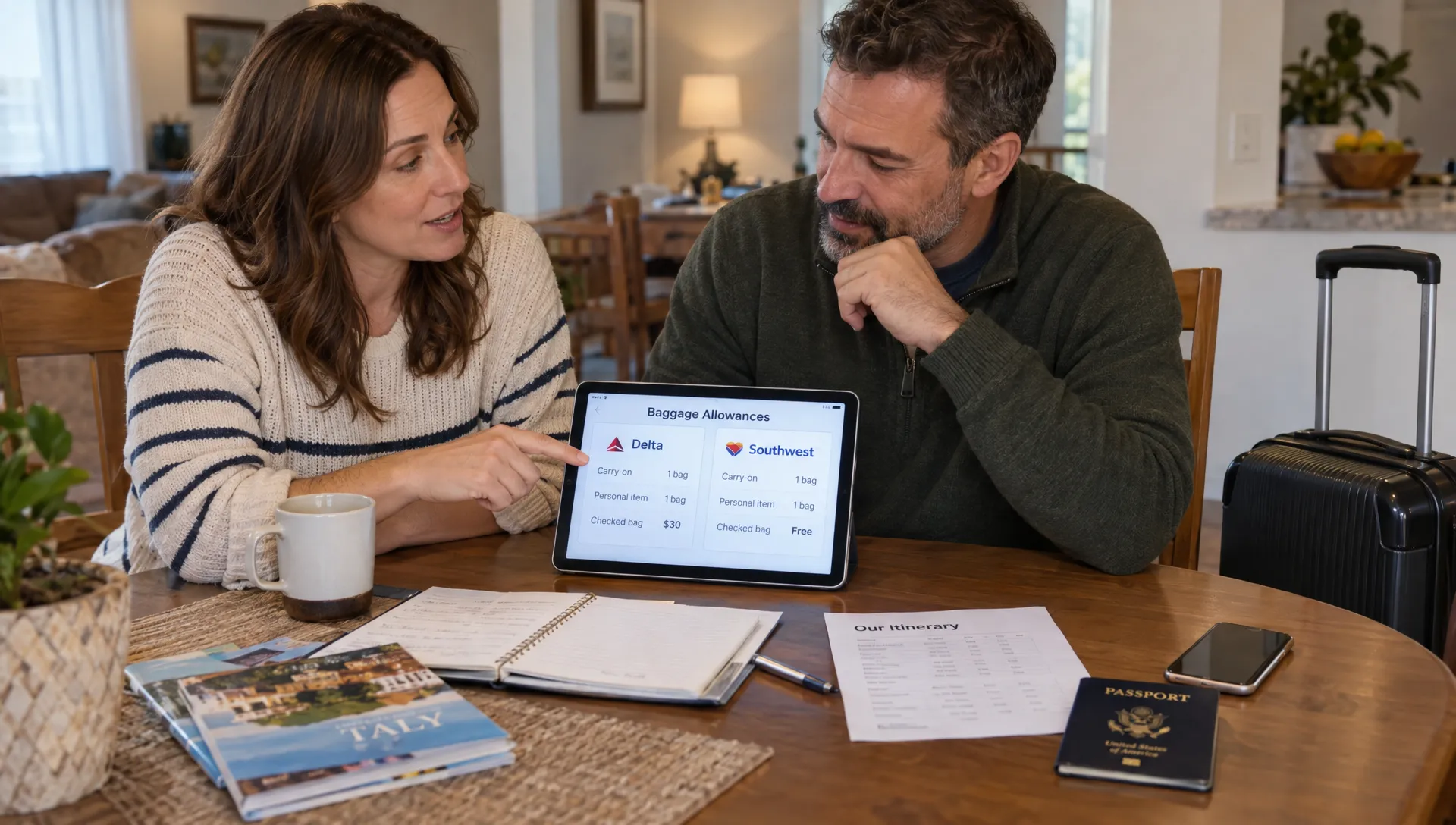
Packing hand luggage on flights with different airport rules means planning for more than your departure airport. A bottle that clears security on the outbound journey may not pass a transfer checkpoint or the airport you use to fly home. Your airline can also impose a smaller bag allowance on one leg of the trip.
The safest approach is to check every security checkpoint and every operating airline, then pack to the strictest applicable limit. That does not mean automatically discarding larger toiletries. It means knowing where you can carry them, where you may need to check them and which rules apply again on the return journey.
Separate airline allowances from airport security rules
Two different checks determine whether your bag can travel in the cabin. Passing one does not guarantee passing the other.
| Rule layer | What it controls | What to check |
|---|---|---|
| Airline baggage policy | Bag dimensions, weight, number of bags and fare entitlement | Each operating airline and your booked fare |
| Security screening | Liquids, prohibited articles and screening procedures | Every airport where you will pass through security |
| Aviation dangerous-goods rules | Batteries, flammable products and other hazardous items | Relevant aviation authority guidance and airline restrictions |
| Destination entry rules | Whether certain food, plants or other goods may enter | Destination customs and biosecurity guidance |
A carry-on bag is luggage you take into the aircraft cabin rather than surrendering as checked baggage. Airlines often distinguish a larger overhead-bin bag from a smaller personal item that fits beneath the seat, but those names do not create a universal allowance.
An airline accepting your suitcase says nothing about whether its contents will pass security. Likewise, a security-approved toiletry bag does not entitle you to an overhead suitcase if your fare includes only a personal item.
Map hand luggage on flights across the whole trip
Write down the outbound airport, any connection airports and the return airport before choosing your toiletries. Include a separate airline check for each flight, especially when different carriers operate the itinerary.
Departure: check the actual airport and terminal
Use the departure airport’s official passenger guidance, not a country-wide assumption or a report about newly installed scanners. Where guidance distinguishes terminals or checkpoints, check the one you expect to use.
Look for separate answers about maximum container size, whether a transparent liquids bag is required and whether liquids must come out of your luggage. Permission to leave liquids inside your bag does not, by itself, mean larger containers are allowed.
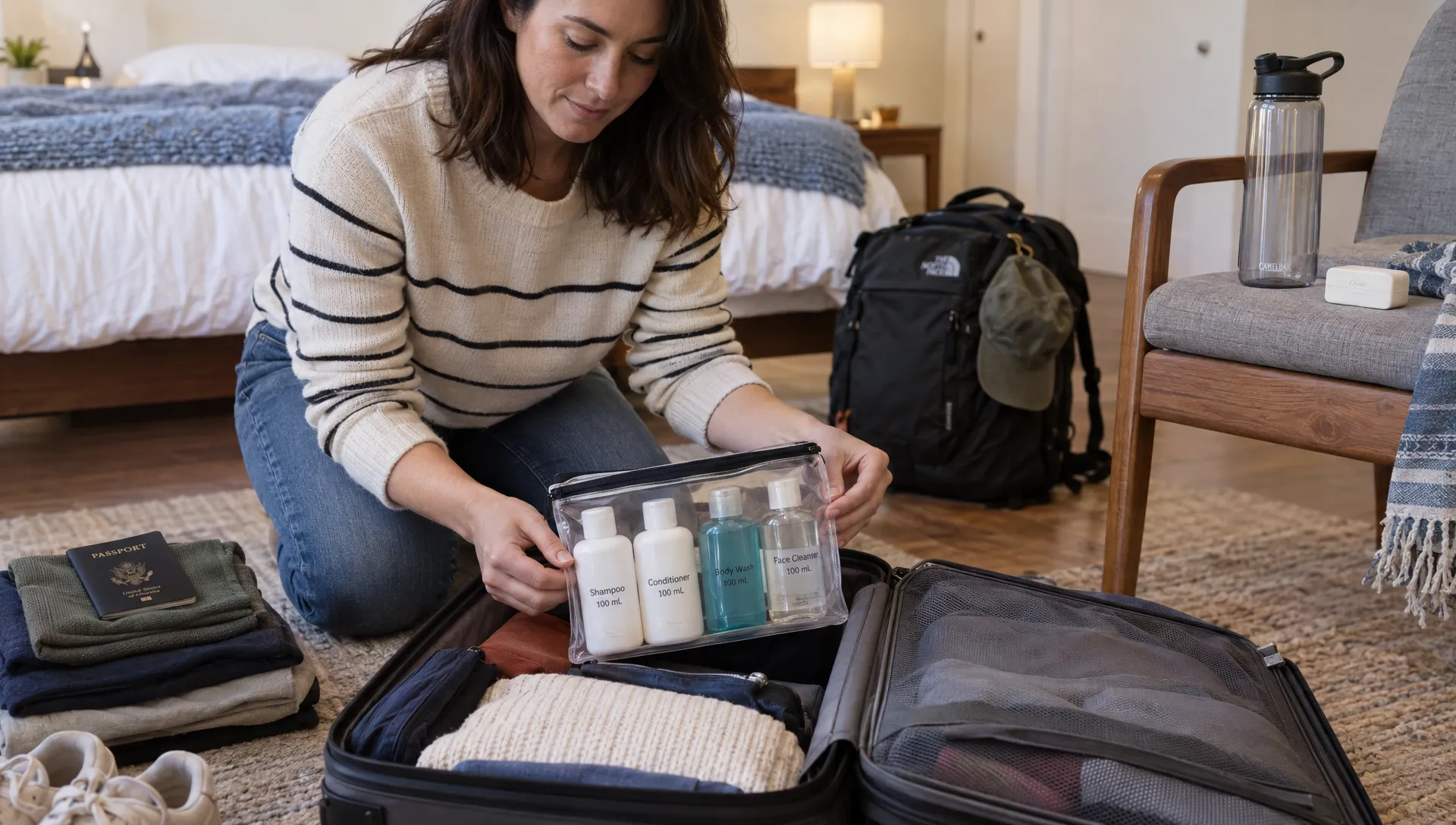
If the published information is unclear, use containers of 100 mL or less for ordinary toiletries and follow the applicable liquids-bag requirements.
Connections: establish whether you will be screened again
When planning hand luggage on flights with connections, the key question is whether the transfer involves another security check. An airside connection can still require screening, depending on the airport, route and transfer arrangements.
A self-transfer that requires collecting checked luggage and returning through departures should be planned as another security screening. A terminal change may also involve screening, but the terminal change alone does not tell you the answer.
Check the airport’s transfer instructions for your specific route. If the path is uncertain, pack as though screening could happen again. Our guide to transfers and terminal changes explains where these extra checks can arise.
Return: make a separate decision
The rules at your holiday destination do not have to match those at home. Check the return airport before leaving, particularly if you plan to bring back toiletries purchased during the trip.
A larger bottle may work for an outbound journey yet need to be used up, left behind or placed in checked baggage before the return. Decide this while packing, rather than at the security queue.
Compare 100 mL and 2 L rules correctly
For hand luggage on flights subject to the standard 100 mL restriction, the container’s capacity matters, not just how much remains inside. A 200 mL bottle containing 30 mL of shampoo is still a 200 mL container.
For US checkpoints, the TSA liquids rule generally allows liquids, aerosols, gels, creams and pastes in travel-size containers of 3.4 ounces (100 mL) or less, within one quart-size bag per passenger. Exemptions apply to certain items.
Other airports may publish different limits. The UK government’s liquids guidance directs passengers to check their departure airport because arrangements vary.
If an airport explicitly permits containers up to 2 L, read the rest of its instructions too. A maximum container size is not necessarily a total allowance, and permission at that checkpoint does not carry over to another airport.
The following examples are hypothetical planning situations, not statements about particular airports:
| Your itinerary | Practical packing decision |
|---|---|
| Departure permits larger containers; return uses 100 mL rules | Take small toiletries throughout or arrange a compliant way to handle larger bottles before returning |
| Departure permits larger containers; transfer screening uses 100 mL rules | Pack ordinary cabin toiletries for the transfer’s 100 mL restriction |
| All relevant checkpoints explicitly permit larger containers | Follow each airport’s bag and screening instructions, plus airline restrictions |
| One checkpoint’s rule cannot be confirmed | Use the stricter 100 mL approach for ordinary toiletries and check bag requirements |
The strictest rule is useful only when it covers the whole itinerary. Checking the outbound airport alone leaves the most common gap: getting home with what you packed.
Build one toiletry kit that works throughout the trip
For a cabin-only trip, a compact kit that meets every planned checkpoint’s rules is usually simpler than maintaining different packing arrangements for each leg.
Include gels, creams and pastes in your assessment, not just pourable liquids. Toothpaste, sunscreen, liquid foundation and spreadable foods can all fall within liquids screening rules. A product being food or cosmetics does not automatically exempt it.
A practical packing check is:
- Check capacity labels: Use clearly marked containers within the smallest applicable size limit.
- Check the bag requirement: Follow the relevant transparent, resealable bag rules rather than assuming any toiletry pouch qualifies.
- Separate exempt items: Keep necessary medicines or baby supplies accessible for declaration or additional screening.
- Plan the return: Leave room for permitted purchases without assuming you can bring back larger bottles.
- Carry an empty water bottle: Refill it after screening where drinking-water facilities are available.
For example, suppose your outbound airport permits a 500 mL shampoo bottle but the return airport permits ordinary liquid containers only up to 100 mL. Taking a smaller amount in compliant containers avoids needing a disposal or checked-baggage plan later.
Solid alternatives can reduce the number of liquid containers you need, but check the actual product. A solid soap bar is different from a tub of soft cleansing balm.
Allow for different airlines and unexpected gate checks
Airport security rules are only half the planning task. For hand luggage on flights operated by different airlines, compare the allowance attached to each booking, not just the airline you purchased the itinerary from.
Check dimensions, weight, the number of permitted pieces and whether an overhead bag costs extra. A suitcase sold as “cabin size” is not guaranteed to fit every airline’s limits. Follow the carrier’s measurement method, including wheels and handles where required.
An airline can require a carry-on bag to go into the hold, including when it exceeds the allowance or cabin storage is unavailable. Charges and arrangements depend on the airline, fare and circumstances.
Keep essentials in an accessible pouch so you can remove them before handing over the bag. Medicines, travel documents and valuables should remain with you. Spare lithium batteries and power banks must not go into checked baggage; follow the FAA’s PackSafe guidance and your airline’s battery rules.
If you cannot remove an item that must stay in the cabin, tell airline staff before surrendering the bag. Do not assume a gate check makes every item inside suitable for the hold.
Treat exemptions and airport purchases as separate cases
Medicines and baby supplies
Necessary medicines, infant feeding supplies and certain other items may qualify for exceptions to ordinary liquid limits. The permitted quantities, evidence requirements and screening procedures depend on the jurisdiction.
Keep these items accessible and check official guidance before traveling. Do not reduce essential medication merely to fit a standard toiletries bag. Instead, establish how it must be presented and whether supporting documentation is required.
When preparing hand luggage on flights across different jurisdictions, verify the exemption at each screening point. A valid medical need does not remove the possibility of additional checks.
Duty-free and other purchases after security
Buying a drink or cosmetic product after security does not guarantee it will survive a later checkpoint. Larger liquids may be subject to specific transfer arrangements, including an approved security tamper-evident bag and proof of purchase.
Keep any required bag sealed and retain the receipt, but confirm that the transfer airport accepts the arrangement. Do not treat an ordinary shopping bag as an equivalent.
For a purchase you cannot risk losing, verify the transfer rules before paying. If they remain unclear, buy after the final security checkpoint or arrange checked transport where the item is permitted.
Frequently asked questions
What is not allowed in a carry-on bag at a TSA checkpoint? Firearms, many sharp objects and various hazardous items are prohibited in carry-on baggage. Ordinary liquids above the standard limit are also restricted unless an exception applies. Check the TSA’s item-by-item packing guidance for the specific object. Some articles are prohibited in both cabin and checked bags.
Can I use a suitcase as hand carry? Yes, if it meets your operating airline’s size, weight and fare conditions. Its contents must also comply with security and dangerous-goods rules. A small suitcase is not automatically included with every ticket.
Do I need to follow the return airport’s rules when packing at home? You need to meet those rules when you pass through that airport. Planning for them at home helps you avoid taking products you cannot bring back without changing your baggage arrangements.
Which rule should I follow if airport information conflicts? For hand luggage on flights with unclear liquid rules, use the stricter 100 mL approach for ordinary toiletries while seeking confirmation from the airport’s current official guidance. Check the liquids-bag requirements too. A scanner announcement or another traveler’s experience is not a substitute for a published allowance.
Check the route before closing your bag
Use Liquid Limits’ trip liquid checker to compare your departure, connection and return airports. Review the verified source links and last-checked dates alongside the results. Where rules are unclear, the tool defaults to the stricter 100 mL rule.
Then check your operating airlines’ baggage allowances separately. Your final packing plan should work at every security checkpoint and fit the cabin entitlement on every flight.