
The liquid rule at the airport is simple in theory and surprisingly easy to get wrong in practice. Most travelers hear 100ml, throw toiletries into a plastic bag, and hope for the best. Then a half-empty 150ml sunscreen gets taken away, a connection airport applies a stricter rule than the departure airport, or a duty-free bottle suddenly becomes a problem at the next checkpoint.
The key is this: airport liquid rules are enforced at the security checkpoint you are passing through, not by what seems reasonable, how much product is left, or what another airport allowed last time. The rule is about container size, presentation, exemptions, and the technology available at that specific airport.
If you understand those pieces, packing gets much easier.
The short version: what security is really checking
At a standard checkpoint, security officers are usually asking four practical questions.
| What security checks | What it means for you |
|---|---|
| Is the item a liquid, gel, aerosol, cream, or paste? | If it can pour, spread, spray, squeeze, smear, or flow, assume it is controlled. |
| Is the container 100ml or smaller? | A partly full 150ml bottle usually fails because the container is too large. |
| Does it fit in the required liquids bag? | Many airports still require a clear, resealable bag, often around 1 liter or 1 quart. |
| Does an exemption apply? | Medicines, baby milk, and special dietary liquids may be allowed in larger quantities but must be screened. |
That container-size point catches many people. If your 200ml shampoo bottle only has a small amount left inside, it can still be refused in a standard 100ml airport. Security generally looks at the marked capacity of the container, not the amount remaining.
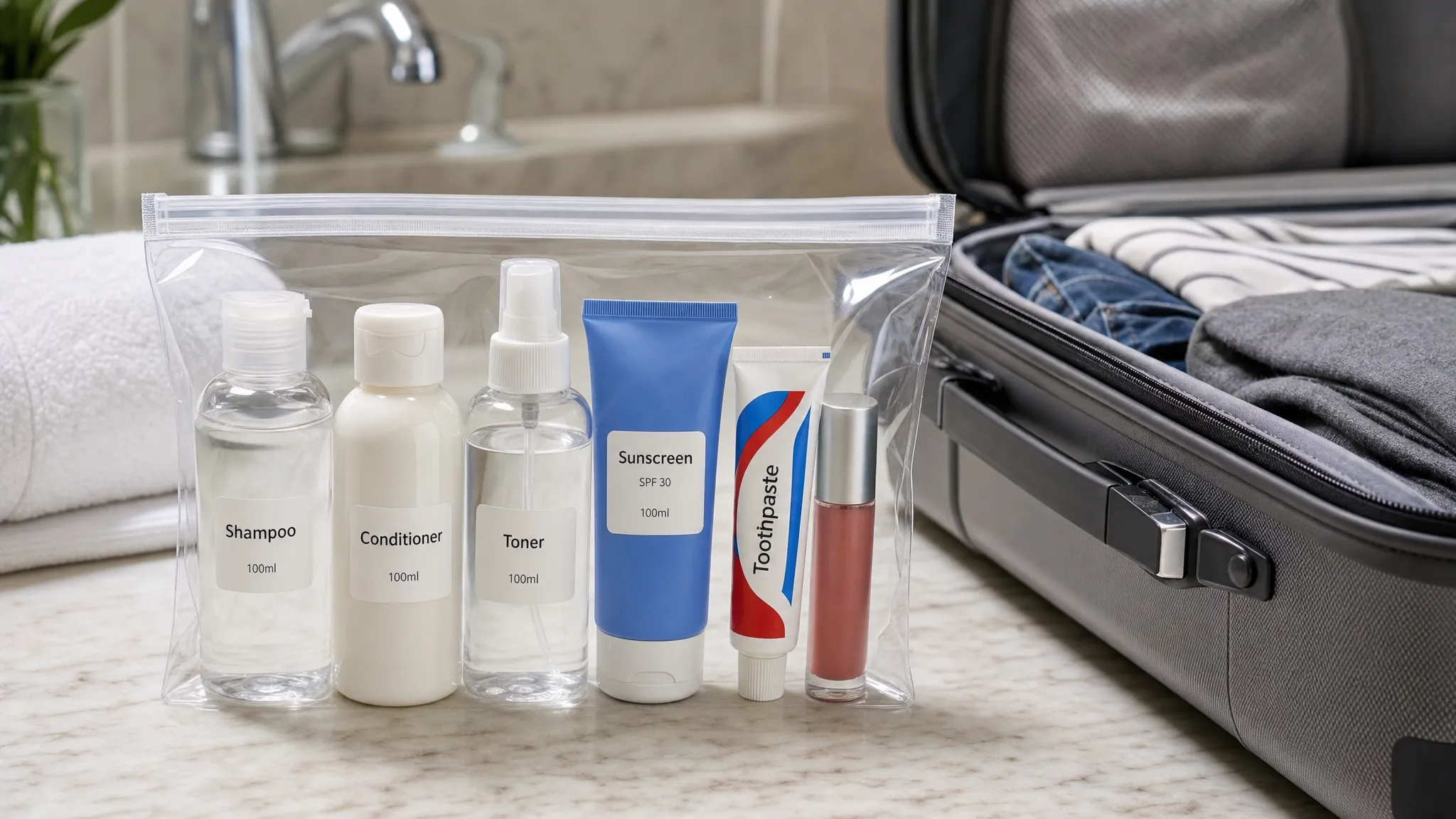
The safest default is to pack cabin liquids in clearly labeled containers of 100ml or less and place them together in a transparent resealable bag. If your airport uses newer scanners and allows larger liquids, that is a bonus, not something to assume without checking.
Why the airport liquid rule exists
The modern airport liquid rule was introduced to reduce the risk of liquid explosives being carried into the cabin. Because liquids can be difficult to identify quickly at scale, security systems created a simplified rule that is easy to apply across millions of passengers: small containers, separated for screening, with limited exemptions.
That is why the rule can feel blunt. A luxury moisturizer, a bottle of hot sauce, a protein shake, and a jar of peanut butter may have nothing in common as products, but at a checkpoint they can all be treated as liquids, gels, creams, or pastes.
The rule is not only about what the item is. It is also about whether security can screen it quickly and confidently.
The 100ml rule, the 2L rule, and why both can be true
Many airports still use the familiar 100ml rule for cabin baggage. In the United States, it is often described as the TSA 3-1-1 rule: containers of 3.4 oz or 100ml, in one quart-size bag, generally one bag per passenger. In the UK, EU, and many other places, the common version is similar: containers of 100ml or less, inside a clear resealable liquids bag.
Some airports with advanced CT scanners may allow larger containers, sometimes up to 2 liters, and may let passengers keep liquids inside their bags. However, this is not universal. Scanner rollouts differ by airport, terminal, lane, and date. Rules can also be paused or reversed while authorities test or update equipment.
That is why the question is not simply: what country am I flying from? A better question is: what rule applies at the exact airport and checkpoint I will use today?
For route planning, especially if you have multiple airports on one trip, you can compare current airport policies in the airport liquid rules directory before you pack.
What counts as a liquid at airport security
Airport security uses a broad definition. If the item is not a dry solid, you should pause and check it.
Common items treated as liquids, gels, aerosols, creams, or pastes include shampoo, conditioner, perfume, toothpaste, sunscreen, foundation, mascara, lip gloss, shaving foam, hair gel, liquid deodorant, roll-on deodorant, spray deodorant, hand sanitizer, sauces, jams, soups, yogurt, honey, and many spreads.
Some items sit in a gray area. Stick deodorant is usually treated as a solid, while roll-on and spray deodorant are treated as liquids or aerosols. Solid lipstick is usually easier than lip gloss. Powder makeup is different from liquid foundation. A bar of soap is different from shower gel.
If you are unsure about a specific item, it is better to check the item directly rather than guessing from the category. For example, the rules for liquids on a plane can differ depending on whether you are packing toiletries, makeup, food, medicine, or duty-free items.
The rule follows the checkpoint, not your whole itinerary
One of the most misunderstood parts of the airport liquid rule is that it applies whenever you pass through security. That may be at your origin airport, a transfer airport, or your return airport.
Imagine you fly from an airport that allows larger liquids because it has advanced scanners. You buy a 300ml skincare product and keep it in your cabin bag. On the way home, your return airport still uses the 100ml rule. That same bottle can now be refused at security.
Connections matter too. If you remain airside and do not pass through another security checkpoint, your liquids may not be rechecked. If you do pass through transfer security, the airport you are connecting through gets to apply its own rules.
This is why a round trip can have two different answers. Your outbound airport may allow something that your return airport will not. When in doubt, pack for the strictest checkpoint on your route.
Why a half-empty oversized bottle can still be confiscated
This feels unfair, but it is one of the most consistent parts of the 100ml rule. If the bottle says 150ml, 200ml, or 250ml, it is usually too large for a standard cabin liquids rule even if it contains less than 100ml of product.
Security officers are not expected to measure the remaining liquid in every container. The printed capacity gives them a fast, consistent way to enforce the rule. A 100ml travel bottle is allowed because its maximum capacity fits the rule. A 200ml bottle with a little product left does not.
The practical fix is simple: decant toiletries into clearly marked travel containers of 100ml or less. Do this before you leave home, not at the airport sink.
Exemptions: when larger liquids may be allowed
The main exemptions are for items that are necessary during the journey. These commonly include prescription and essential medicines, baby milk, baby formula, expressed breast milk, baby food, and special dietary liquids.
Exemptions do not mean unlimited liquids with no screening. They usually mean you can carry a reasonable quantity above 100ml, but you should present it separately and expect additional checks. Security may ask you to open the item, prove its purpose, or place it through a separate screening process.
For medicines, keep the original label where possible and bring supporting documentation if the item is unusual, injectable, refrigerated, or medically important. You do not always need a prescription for every over-the-counter medicine, but documentation can reduce friction when a container is larger than 100ml.
Travelers carrying non-toiletry substances should be even more careful. Lab samples, research materials, specialty compounds, and chemicals may trigger rules beyond ordinary cabin liquid limits, including airline, customs, dangerous goods, and import restrictions. Even when product documentation is available from sources such as batch-tested research peptide suppliers, it does not override airport security rules or guarantee cabin acceptance.
Duty-free liquids: sealed bags help, but they are not magic
Duty-free liquids are a special case. In many international airports, liquids bought after security can be carried in a tamper-evident sealed bag, often with the receipt inside. This is designed to help travelers take perfumes, spirits, cosmetics, and other larger liquids through onward connections.
The problem is that duty-free rules depend on the next checkpoint. If you have a connection where you must pass through security again, the sealed duty-free bag may be accepted, inspected, or refused depending on local rules and whether the bag is intact.
Do not open the sealed bag before your final destination. Keep the receipt visible. If your trip includes multiple transfers or separate tickets, consider putting duty-free liquids in checked baggage where possible before the next security screening.
Checked baggage is different, but not rule-free
The 100ml cabin rule usually does not apply to checked baggage. Full-size shampoo, sunscreen, perfume, sauces, and many other liquids can often go in your checked bag.
However, checked baggage has its own limits. Aerosols, alcohol, flammable products, corrosive substances, and certain chemicals can be restricted or prohibited. Airlines and aviation authorities set dangerous goods rules, and customs rules may apply when crossing borders.
For ordinary toiletries, checked baggage is usually the easiest place for larger containers. For anything pressurized, alcoholic, chemical, or high value, check the specific rules before packing.
How to pack when rules are unclear
Airport liquid rules can change faster than travel habits. Scanner upgrades, temporary restrictions, terminal differences, and security advisories can all affect what happens at the checkpoint.
A conservative packing strategy saves time and money:
- Use 100ml or smaller containers for anything you need in the cabin.
- Keep liquids together in a clear resealable bag unless your airport clearly says otherwise.
- Pack larger toiletries in checked baggage when available.
- Check both outbound and return airports, plus any connection where you may pass through security.
- Treat unclear rules as 100ml rules.
This approach may feel cautious, but it is the one least likely to end with repacking, delays, or losing an expensive item at security.
A simple route-based way to think about the liquid rule
Instead of asking whether an item is allowed on a plane, ask where it must pass through security. The answer can change by airport.
| Travel situation | Rule that matters most | Smart packing choice |
|---|---|---|
| Direct flight from a 100ml airport | Departure airport security | Use 100ml containers in a liquids bag. |
| Direct flight from an airport allowing larger liquids | Current departure airport policy | Check the airport rule before relying on larger containers. |
| Round trip with different airports | The stricter airport on either leg | Pack cabin liquids to the stricter rule. |
| International connection with transfer security | Connection airport security | Keep liquids 100ml unless duty-free rules clearly apply. |
| Medicine or baby food | Exemption rules at the checkpoint | Present separately and bring documentation when useful. |
This is also where tools like Liquid Limits are useful. Instead of checking only one airport, you can compare the liquid rule across your trip, including the return flight.
Common mistakes that cause problems at security
The most common mistakes are easy to avoid once you know how the rule works. Travelers often bring oversized containers that are almost empty, forget that gels and pastes count, assume a rule from one airport applies everywhere, or buy duty-free liquids before a connection that has stricter screening.
Another mistake is relying on airline baggage pages alone. Airlines can explain cabin baggage size and weight, but airport security rules are set by security authorities and the airport screening process. Your airline may not be the final authority on whether a 150ml cream can pass through a checkpoint.
Finally, do not assume that last year’s experience is still accurate. If an airport was testing relaxed liquid rules, that policy may have changed. If a new scanner lane was available in one terminal, it may not apply to your terminal.
Frequently Asked Questions
Does the airport liquid rule apply to checked bags? The 100ml cabin liquid rule usually applies to carry-on bags, not checked bags. Checked baggage can hold many larger liquids, but dangerous goods, alcohol, aerosol, customs, and airline rules may still apply.
Can I bring a 150ml bottle if it is almost empty? Usually no at a standard 100ml checkpoint. Security normally checks the container capacity printed on the bottle, not the amount left inside.
Are creams, gels, and pastes treated like liquids? Yes. Toothpaste, hair gel, sunscreen, foundation, lip gloss, peanut butter, sauces, and similar products are commonly treated as liquids, gels, creams, or pastes for cabin baggage screening.
Do newer airport scanners mean I can bring any liquid? No. Some airports with advanced scanners may allow larger containers, but policies vary by airport, terminal, lane, and date. Always check the specific airport before packing larger cabin liquids.
Which airport rule applies on a connecting flight? If you pass through security during your connection, the connection airport’s rule applies. If you do not pass through another checkpoint, your liquids may not be rechecked, but this depends on the airport and route.
Check before you pack
The safest way to handle the liquid rule at the airport is to check your actual route, not just the country you are visiting. Your departure airport, connection airport, and return airport can all matter.
Liquid Limits helps you compare airport, item, and route rules side by side, with verified source links, last-checked dates, daily updates, and a stricter 100ml fallback when rules are unclear. Check before you pack, and you will know whether your trip is a 100ml trip, a 2L trip, or a trip where the stricter rule wins.