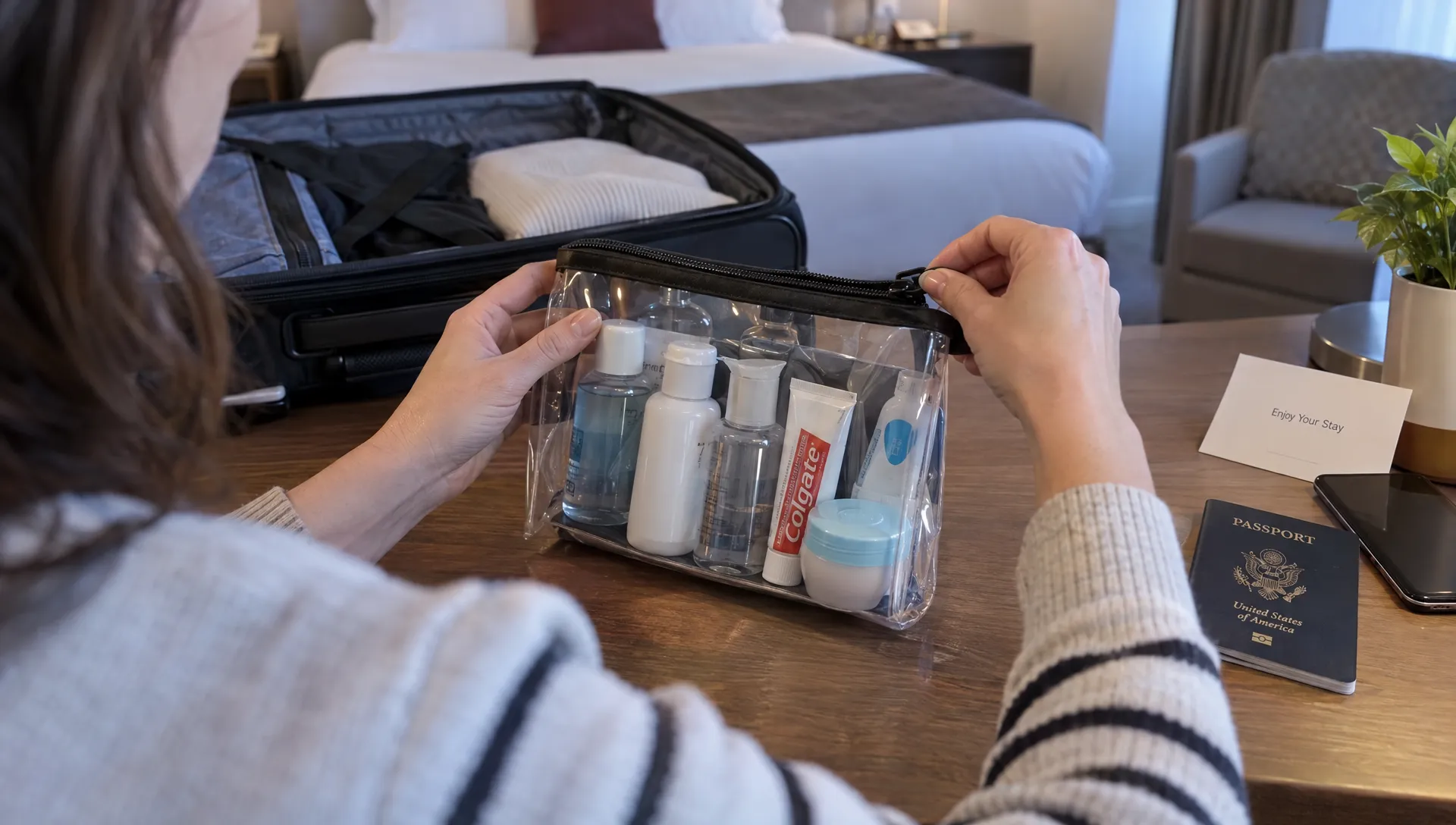
The best bag for liquids on flights is one that meets your airport’s rules, closes easily when packed and lets security staff see what is inside. A pouch advertised as “TSA-approved” is not enough on its own, especially if your trip includes an international connection or a return airport with different requirements.
Before buying, check the bag’s actual capacity, transparency and closure. Then test it with the toiletries you intend to carry. This guide focuses on choosing a practical bag, rather than relying on a label that may not match your journey.
Start with your airport rules, not the product description
Liquid restrictions apply at security checkpoints, so the bag you need depends on where you will be screened. Your airline’s cabin baggage allowance does not replace those requirements.
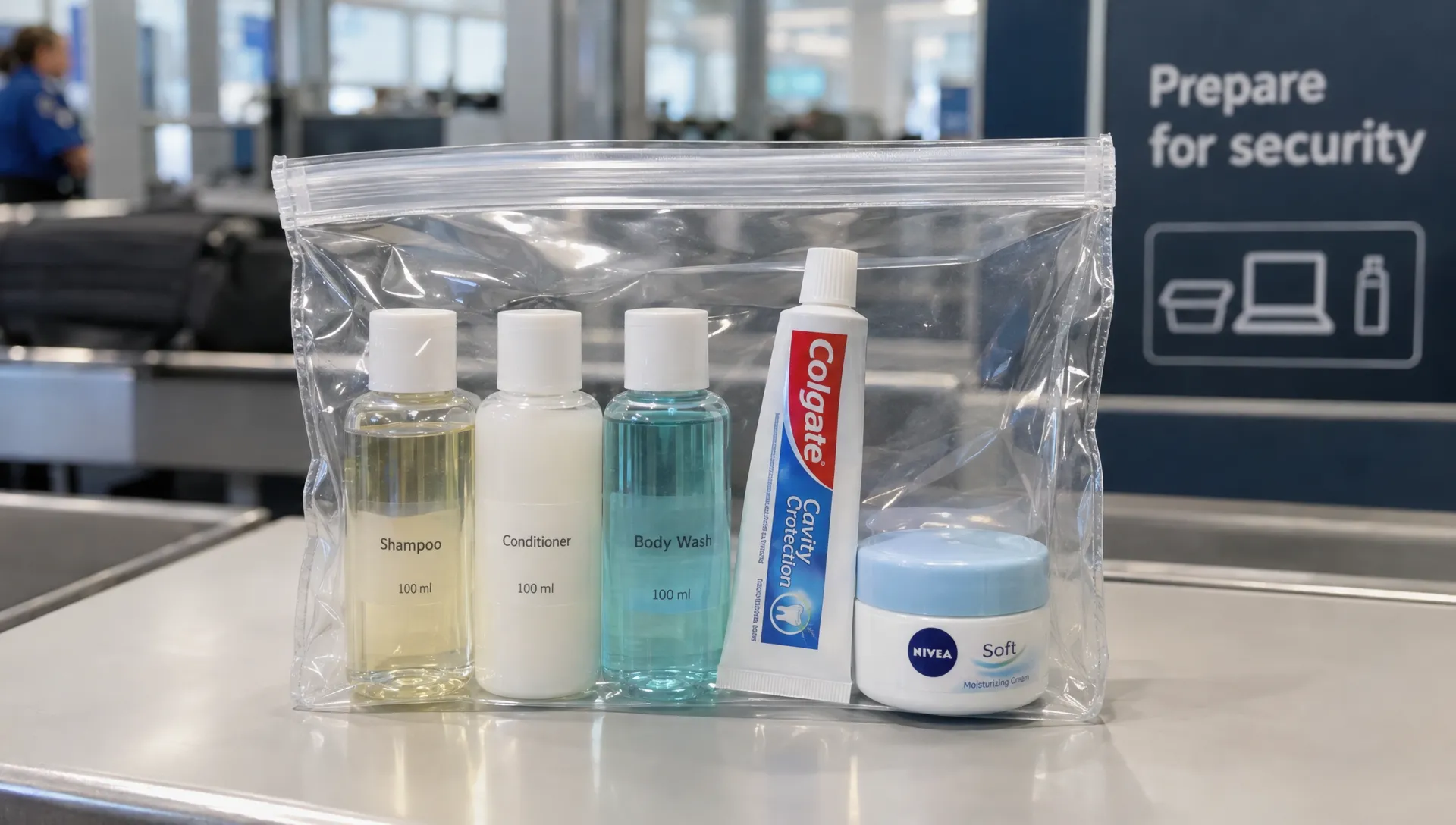
For US checkpoints, the TSA liquids rule allows ordinary carry-on liquids, gels and aerosols in containers of 3.4 ounces (100 milliliters) or less, inside one clear, quart-sized, resealable bag per passenger.
International requirements are not identical. For example, the UK government’s liquids guidance explains that rules depend on the airport. Where a separate liquids bag is required, its guidance describes a transparent, resealable bag holding no more than one liter and measuring approximately 20 × 20 centimeters.
A US quart and a liter are not the same capacity. One US liquid quart is about 946 milliliters. A pouch labeled “1 liter” should not automatically be treated as quart-sized.
Check every airport where you expect to pass through security, including the journey home. If you will be screened during a transfer, our guide to taking liquids on flights with a connection explains why your departure rules may not be enough.
Compare a bag for liquids on flights by its construction
Once you know the applicable requirements, compare the bag itself. Price, branding and the word “travel” tell you less than its usable space and how it closes when full.
| Bag type | Practical advantages | What to check before buying |
|---|---|---|
| Clear food-storage bag | Lightweight, flexible and easy to replace | Correct capacity, secure seal and resistance to tearing |
| Reusable clear zip pouch | More durable for repeated trips | Stated capacity, transparent panels and a fully closing zipper |
| Structured clear cosmetic case | Can protect small bottles from being squeezed | Depth and capacity, since many are larger than security limits |
| Hanging toiletry organizer | Useful for organizing toiletries at your destination | Usually better kept separate from the checkpoint liquids bag |
| Pouch included in a travel-bottle set | Convenient starting point | Bag size and each bottle’s marked capacity, checked independently |
For a bag for liquids on flights, a simple design is often easier to assess than a case with pockets, thick trim and several compartments. That does not make every reusable pouch unsuitable. It means you should buy it for its documented dimensions and capacity, not its appearance.
Check capacity as well as dimensions
A flat bag and a box-shaped pouch can have similar front dimensions but very different capacities. A deep base or expandable sides add space that a product photograph may not make obvious.
Look for the stated capacity alongside the measurements. If a listing provides only width and height, do not assume it meets a quart or one-liter requirement. Equally, “holds six bottles” tells you little unless you know the bottles’ sizes and shapes.
Avoid buying the largest pouch that looks close enough. The useful capacity is the amount you can pack while keeping the bag within the relevant rules and allowing it to close normally.
Prioritize clear panels and a straightforward closure
Choose transparent panels that make the contents easy to inspect. Opaque linings, frosted material and large decorative panels can make a bag harder to assess against a clear-bag requirement.
A resealable closure should work repeatedly without splitting or separating. Check zipper ends, slider attachments and the seams beside the opening, especially on reusable designs. A robust pouch is less useful if the opening is so narrow that removing one bottle means unpacking everything.
A bag for liquids on flights should also be easy to open and close with dry or slightly damp hands. For frequent travel, that everyday usability matters more than extra compartments.
Do not confuse durability with leak protection
Thicker material can resist punctures, but thickness alone does not make a pouch watertight. A standard zipper may still let spilled shampoo escape, even when the panels themselves are waterproof.
Treat the liquids bag as secondary containment. Tight bottle caps, intact seals and suitable refillable containers are your first protection against leaks. For reusable bags, look for seams you can inspect and an interior you can wipe clean.
If a product claims to be leakproof, check whether that claim covers the entire closed bag or only its material. Those are different promises.
Test the bag with your actual toiletries
Do a full packing trial before your departure day. An empty pouch can look roomy and compliant, then become awkward once rigid bottles and wide jars are inside.
- Check each container’s marked capacity: Where the 100 ml rule applies, a half-empty 150 ml bottle is still too large for ordinary carry-on liquids.
- Pack everything you plan to take: Include toothpaste, creams, mascara and other products treated as liquids or gels, not just shampoo bottles.
- Close the bag without force: The closure should meet fully without stretching the sides, compressing bottles hard or holding the opening together by hand.
- Practice taking it out: Put it in your cabin bag, then check that you can retrieve and repack it without emptying the rest of your luggage.
Leave enough flexibility to reposition a bottle if staff need a closer look. A tightly packed pouch may technically close at home but become frustrating to reseal after inspection.
Check your toiletries again before the return flight. Purchases made during the trip still need to fit the rules at your next checkpoint. Space left by used-up shampoo may help, but a larger souvenir lotion bottle does not become acceptable simply because there is room for it.
Make your toiletries fit, rather than buying a bigger pouch
If the correct-sized bag will not close, reduce the contents before replacing it with a larger one. Start with products you can leave behind, obtain at your destination or share with someone traveling with you.
Container shape matters. Several squat jars may use the available space less efficiently than narrow bottles, even when their total liquid volume is modest. Bulky caps and rigid packaging also take up room without adding usable product.
When choosing a bag for liquids on flights, test its opening against your widest essential item. A compliant pouch that cannot comfortably take your necessary containers is not a good practical choice.
Refillable bottles can help, but choose containers with clear capacity markings and materials suitable for the contents. Keep medicines in appropriate packaging and check their separate screening requirements rather than casually decanting them into cosmetic bottles.
Solid toiletries may reduce pressure on your liquids allowance. A solid soap bar is different from shower gel, but a soft paste or gel does not stop counting as a liquid because its packaging calls it a “bar” or “balm.” Check uncertain items individually.
Keep your security bag separate from your full toiletry kit
Your complete bathroom kit does not have to fit inside the liquids pouch. Dry items such as a toothbrush, comb and ordinary solid soap can usually stay elsewhere in your luggage, subject to any item-specific restrictions.
A useful arrangement is to keep the clear liquids pouch inside a larger toiletry organizer during travel, then remove it if the checkpoint requires separate presentation. This gives you convenient organization without relying on the larger case to satisfy the liquids-bag rule.
The right bag for liquids on flights should be accessible near the top of your cabin baggage, rather than buried beneath clothing. Follow the instructions at the checkpoint, since some screening systems allow liquids to remain packed while others require removal.
Medically necessary liquids and certain baby or dietary supplies may qualify for exceptions. Check the relevant authority’s requirements and keep those items available for inspection. Buying a larger ordinary liquids pouch is not a substitute for following the exception procedure.
Frequently asked questions
Does a liquids bag have to say “TSA-approved”? No. The TSA’s published rule specifies a clear, quart-sized, resealable bag, not a particular retail brand. Marketing wording does not replace checking the bag’s capacity or meeting the rules for its contents.
Can I use a reusable zipper pouch instead of a disposable bag? It can be suitable if it meets the checkpoint’s requirements for size, transparency and resealability. Some cosmetic pouches are much larger than they appear online, so verify capacity before buying. Follow any more specific instructions published by your airport.
Can I bring two liquids bags? At US checkpoints, the ordinary TSA allowance is one quart-sized liquids bag per passenger. Do not assume that splitting your toiletries between two small pouches is acceptable. Qualifying exempt liquids follow separate procedures.
Does every container need its own plastic bag? Ordinary toiletries generally go together in the single permitted liquids bag where that rule applies. Individually wrapping each bottle does not increase your allowance and can make the contents less visible. Prevent leaks by securing the containers themselves.
Can I put oil in my liquids bag? Ordinary cooking oil is treated as a liquid and must meet the applicable container and bag restrictions. Other oils may have additional restrictions depending on their composition. A bag for liquids on flights does not make a hazardous or prohibited substance acceptable.
Check your route before choosing your bag
Buy for the strictest checkpoint you will encounter, then pack to that rule in both directions. A clear, correctly sized pouch that closes comfortably is more useful than an oversized organizer with a reassuring label.
Use Liquid Limits to check your trip’s liquid rules, including your return airport. You can review source links and last-checked dates before deciding which bag and containers to take. When a rule is unclear, Liquid Limits defaults to the stricter 100 ml limit.