
The limits on liquids on flights can feel simple until you add a connection, a return airport, duty-free shopping, or a newer security scanner. In many places, the familiar rule still applies: liquids in your cabin bag must be in containers of 100 ml or 3.4 oz or less, usually packed together in a clear resealable bag.
The complication is that not every airport applies the same allowance in every lane. Some airports with approved advanced scanners may allow larger containers, while others still enforce the 100 ml rule strictly. If you want the safest packing strategy, assume the strictest cabin rule applies unless you have checked the departure airport, connection airport, and return airport.
The quick answer: what are the limits on liquids on flights?
For most travelers, the cabin bag liquid rule means:
- Each liquid, gel, cream, paste, or aerosol must be in a container of 100 ml or 3.4 oz or less.
- The container size matters, not how much product is left inside it.
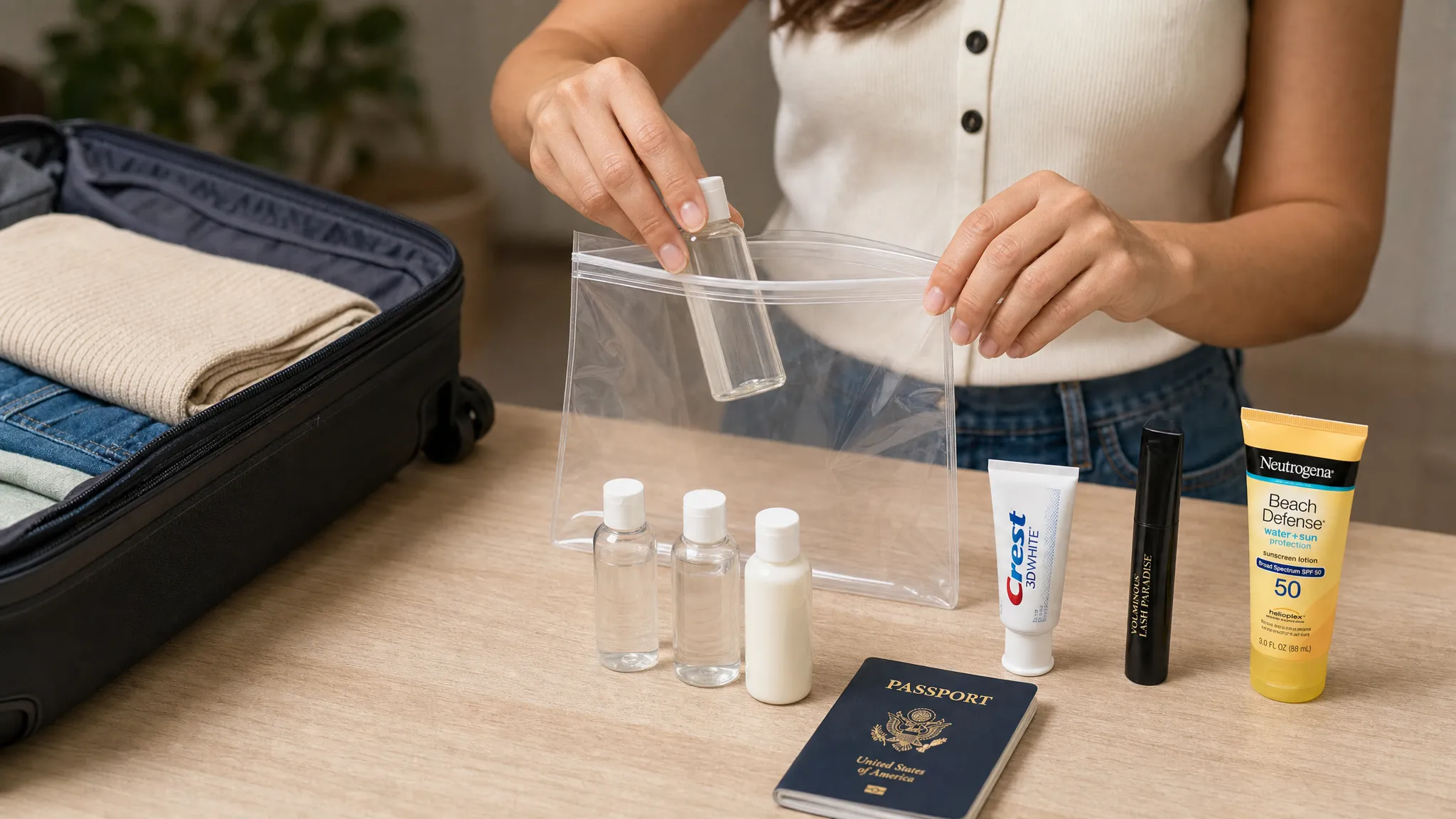
- Your liquid containers usually need to fit inside one clear resealable liquids bag.
- Medicines, baby food, and special dietary liquids may be allowed in larger amounts, but they may need extra screening.
- Checked baggage usually allows larger toiletries, but dangerous goods rules can still restrict aerosols, alcohol, and flammable items.
In the United States, the TSA describes this as the 3-1-1 liquids rule: 3.4 oz containers, one quart-sized bag, one bag per passenger. In the UK, the government also explains the standard hand luggage restrictions for liquids, with exceptions for essential medical needs and baby food.
Here is the practical version:
| Where you pack it | Common liquid limit | What to watch for |
|---|---|---|
| Cabin bag at standard security | 100 ml or 3.4 oz per container | Must usually fit in a clear resealable liquids bag |
| Cabin bag at some advanced-scanner airports | May be higher where officially permitted | Rules can vary by airport, terminal, and lane |
| Checked bag | Not usually subject to the 100 ml security rule | Airline, customs, alcohol, and dangerous goods limits may still apply |
| Medicines and baby essentials | Often allowed above 100 ml when needed | May require inspection, proof, or separate presentation |
| Duty-free liquids | Often allowed if sealed in an approved security bag | Connections can create problems if the bag is opened or not accepted |
What counts as a liquid at airport security?
Airport security uses “liquid” more broadly than many travelers expect. It is not just water, perfume, or shampoo. If a product can be poured, spread, sprayed, squeezed, or smeared, it may be treated as a liquid for cabin baggage screening.
Common examples include:
- Shampoo, conditioner, shower gel, lotion, and sunscreen
- Toothpaste, hair gel, shaving foam, and deodorant sprays
- Perfume, cologne, aftershave, and essential oils
- Mascara, liquid eyeliner, foundation, concealer, and lip gloss
- Peanut butter, jam, honey, yogurt, sauces, dips, and soft cheese
- Aerosols such as dry shampoo, body spray, and hairspray
Makeup is one of the most common sources of confusion. Powder blush or a solid lipstick is usually treated differently from a liquid foundation or gel lip product. For item-specific checks, Liquid Limits has dedicated guidance on products such as mascara in cabin bags and lip gloss on a plane, which are both commonly treated as liquids or gels.
A simple test helps: if you would need a cap, lid, pump, tube, jar, or nozzle to stop it leaking, pack it as a liquid.
The 100 ml rule is about the container, not the contents
One of the most frustrating mistakes is bringing a half-empty full-size bottle. A 200 ml shampoo bottle with only 50 ml left inside can still be refused because the container is larger than 100 ml.
Airport officers do not usually measure the remaining contents. They look at the printed container capacity. If the bottle says 150 ml, 200 ml, 250 ml, or any size above the local cabin limit, it may fail screening even if it is almost empty.
The safest approach is to decant toiletries into travel-size containers clearly marked 100 ml or less. If a container has no printed capacity, it may be questioned, especially at stricter checkpoints.
Why liquid rules vary by airport, route, and return trip
The airline you fly with matters for baggage size and weight, but airport security rules are usually set by the country, airport authority, or security regulator where you are screened. That means your departure airport matters most for cabin liquids.
Your itinerary can create three different liquid checks:
| Trip stage | Why it matters |
|---|---|
| Outbound departure | Your cabin liquids must pass the airport where you start your trip |
| Connection or transit | You may be screened again before the next flight |
| Return departure | The return airport may have stricter rules than your outbound airport |
This is why a one-way search can be misleading. You may depart from an airport with relaxed rules but return from an airport that still enforces 100 ml. If you bought a full-size product during your trip, it may be fine in your checked bag but not in your cabin bag on the way home.
This is also where public clarity matters. Airport liquid rules are public rules applied under time pressure, and travelers benefit when authorities explain them clearly, much like broader technology-driven public transparency initiatives aim to make civic decisions easier for people to understand and act on.
For a route-based check, Liquid Limits is designed to compare the liquid rule for your whole trip, including the return flight, so you can plan around the strictest rule instead of guessing.
What about airports with new scanners and larger liquid allowances?
Some airports have introduced or tested advanced cabin baggage scanners that can screen liquids more effectively. Where these systems are approved and fully implemented, travelers may be allowed to keep liquids in their bags or carry containers larger than 100 ml, sometimes described as up to 2 liters.
However, this is not a universal rule. It may depend on:
- The country’s aviation security regulations
- The airport and terminal
- Whether every lane has the newer scanner
- Temporary restrictions or policy changes
- Whether your connection airport accepts the same allowance
The key point is that “new scanners” does not automatically mean “no 100 ml rule.” A single airport can have different arrangements by terminal or security lane, and governments can change permissions quickly.
That is why Liquid Limits defaults to the stricter 100 ml rule when rules are unclear. It is better to pack safely than to lose an expensive product at security.
If you want a broader airport-by-airport view before you travel, you can check the Liquid Limits airport rules directory, which lists airport liquid limits with sources and last-checked dates.
Cabin bag vs checked bag: the rules are different
The 100 ml rule is mainly a cabin baggage security rule. Checked baggage goes through a different screening process, so full-size shampoo, conditioner, body lotion, and many other toiletries can usually go in your checked suitcase.
That does not mean checked baggage is unlimited. Separate rules may apply to:
- Aerosols, especially flammable sprays
- Alcohol, particularly high-strength spirits
- Cleaning products and solvents
- Fuel, lighter fluid, and other flammable liquids
- Chemical products, corrosives, and certain gels
A normal 250 ml bottle of shampoo is usually fine in checked baggage. A camping fuel canister is not. A large aerosol may be limited by airline or dangerous goods rules. Alcohol can be restricted by percentage strength and total quantity.
If you are unsure whether an item is just a toiletry or a regulated dangerous good, check your airline and the airport security guidance before packing it.
Medicines, baby food, and special dietary liquids
Most major airport security systems allow reasonable quantities of essential medical liquids, baby milk, baby food, and special dietary liquids above the standard 100 ml limit. These exceptions exist because some travelers need liquids during the journey and cannot simply replace them with travel-size versions.
Examples may include:
- Prescription liquid medicines
- Insulin and related supplies
- Contact lens solution needed during travel
- Baby milk, formula, and sterilized water
- Baby food pouches or jars
- Liquid nutrition required for medical or dietary reasons
You should pack these items so they are easy to remove for inspection. Keep prescription labels, doctor’s notes, or supporting documentation where relevant, especially for international trips. Rules vary, but being organized reduces delays.
Do not assume every “health” or “wellness” liquid is exempt. A full-size face serum, protein shake, or cosmetic spray may still be treated as a normal liquid unless it is medically necessary for the journey.
Duty-free liquids and connecting flights
Duty-free liquids can be confusing because they are often sold after security in sizes much larger than 100 ml. Perfume, cosmetics, wine, and spirits may be allowed into the cabin if they are packed in a sealed security tamper-evident bag, often called a STEB, with the receipt visible inside.
The problem is connections. If you change planes and go through security again, the next airport may inspect the duty-free bag. If the bag has been opened, damaged, or is not accepted by that airport’s rules, the item may be refused.
For international trips, buy duty-free liquids with your full route in mind. A large bottle bought before a connection is riskier than one bought at your final departure airport before the last flight.
How to pack liquids without delays
Packing well is less about memorizing every global rule and more about reducing uncertainty. The most reliable method is to pack your cabin liquids as if the 100 ml rule applies unless you have confirmed a more generous rule for every security checkpoint on your route.
Use travel-size containers with clear labels. Place them in a resealable transparent bag if your airport requires it. Keep the bag near the top of your carry-on so you can remove it quickly if asked.
Before you leave for the airport, ask yourself:
- Is every cabin liquid in a container of 100 ml or less?
- Does the printed label show the container size?
- Are gels, creams, pastes, aerosols, and liquid makeup included?
- Are medicines and baby essentials easy to present separately?
- Will I go through security again during a connection?
- Is my return airport stricter than my outbound airport?
If the answer is uncertain, move the item to checked baggage or leave it at home. This is especially true for expensive skincare, perfume, specialty foods, and full-size cosmetics.
For a deeper plain-English explainer on cabin liquids, see Liquid Limits’ guide to travel limits on liquids for cabin bags.
A simple decision guide
Use this table when deciding where to pack a liquid item:
| Item situation | Best packing choice | Why |
|---|---|---|
| Travel-size toiletry, 100 ml or less | Cabin bag | Usually fits standard security rules |
| Full-size shampoo or lotion | Checked bag | Too large for standard cabin screening |
| Essential medicine over 100 ml | Cabin bag, separate for inspection | Often exempt when needed during travel |
| Baby milk or formula | Cabin bag, separate for inspection | Commonly allowed in reasonable quantities |
| Expensive perfume over 100 ml | Checked bag or buy after final security | Risky if you face a strict checkpoint |
| Duty-free alcohol before a connection | Only if sealed and accepted on route | Connection security may re-check it |
| Aerosol spray | Check airline rules | Size and flammability restrictions may apply |
The safest rule for 2026 travel
As of 2026, the safest assumption is still this: pack cabin liquids in 100 ml or 3.4 oz containers unless you have verified that every relevant airport allows more.
That does not mean larger allowances never exist. It means they are not consistent enough to rely on blindly. Airport scanner upgrades, security policy changes, and connection screening can all affect what actually happens at the checkpoint.
Liquid Limits helps by checking airport, item, and route rules, showing verified source links and last-checked dates where available. When a rule is unknown or unclear, the tool falls back to the stricter 100 ml guidance so you can avoid unpleasant surprises.
Frequently Asked Questions
What is the standard limit on liquids on flights? The standard cabin bag limit is usually 100 ml or 3.4 oz per container, with containers placed in a clear resealable liquids bag. Some airports may allow more with approved scanners, but you should verify before relying on that.
Can I bring a 200 ml bottle if it is half empty? Usually no. Security normally looks at the container size, not the amount left inside. A 200 ml bottle can be refused even if it contains less than 100 ml.
Do liquid limits apply to checked luggage? The 100 ml cabin liquid rule generally does not apply to checked baggage, but dangerous goods, airline, customs, alcohol, and aerosol restrictions can still apply.
Are medicines allowed over 100 ml? Essential medicines are often allowed in quantities needed for the journey, but they may require extra screening. Keep them easy to access and bring supporting documentation when appropriate.
Do return flights have the same liquid rules? Not always. Your return airport may apply different rules from your outbound airport, especially if one airport has newer scanners and the other does not. Always check both directions.
Can I bring duty-free liquids through a connection? Sometimes, but they usually need to stay sealed in an approved security bag with proof of purchase. If you go through security again, the connection airport’s rules apply.
Check before you zip your bag
The limits on liquids on flights are easiest to manage when you plan around the strictest checkpoint on your itinerary. Before you pack, check your departure airport, connection airport, return airport, and the specific items you want to bring.
Use Liquid Limits to compare airport and route liquid rules side by side, with verified guidance, source links, and daily updates, so you know whether to pack 100 ml, check a full-size bottle, or leave it behind.