
Airport liquid rules are easy to misunderstand because travelers often hear two different messages at once: “100 ml only” and “new scanners allow bigger bottles.” Both can be true, but not always for your airport, your route, your connection, or your return flight.
The simplest way to follow liquid guidelines for flying without confusion is this: pack for the strictest security checkpoint you will pass through, not the most generous rule you found online. If any airport on your trip still enforces the 100 ml rule, that rule should shape your cabin bag.
Start with the rule that actually matters: your security checkpoint
Liquid rules are enforced when your cabin bag goes through airport security. That may sound obvious, but it explains most travel confusion.
Your airline may fly to a country with relaxed rules, but your departure airport may still require 100 ml containers. Your outbound airport may have newer scanners, but your return airport may not. Your first flight may be domestic, but a connection can put you through another security screening with different rules.
That is why route-based checking is more reliable than relying on a generic packing article. Before you pack, use Liquid Limits to check your full route and compare the strictest liquid rule across your trip, including the return flight. When information is unclear, the safer assumption is the stricter 100 ml rule.
What counts as a liquid when flying?
Airport security uses a broader definition of “liquid” than many travelers expect. It usually includes anything that can be poured, spread, sprayed, squeezed, pumped, smeared, or run.
That means your liquids bag is not just for water and shampoo. It can also include creams, gels, pastes, lotions, aerosols, roll-ons, mascara, lip gloss, liquid foundation, hair gel, sunscreen, toothpaste, perfume, and many food items such as yogurt, jam, honey, sauces, and nut butters.
The practical test is simple: if the item is not a solid and could change shape inside its container, assume airport security may treat it as a liquid.
For a deeper item-by-item overview, Liquid Limits has a separate guide on which liquids you can bring on a plane, but the safest packing habit is to treat borderline gels, creams, and pastes as liquids unless you have verified otherwise.
The standard cabin liquid rule in plain English
Across many airports, the familiar cabin liquid rule still looks like this: each liquid container must be 100 ml, 3.4 oz, or smaller, and those containers usually need to fit inside one clear resealable liquids bag.
In the United States, the Transportation Security Administration describes this as the 3-1-1 liquids rule: 3.4 oz containers, 1 quart-sized bag, 1 bag per passenger. In the UK and many European contexts, the bag is commonly described as a transparent resealable plastic bag with a capacity around 1 liter, although exact wording and enforcement can vary by airport.
The container size matters more than the amount left inside. A 200 ml shampoo bottle that is half empty can still be refused because the container itself is larger than the permitted size. Security staff do not usually measure what remains inside the bottle.
Here is the basic cabin liquid framework most travelers should use unless they have verified a different airport-specific rule.
| Situation | Usual guideline | What to do |
|---|---|---|
| Standard cabin liquids | Containers up to 100 ml or 3.4 oz | Pack them in a clear resealable liquids bag |
| Larger bottles in cabin bags | Allowed only where the airport confirms a larger limit | Do not assume this applies across your whole trip |
| Checked baggage | No general 100 ml cabin-style limit for ordinary toiletries | Still check dangerous goods limits for alcohol, aerosols, and chemicals |
| Medicines and medical liquids | Often allowed above 100 ml when necessary | Keep them separate and be ready for additional screening |
| Baby milk, formula, and baby food | Usually exempt in reasonable quantities | Present them separately at security |
| Duty-free liquids | May be allowed if sealed correctly | Keep receipt and tamper-evident bag intact, especially on connections |
Why some airports mention 2 liters
Some airports use newer CT scanners that can screen liquids more effectively. In certain places, that has led to different cabin liquid rules, sometimes allowing larger containers, often described as up to 2 liters.
The confusing part is that scanner upgrades do not happen everywhere at the same time. Even within the same country, one airport may publish different instructions from another. Even within the same airport, not every lane or terminal may operate under the same procedure. Temporary changes, equipment maintenance, local regulator decisions, and security alerts can also affect what passengers are allowed to carry.
So if you see a 2 liter allowance, treat it as an airport-specific rule, not a universal travel rule. It may help on that one departure, but it may not protect you on the return flight or during a connection.
This is also why printed airport pages and old forum posts can mislead travelers. Airport liquid rules have changed repeatedly in recent years, and a rule that was accurate last season may not be accurate on the day you fly.
A simple packing method that avoids most liquid problems
You do not need to memorize every airport rule to pack well. You need a repeatable system.
- List every airport where you may go through security: Include departure, transfer, and return airports. If you leave the secure area during a layover, assume you may be screened again.
- Check the strictest airport rule: Use official airport sources or a route checker rather than relying only on airline summaries.
- Move nonessential full-size liquids to checked baggage: This is the easiest fix for shampoo, conditioner, large sunscreen, and body lotion.
- Decant cabin essentials into small labeled containers: Use containers of 100 ml or less if any airport on the trip requires it.
- Replace liquids with solids where possible: Solid deodorant, bar soap, shampoo bars, stick sunscreen, and powder makeup reduce liquids bag pressure.
- Separate exceptions before security: Medicines, baby food, breast milk, and special dietary liquids should be easy to remove and explain.
- Recheck before the return flight: Do not assume the rules you used outbound will be accepted at the airport where you fly home.
If you follow that system, you will rarely need to repack at the security belt, throw away toiletries, or argue over whether a product counts as a gel.
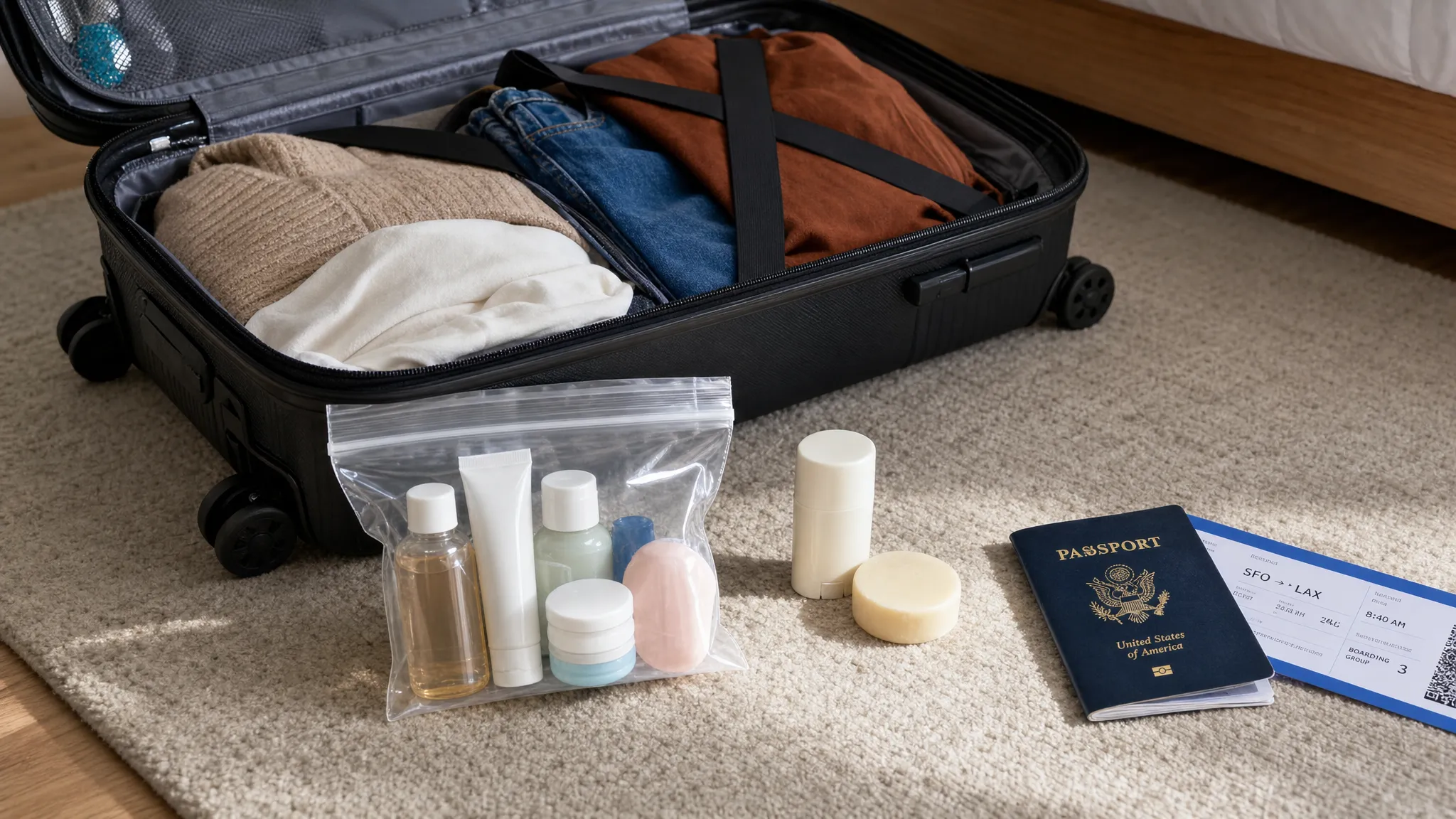
Common items that cause confusion
The most frustrating liquid mistakes usually involve everyday products that do not look like “liquids” at first glance. Makeup, food, and personal care items are the biggest culprits.
| Item | Usually treated as a cabin liquid? | Low-stress packing choice |
|---|---|---|
| Toothpaste | Yes | Use a travel-size tube under 100 ml |
| Mascara | Yes | Put it in the liquids bag |
| Lip gloss | Yes | Pack it with gels and cosmetics |
| Liquid or cream foundation | Yes | Use a small container or choose powder foundation |
| Stick deodorant | Usually no | Good swap for gel or roll-on deodorant |
| Aerosol deodorant | Yes | Must meet cabin liquid and aerosol rules |
| Peanut butter, jam, honey, sauces | Yes | Pack small portions or place in checked baggage |
| Contact lens solution | Yes, unless medically necessary rules apply | Use a travel-size bottle when possible |
| Refillable water bottle | Empty bottle is allowed | Fill it after security |
| Sunscreen lotion | Yes | Use 100 ml cabin size or pack larger bottle in checked baggage |
Makeup deserves special attention because travelers often split it mentally into “cosmetics” rather than “liquids.” Airport security does not make that distinction. A powder compact is usually different from a liquid foundation bottle. A lipstick is usually different from lip gloss. When in doubt, put creamy or gel-like cosmetics in the liquids bag.
Medicines, baby items, and medical necessities
Most airport liquid guidelines include exemptions for necessary medical liquids and baby feeding items. These exemptions are important, but they do not mean you can simply leave everything buried in your bag.
Medicines, liquid nutrition, medical gels, cooling packs used for medical purposes, baby formula, breast milk, baby food, and toddler drinks may be allowed in amounts above the normal 100 ml limit. They may also be subject to separate screening.
The best approach is to pack these items together, keep labels when possible, and present them proactively at the checkpoint. You do not always need a prescription for every exempt liquid, but documentation can help if the item is unusual, unmarked, or needed in a larger quantity.
The UK government’s hand luggage restrictions and TSA guidance both emphasize that special categories may be treated differently from ordinary toiletries. Still, the final screening process depends on local officers and airport procedures, so clear packing makes the conversation easier.
Duty-free liquids are not automatically safe on connecting flights
Duty-free purchases create another common trap. You may be allowed to buy a large bottle of perfume, liquor, or skincare after security, but that does not guarantee it will pass a later checkpoint.
Many airports allow duty-free liquids over 100 ml if they are packed in a sealed, tamper-evident security bag with proof of purchase. The bag must remain sealed. If you open it, remove the receipt, or repack the item loosely in your carry-on, you may lose the protection that made it acceptable.
Connections make this more complicated. If you pass through security again after landing, the next airport’s rules apply. Some routes handle sealed duty-free liquids smoothly. Others can be stricter, especially if the purchase was made outside that security region or the receipt is unclear.
If the item is expensive or hard to replace, check your connection airport before buying. For alcohol, also remember that checked baggage rules and customs limits are separate from cabin liquid screening.
Checked baggage solves size, but not every restriction
Putting full-size toiletries in checked baggage is often the easiest way to avoid cabin liquid stress. A 300 ml shampoo, a large sunscreen bottle, or a full-size body lotion will usually be better in checked luggage than in a carry-on.
But checked baggage is not a free zone. Some liquids are restricted or prohibited because they are flammable, corrosive, toxic, pressurized, or otherwise hazardous. Strong chemicals, some solvents, certain paints, fuel, and many industrial products are not treated like ordinary toiletries.
Aerosols and alcohol also have special limits. Personal care aerosols are usually allowed within quantity and safety restrictions, but large or non-toiletry aerosols can be a problem. Alcohol rules can depend on alcohol percentage and total volume. If you are packing unusual liquids, check your airline, airport, and dangerous goods guidance before you travel.
The U.S. Federal Aviation Administration’s PackSafe guidance is a useful reference for hazardous materials, even if you are not flying in the United States, because it helps travelers understand why some items are restricted beyond the ordinary 100 ml rule.
The return-flight mistake: why “it worked last time” is not enough
Many travelers pack carefully for the outbound flight, then forget that the return airport may enforce a different rule. This is especially common when flying from an airport with newer scanners to one with stricter procedures, or when buying full-size products during the trip.
For example, you might depart from an airport that allows larger liquids through a specific scanner system, buy a 250 ml skincare product abroad, and then discover that your return airport still applies the 100 ml container limit. The fact that the product entered your destination country does not mean it can leave in your cabin bag.
The same problem can happen on multi-city trips. A bottle allowed on the first leg can become a problem after a domestic-to-international transfer, a self-transfer, or a layover where you exit and re-enter security.
Before packing for home, check the airport you are actually departing from. Liquid Limits keeps an airport liquid rules directory with airport-level limits, sources, and last-checked dates so you can avoid relying on old assumptions.
A quick decision rule for uncertain items
When an item feels borderline, ask three questions.
First, is it pourable, spreadable, sprayable, squeezable, creamy, gel-like, or paste-like? If yes, treat it as a liquid.
Second, is the container 100 ml or smaller? If not, do not pack it in your cabin bag unless you have verified that every security checkpoint on your itinerary allows a larger container or the item qualifies for an exemption.
Third, would losing this item at security ruin your trip? If yes, pack it in checked baggage, buy it after arrival, switch to a solid version, or verify the exact rule before you leave.
This decision rule is deliberately conservative. It may feel stricter than some airports require, but it reduces the chance of last-minute confiscation.
Frequently Asked Questions
What are the main liquid guidelines for flying? The main guideline is that cabin liquids often need to be in containers of 100 ml or 3.4 oz or less, placed in a clear resealable liquids bag. Some airports allow larger containers with newer scanners, but you should verify each airport on your route.
Does the 100 ml rule apply to the liquid amount or the bottle size? It applies to the container size. A larger bottle that is partly empty can still be rejected because security checks the labeled capacity of the container, not just the liquid remaining inside.
Can I bring full-size toiletries in checked baggage? Usually yes for ordinary toiletries, but hazardous liquids, aerosols, alcohol, and chemicals can have separate restrictions. Check airline and dangerous goods rules if the item is flammable, pressurized, corrosive, or unusually large.
Are medicines and baby milk exempt from liquid limits? Necessary medicines, baby formula, breast milk, baby food, and some medical liquids are often allowed above the standard cabin limit. Pack them separately and be ready for additional screening.
If one airport allows 2 liter liquids, can I use that rule for my whole trip? No. A larger airport allowance applies only where it is confirmed and enforced. Your connection or return airport may still require 100 ml containers, so check the strictest rule across the whole itinerary.
Check before you pack
Liquid rules are not confusing because travelers are careless. They are confusing because airport technology, local regulations, exemptions, and route details do not always line up.
The safest habit is simple: verify your departure, connection, and return airports before packing, then follow the strictest rule you find. If the rule is unclear, pack to 100 ml.
Use Liquid Limits before your next flight to check airport, item, and route-specific liquid rules with source links and last-checked dates, so you can pack your cabin bag with confidence instead of guesswork.