
Most travelers learn the liquids rule the hard way, at the security bin, with a full-size shampoo, a half-finished drink, or an expensive serum they assumed would be fine. The basic rule is easy to remember, but the real challenge is knowing which airport, terminal, connection, or return flight applies it.
For most cabin bags, the safest assumption is still simple: liquids, aerosols, gels, creams, and pastes should be in containers of 100ml, or 3.4 oz, or less and fit inside your liquids bag. Some airports and screening lanes may allow larger containers because of newer scanners, but that does not mean every airport on your trip will.
This guide explains the key liquid restrictions when flying, how to avoid common packing mistakes, and why checking the strictest rule across your whole route is the smartest way to pack.
The core rule: the container matters, not the amount left
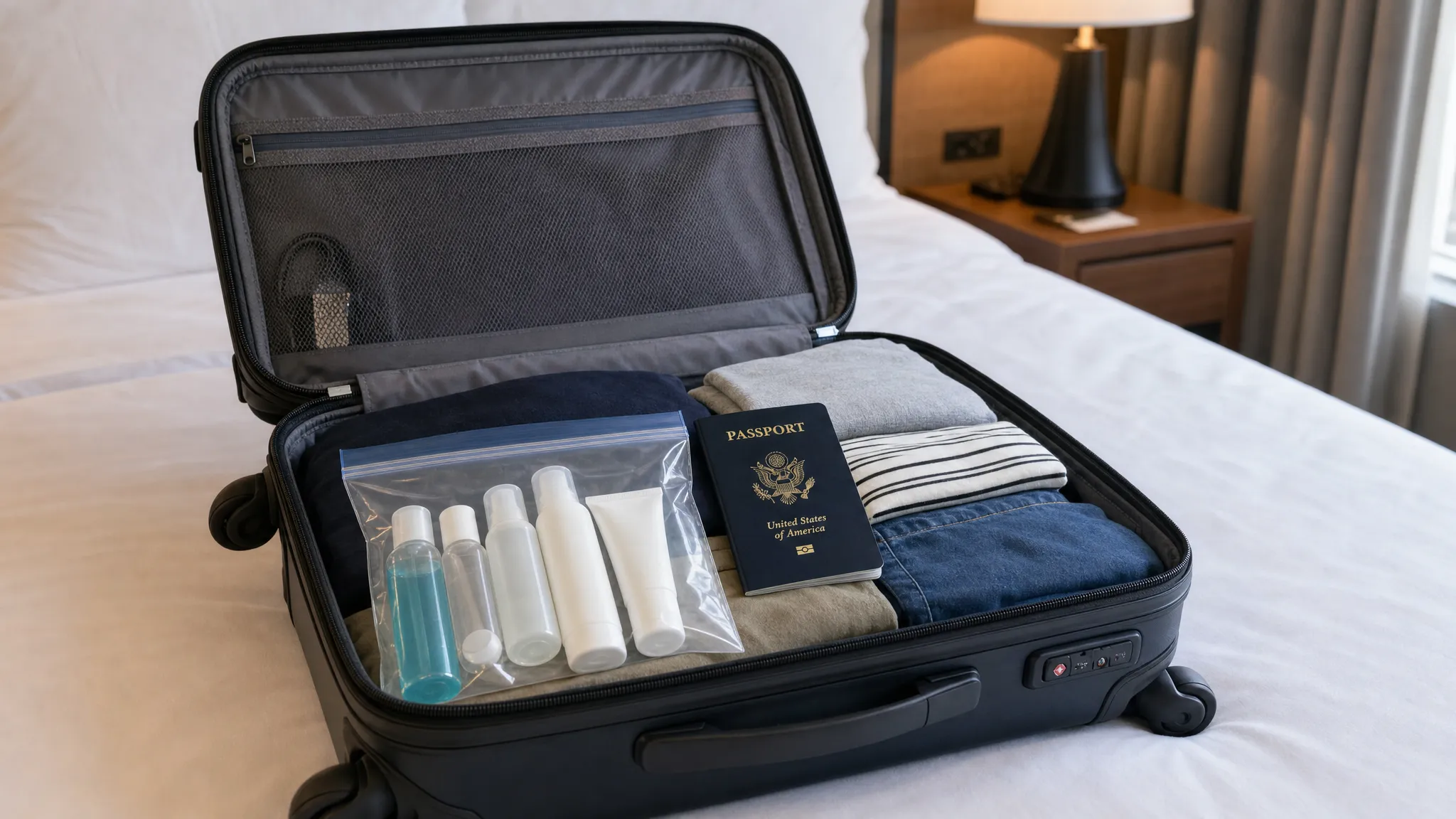
At many airport security checkpoints, each liquid container in your cabin bag must be 100ml or smaller. In the United States, the TSA liquids rule describes this as 3.4 oz, or 100ml, containers placed in one quart-sized bag. In the UK, official hand luggage restrictions also treat liquids, gels, pastes, and similar items as restricted cabin items.
The most important detail is that security usually checks the container size, not the amount of product remaining inside. A 200ml bottle that is almost empty can still be refused because the container itself is too large. If you want to bring a small amount of a product, decant it into a travel-size container marked 100ml or less.
The rule applies at the security checkpoint, not in the aircraft cabin. Once you pass security, you may usually take drinks or other liquids bought airside onto the plane, unless your destination, airline, or transfer airport adds another screening requirement.
What counts as a liquid when flying?
Airport liquid restrictions cover more than water, perfume, and shampoo. Security teams generally include anything that can be poured, spread, sprayed, squeezed, smeared, or held in a gel-like form.
That means many everyday travel items count as liquids even if you do not think of them that way. Toothpaste, mascara, peanut butter, sunscreen, hair gel, hand sanitizer, and lip gloss are common examples. If you are unsure whether a cosmetic counts, treat it as a liquid unless official guidance says otherwise. For a practical example, Liquid Limits explains why lip gloss is treated as a liquid or gel for cabin rules.
| Item type | Usually treated as a liquid? | Packing note |
|---|---|---|
| Shampoo, conditioner, body wash | Yes | Use 100ml travel bottles for cabin bags. |
| Toothpaste, gels, creams | Yes | Pack in your liquids bag. |
| Mascara, lip gloss, liquid foundation | Yes | Keep small makeup liquids together. |
| Solid deodorant, bar soap, powder makeup | Usually no | Rules can vary for powders and unusual items. |
| Soft cheese, jam, honey, sauces | Yes | Pack in checked baggage if over the limit. |
| Aerosol deodorant or hairspray | Yes | Cabin and checked baggage may also have aerosol safety limits. |
When an item is borderline, packing it as a liquid is the lower-risk choice. It may take a little more space in your liquids bag, but it reduces the chance of delays or confiscation.
Carry-on rules are different from checked baggage rules
Liquid restrictions are strictest for cabin baggage because cabin bags go through passenger security screening. Checked baggage can usually contain larger toiletries and other non-dangerous liquids, but it is not a free-for-all.
Checked bags are still subject to aviation safety rules, airline policies, customs rules, and restrictions on dangerous goods. For example, aerosols, flammable liquids, high-proof alcohol, certain chemicals, and pressurized containers may be limited or prohibited. If an item is combustible, corrosive, or under pressure, do not assume it is allowed just because it is going in the hold.
For ordinary toiletries, checked baggage is often the easiest solution. Full-size shampoo, sunscreen, lotion, contact lens solution, and similar items are generally better packed in checked luggage if you do not need them during the airport journey.
The strictest checkpoint on your route wins
The biggest mistake travelers make is checking only the departure airport. In reality, you may face liquid screening at multiple points.
You should consider:
- Your outbound departure airport
- Any transfer airport where you may be re-screened
- Your destination airport if you buy liquids before a domestic or onward connection
- Your return departure airport
- Any return connection or transit point
This matters because liquid rules may differ by country, airport, terminal, scanner type, and temporary policy. Some airports advertise newer scanning technology, while others still enforce the traditional 100ml rule. Even within the same airport, different lanes or terminals may not operate under identical procedures.
If one checkpoint on your itinerary still requires 100ml containers, pack for that rule. Liquid Limits is built around this exact problem: you can check airport rules and route combinations rather than relying on a single airport page. If you are researching specific airports, the airport liquid rules directory is a useful place to compare current limits, sources, and last-checked dates.
Why some airports mention 2L liquids
Newer computed tomography, or CT, scanners can inspect bags in more detail. Where regulators and airports allow it, these scanners may let passengers keep liquids and electronics inside bags and may permit larger liquid containers, sometimes up to 2 liters.
However, this is not universal. A route that starts at a more flexible airport can still include a stricter return airport. A terminal upgrade may not apply to every lane. A temporary rule change can also bring back the 100ml limit even after new scanners are installed.
That is why “my airport has new scanners” is not enough information. The safer question is: what is the strictest liquid rule I will face before I reach home? For a broader update on how this plays out today, see Liquid Limits’ guide to airport liquid limits for carry-ons in 2026.
Exceptions: medicines, baby food, and special dietary needs
Most airport liquid rules include exceptions for medically necessary liquids, baby milk, baby food, and special dietary items needed during the journey. These items may be allowed in quantities above 100ml, but you should expect extra screening.
Pack exceptions separately and tell security staff before your bag is screened. If you are carrying prescription medicine, keep it in original packaging where possible and bring supporting documentation if the item is unusual, high volume, or injectable. For baby items, carry only what you reasonably need for the journey, including delays.
The word “exception” does not mean “no checks.” It means the item can be considered outside the standard liquids bag rule if it meets the relevant conditions. Security officers can still test, inspect, or refuse items depending on local rules.
Duty-free liquids: allowed, but not always simple
Duty-free liquids can be confusing because they are often sold in bottles larger than 100ml after security. In many cases, duty-free alcohol, perfume, or cosmetics are allowed if they are sealed in a tamper-evident security bag with the receipt visible.
The problem appears during connections. If you leave the secure area, change airports, or go through transfer security, your duty-free liquids may be checked again. Some transfer points accept properly sealed duty-free bags. Others may apply stricter rules, especially if the bag has been opened or the receipt is missing.
If you have a connection, ask the shop staff whether your purchase will remain compliant through your transit airport and destination. Keep the security bag sealed until the end of your final flight. If the item is expensive, consider buying it at your last airport before arrival rather than before a connection.
A simple packing system that works for most trips
You do not need to memorize every airport rule if you pack with a conservative system. The goal is to make your cabin bag pass the strictest likely screening point while keeping essential items accessible.
Use this approach for low-stress packing:
- Put all cabin liquids in clearly labeled containers of 100ml or less.
- Choose solid alternatives where practical, such as bar soap, solid deodorant, balm sticks, or powder makeup.
- Keep medicines and baby items separate so you can declare them quickly.
- Pack full-size toiletries in checked baggage if you are checking a bag.
- Do not buy large duty-free liquids before a connection unless you understand the transfer rules.
- Check both outbound and return airports before packing, not just your first departure point.
This system may feel more conservative than some airport rules require, but it is reliable. It also prevents a common return-trip problem: packing confidently for a 2L airport on departure, then discovering your return airport still enforces 100ml containers.
Common mistakes that lead to confiscated liquids
Most liquid problems are avoidable. They usually happen because travelers apply the right rule in the wrong way.
| Mistake | Why it causes trouble | Better choice |
|---|---|---|
| Packing a half-empty 200ml bottle | Security checks container capacity. | Use a 100ml travel bottle. |
| Assuming makeup is exempt | Many cosmetics are liquids, gels, or creams. | Put liquid makeup in your liquids bag. |
| Checking only the outbound airport | Return and transfer airports may be stricter. | Check the full route both ways. |
| Opening a sealed duty-free bag | It may no longer qualify at transfer security. | Keep it sealed with the receipt visible. |
| Treating food as automatically allowed | Spreads, sauces, and soft foods can count as liquids. | Pack large quantities in checked baggage. |
A good test is to ask whether the item can spread, squeeze, spray, pour, or smear. If yes, assume liquid restrictions apply.
Special situations: business samples, gifts, and bulk liquids
Travelers sometimes carry liquids that are not personal toiletries: product samples, cosmetics for events, sauces as gifts, wellness products, or retail stock. These items create more risk because they are often larger, more numerous, or harder to explain at security.
If you are carrying commercial samples, bring documentation and check customs rules as well as airport liquid rules. Security restrictions are only one part of the journey. Import rules, airline baggage limits, and destination regulations may also apply.
For larger quantities, shipping may be simpler than flying with the items. Business travelers, exhibitors, and growing eCommerce brands can often avoid cabin liquid restrictions entirely by using a fulfilment or warehousing partner, such as a UK 3PL logistics provider, to store, pack, or transport goods separately from passenger baggage.
Pre-flight liquid checklist
Before you zip your bag, take five minutes to check the items most likely to cause issues. This is especially important if you are flying internationally, connecting through another country, or returning from an airport with different scanner rules.
| Question | If the answer is yes | What to do |
|---|---|---|
| Is any cabin liquid over 100ml? | It may be refused at stricter checkpoints. | Move it to checked baggage or decant it. |
| Do you have a connection? | You may be screened again. | Check transfer rules and duty-free handling. |
| Are you bringing medicine or baby food? | It may qualify for an exception. | Pack separately and declare it. |
| Are you relying on a 2L airport rule? | Your return airport may differ. | Confirm the strictest rule for the full trip. |
| Are any liquids gifts or commercial goods? | Customs and airline rules may also apply. | Check documentation and consider shipping. |
Frequently Asked Questions
What is the standard liquid restriction when flying? The standard rule at many airports is that cabin liquids must be in containers of 100ml, or 3.4 oz, or less and fit inside a clear resealable liquids bag. Some airports may allow larger amounts, but you should verify every checkpoint on your route.
Can I bring a 200ml bottle if it is half empty? Usually no. Security generally looks at the container size, not how much liquid remains inside. A 200ml bottle can be refused even if it contains less than 100ml.
Do liquid restrictions apply to checked baggage? The 100ml cabin liquids rule is mainly for carry-on bags. Checked baggage can usually contain larger toiletries, but dangerous goods rules, airline limits, customs rules, and restrictions on aerosols or flammable liquids can still apply.
Are medicines exempt from the 100ml rule? Medically necessary liquids may be allowed in larger quantities, but they can be inspected or tested. Keep them separate, declare them at security, and carry documentation when appropriate.
Should I follow the 100ml rule if my airport says it allows 2L liquids? If every security checkpoint on your route clearly allows larger liquids, you may be able to use that rule. If any airport, transfer point, or return flight is unclear, packing to the 100ml rule is the safer option.
Check liquid rules before you pack
Liquid restrictions when flying are not difficult because the basic rule is complicated. They are difficult because routes are complicated. A return flight, transfer airport, temporary policy, or different scanner lane can change what is allowed.
Before your next trip, check the strictest rule for your whole itinerary with Liquid Limits. You can look up airports, routes, and specific items, with verified source links, last-checked dates, and a conservative fallback when rules are unclear.