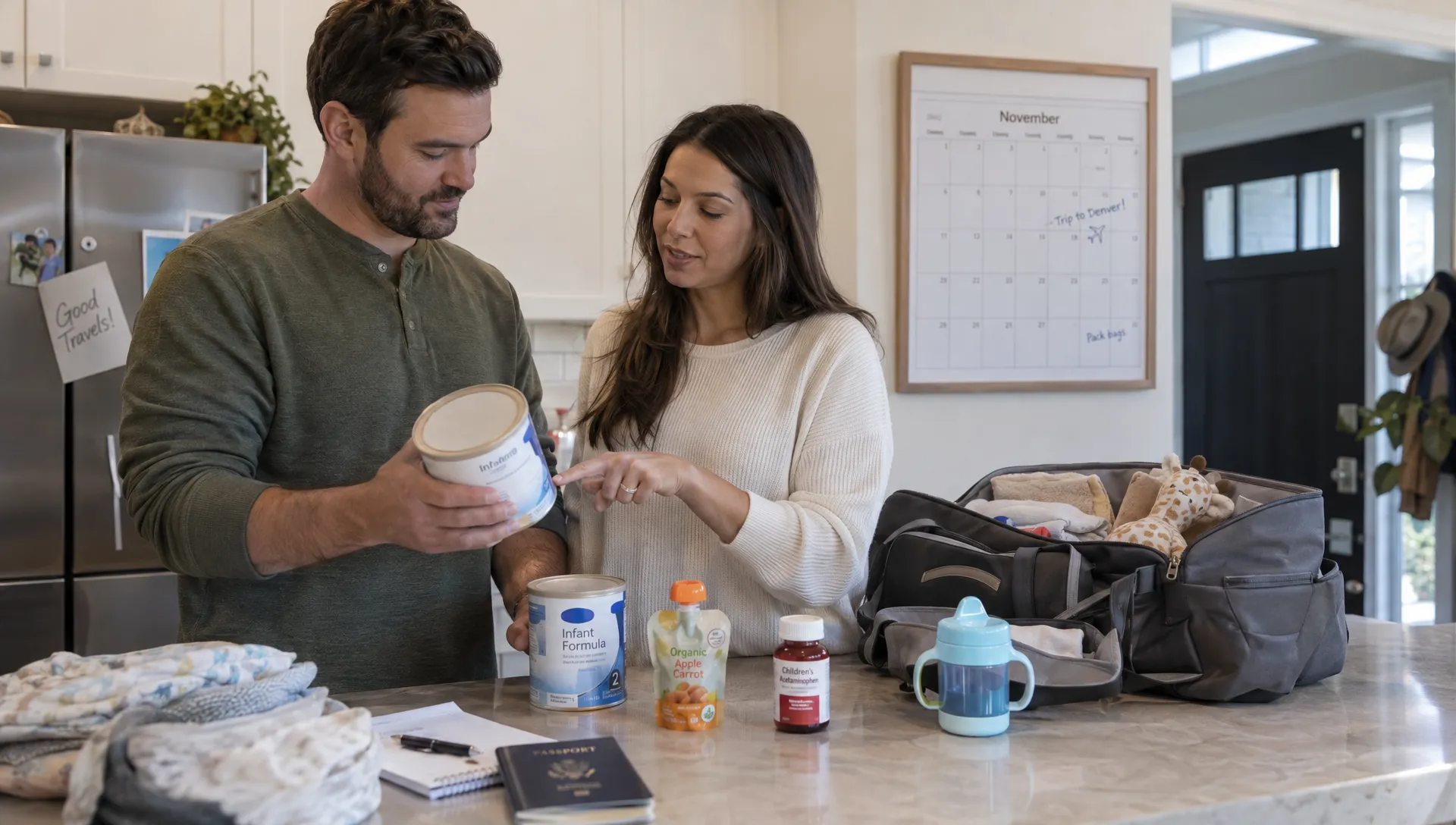
A bottle of formula, a pouch of applesauce and a child’s cough medicine may look like three ordinary liquids, but airport security can treat them differently. The rules for liquids when flying with children distinguish between everyday toiletries, feeding supplies and medically necessary items.
The practical approach is to pack those categories separately, check the exceptions at each security checkpoint and avoid assuming that anything intended for a child is automatically exempt.
Start by separating ordinary liquids from feeding supplies
At checkpoints using the standard liquid restriction, ordinary cabin liquids must be in containers holding no more than 100 ml (3.4 oz). The container’s capacity matters, not how much remains inside. A half-empty 200 ml sunscreen bottle still exceeds that limit.
In the US, these containers belong in one quart-sized liquids bag per passenger. Other authorities commonly specify a transparent, resealable bag with a maximum capacity of one liter. Follow the departure airport’s published instructions.
Children’s shampoo, toothpaste, sunscreen and ordinary drinks generally belong in this category. Having a child with you does not make the entire family’s liquids exempt.
Baby feeding supplies and medically necessary liquids need a separate check. Some can exceed the usual container limit, but they may require declaration and additional screening. Also distinguish airport security rules from your airline’s baggage allowance: permission to carry milk does not automatically mean permission to bring an additional bag.
How rules for liquids when flying change for baby feeds
At US checkpoints: formula, breast milk and toddler supplies
The TSA’s guidance for traveling with children allows formula, breast milk, toddler drinks and baby or toddler food, including puree pouches, in quantities greater than 3.4 oz in carry-on baggage. These supplies do not need to fit inside the quart-sized liquids bag.
Tell the TSA officer about them at the beginning of screening and remove them from your carry-on for separate inspection. Bring quantities suited to your trip and foreseeable delays rather than assuming every amount will pass without questions.
Your child does not have to be present for TSA to allow these supplies. This is particularly useful for a parent transporting expressed breast milk while traveling alone.
The exception does not mean that every drink for every child qualifies. A school-age child’s ordinary juice bottle should not be treated as a toddler-feeding exception simply because it belongs to a child.
At UK checkpoints: the item and your child’s presence matter
For UK departures, the rules for liquids when flying distinguish expressed breast milk from other baby-feeding supplies. The UK government’s baby-food and baby-milk guidance allows breast milk in hand luggage even when you are not traveling with a baby, with individual containers limited to 2,000 ml.
For the other baby-feeding items listed in that guidance, including formula, baby food and sterilized water for a baby, you must be traveling with the baby. You may bring enough for the journey, subject to screening.
The UK guidance also says frozen breast milk is not permitted in hand luggage. That is a significant difference for parents accustomed to US procedures, so check the exact form of milk you plan to transport rather than searching only for a general “baby milk allowed” answer.
At EU checkpoints: check the local instructions
The EU’s hand-luggage guidance permits medicines and baby food in quantities above the ordinary liquid limit, though additional checks may apply.
Use that as a starting point, then consult the airport’s own guidance for milk, water, quantities and presentation at screening. Permission at your first airport does not guarantee identical handling at your next checkpoint.
Treat children’s medicines and cooling packs separately
Liquid medicine is not an ordinary toiletry
A medically necessary liquid may qualify for an exception even when its bottle exceeds 100 ml. This can matter for prescription medicine or a liquid treatment your child needs during travel.
Keep medicine easy to identify, preferably in its original labeled packaging. Carry a prescription or clinician’s letter when relevant, especially for international travel. Documentation requirements differ by authority, so check them before departure rather than assuming a pharmacy label is sufficient everywhere.
For medication, the rules for liquids when flying depend on medical necessity and local screening requirements, not simply the child’s age. A family-size bottle packed “just in case” should not automatically be treated as exempt.
At US checkpoints, the TSA’s liquid-medication guidance allows medically necessary liquids in reasonable quantities and requires travelers to tell the officer about them at the start of screening.
Cooling packs can qualify, but they still need screening
At TSA checkpoints, ice packs, freezer packs and gel packs used to cool the permitted baby-feeding supplies can travel in carry-on baggage. Partially frozen or slushy packs are subject to additional screening rather than automatically being prohibited.
Do not extend that permission to every cooling pack in your luggage. A pack used for an ordinary picnic drink may fall under different rules. Other countries can also handle frozen milk and cooling accessories differently.
Pack the cooler so staff can access its contents without dismantling your entire carry-on. For medicines requiring temperature control, follow the storage instructions and ask a pharmacist about the journey’s expected duration.
Pack for inspection as well as feeding
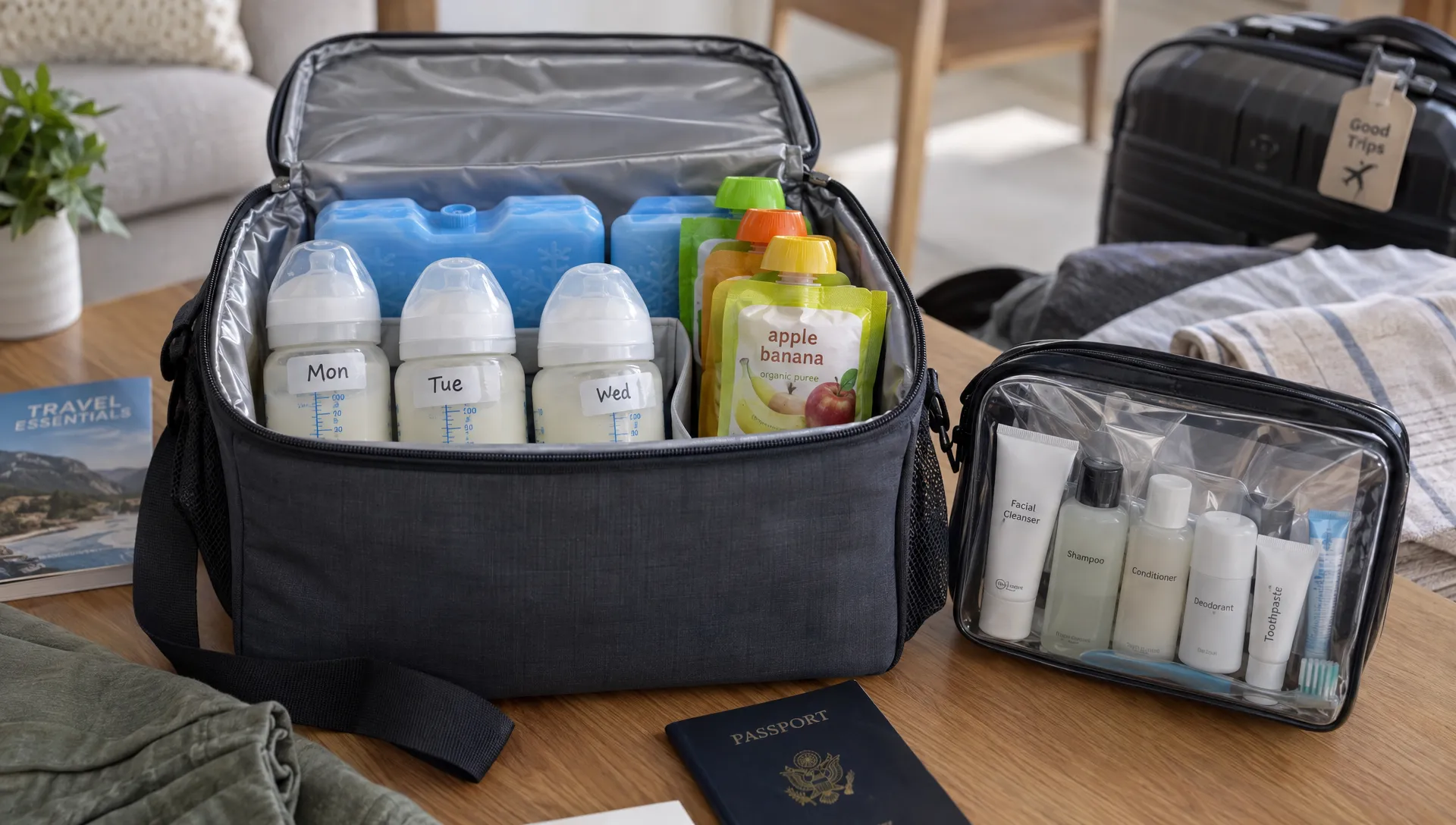
Knowing the rules for liquids when flying helps you choose the right supplies; organizing them well makes the checkpoint easier to manage. Keep ordinary toiletries in their required liquids bag and exempt feeding supplies together in an accessible section of your carry-on.
A practical packing arrangement is:
| Item | Where to keep it | What to check before departure |
|---|---|---|
| Travel-size shampoo and toothpaste | Ordinary liquids bag | Container capacity and bag requirements |
| Formula, breast milk and baby food | Accessible feeding pouch or cooler | Local exception, quantity and child-presence requirements |
| Liquid medicine | Accessible medication pouch | Declaration and documentation requirements |
| Cooling packs | With the supplies they keep cold | Rules for frozen, partially frozen and melted packs |
| Empty feeding bottle or cup | Accessible pocket | Whether it is completely empty before screening |
Use leak-resistant containers and keep identifying labels visible. Avoid transferring medicine into an unmarked travel bottle simply to make it smaller.
At TSA screening, tell the officer if you do not want feeding supplies X-rayed or opened. Alternative procedures involve additional screening; this is not a way to avoid inspection altogether. Do not assume the same options exist at every international airport.
Allow extra time for these checks. A family with a cooler, several bottles and liquid medicine may take longer to clear security than someone carrying only standard toiletries.
Plan for connections and the flight home
The airport where you depart is only one part of the journey. A connection can introduce another security check, particularly when you change terminals, leave the secure area or follow an airport’s transfer procedure that includes rescreening.
Before packing, identify every place where your family may pass through security. Then check the rules for the actual items you will have at that point. An allowance for expressed breast milk does not necessarily cover a large bottle of water bought after the previous checkpoint.
Our guide to liquid rules on outbound and return trips explains why the journey home deserves a separate check. For families, that includes any milk, medicine or baby food purchased at the destination.
Check the rules for liquids when flying at each of those checkpoints, rather than relying on the most generous airport on your itinerary. New scanners or larger allowances for ordinary liquids at one airport do not establish the rules elsewhere.
An empty bottle can reduce problems with ordinary drinking water. Empty it before security and refill it afterward where suitable water is available. For infant feeds, follow the formula manufacturer’s preparation instructions and established hygiene guidance; airport convenience should not determine how you prepare a feed.
Do a final family carry-on check
The evening before departure, inspect the containers rather than relying on a packing list alone. Check the printed capacity of toiletries, confirm medicine labels are readable and make sure cooling supplies are easy to remove.
For a family trip, the rules for liquids when flying are easiest to apply when each item has a clear purpose. Ask whether it is an ordinary liquid, a qualifying feeding supply or a medically necessary item, then verify the relevant allowance.
Your final check should cover these points:
- Every checkpoint: Include departure, any connecting-airport screening and the return journey.
- Feeding quantities: Pack for expected feeds and realistic delays, while checking local quantity guidance.
- Child-presence requirements: Confirm whether the feeding exception requires the baby to travel with you.
- Medicine paperwork: Keep any required evidence accessible with the medicine.
- Screening access: Make bottles, pouches and cooling packs reachable without unpacking everything.
- Ordinary liquids: Check that toiletries and non-exempt drinks meet the applicable container limits.
Frequently asked questions
Can I bring ready-to-feed formula in bottles larger than 100 ml? At TSA checkpoints, formula can exceed the usual 100 ml limit and does not need to fit in the quart-sized bag. Declare it and present it separately. Other authorities have their own quantity, screening and child-presence requirements.
Can I bring breast milk without my baby? Yes at US TSA checkpoints. UK guidance also permits breast milk without a baby present, but sets a 2,000 ml maximum per container and does not permit frozen breast milk in hand luggage. Check other departure countries individually.
Are puree pouches treated as liquids? Treat purees as liquids or gels for packing purposes. TSA includes baby and toddler puree pouches in its feeding-supply exception. A similar pouch intended as an ordinary snack for an older child should not automatically be assumed exempt.
Do the rules for liquids when flying allow a large juice bottle for an older child? Not automatically. TSA specifically includes toddler drinks in its exception, but that does not create a general exemption for older children’s beverages. Unless another applicable exception covers it, follow the ordinary liquid limit.
Can I take powdered formula instead? Powdered formula is not a liquid, though powders may receive additional screening and some routes have separate powder requirements. Any water you carry is assessed separately. If you use powder, plan safe preparation rather than assuming every airport or aircraft water source is suitable.
Does buying a drink after security solve the problem? It may solve the issue at that checkpoint, but a later security check can apply its own restrictions. Finish or empty ordinary drinks before rescreening unless they qualify for an exception there.
Check your family’s route before you pack
Use Liquid Limits to check airport and route liquid rules for your departure, connections and return flight. It provides item-specific checks, verified source links and last-checked dates, with daily rule updates.
When a rule is unclear, Liquid Limits defaults to the stricter 100 ml allowance. Use the linked official guidance to confirm feeding and medical exceptions rather than assuming a general airport limit answers every question about your child’s supplies.