
Liquid rules often feel simple until you fly home. You may depart from an airport that has newer screening equipment, buy toiletries abroad, connect through a different country, and then discover that the return checkpoint follows a stricter rule than the one you used on the outbound journey.
That is why the most reliable way to think about the rules for liquids on flights is not, Can I take this liquid on a plane? It is, Which security checkpoints will screen my cabin bag on this specific trip, including the way back?
For most travelers, the safest default is still the familiar 100ml, 3.4oz container rule for cabin baggage. Some airports and scanner lanes may allow larger containers, sometimes up to 2 liters, but those allowances are local, changeable, and not guaranteed across a whole itinerary. If your return airport or connection applies the 100ml rule, that stricter rule controls what you can keep in your carry-on.
The basic cabin liquid rule
The common international standard is simple: liquids, aerosols, gels, creams, pastes, and similar spreadable or pourable items must usually be in containers of 100ml, 3.4oz, or less when packed in cabin baggage. Those containers are often expected to fit inside a single clear, resealable plastic bag.
The U.S. Transportation Security Administration describes this as the 3-1-1 liquids rule: 3.4oz containers, in one quart-size bag, one bag per passenger. Many countries use similar 100ml logic, although the exact bag size, screening process, and exemptions can differ.
Checked baggage is different. Full-size shampoo, sunscreen, perfume, and many other liquids can usually go in checked bags, subject to airline weight limits, customs rules, hazardous material rules, and product-specific restrictions. Cabin baggage rules matter because your carry-on bag goes through airport security where liquid screening happens.
If you want a broader refresher on the standard carry-on setup, Liquid Limits also has a plain-English guide to flying liquid requirements for carry-on bags.
| Where the liquid is packed | Typical rule | What to check |
|---|---|---|
| Cabin bag or personal item | Usually 100ml, 3.4oz containers in a liquids bag | Airport security rule for each departure and connection |
| Checked bag | Larger containers are usually allowed | Airline limits, leak protection, hazardous goods, customs rules |
| Duty-free security bag | May be allowed if sealed with receipt | Transit and return airport rules |
| Medical or baby items | Often exempt from the standard size limit | Documentation, screening process, and local policy |
Why return trips create liquid rule mistakes
A round trip is really two departure experiences. On the outbound flight, your home airport screens your cabin bag. On the return flight, your destination airport screens it. If you connect on either journey and your cabin bag is screened again, that connecting airport also matters.
This is the detail that catches people. An airport at home may allow a larger bottle because a certain terminal has upgraded scanners. Your return airport may still require 100ml containers. Or you may pass security at a destination that allows a local exception, then connect through an airport that screens transfer passengers under a stricter policy.
The airline ticket does not create one universal liquid rule for the whole itinerary. Security rules are applied at the checkpoint where your bag is screened.
| Trip moment | Which rule matters | Common traveler mistake |
|---|---|---|
| Outbound departure | Your first departure airport | Assuming the same rule will apply everywhere |
| Outbound connection | Transfer airport, if rescreened | Buying a large drink or toiletry before a second security check |
| Return departure | The airport you fly home from | Packing full-size items bought during the trip into a cabin bag |
| Return connection | Transfer airport, if rescreened | Assuming duty-free liquids are always protected |
For example, suppose you fly from New York to London and return from Paris through Amsterdam. Your outbound airport, return airport, and connection airport may all have different equipment, local policies, and enforcement habits. The safest packing decision is based on the strictest checkpoint, not the most generous one.
100ml vs 2L: use the strictest rule for the whole route
Newer CT scanners can inspect cabin bags differently, and some airports have tested or introduced more generous liquid allowances. Travelers often summarize this as the 2L liquid rule. The problem is that the rule may depend on the airport, terminal, scanner lane, government direction, and date.
The UK government, for instance, continues to publish official hand luggage restrictions for liquids and security screening, and airports may communicate local instructions at the checkpoint. In practice, signs, staff directions, and official airport pages are what matter on the day you travel.
If any airport on your route is unclear, the conservative answer is to pack cabin liquids in 100ml containers. This is especially important for return trips because you may not be near your usual travel supplies, and you may be carrying purchases you made abroad.
| Situation | Safest cabin packing choice |
|---|---|
| Every departure and transfer airport clearly allows larger liquids | Follow the exact airport instructions, but keep proof and be ready for staff direction |
| One airport on the route still uses 100ml rules | Pack all cabin liquids in 100ml containers |
| The return airport rule is unclear | Treat it as 100ml |
| You have full-size liquids you cannot lose | Put them in checked baggage if allowed, or ship them separately |
| You bought toiletries abroad | Repack into 100ml containers before the return flight |
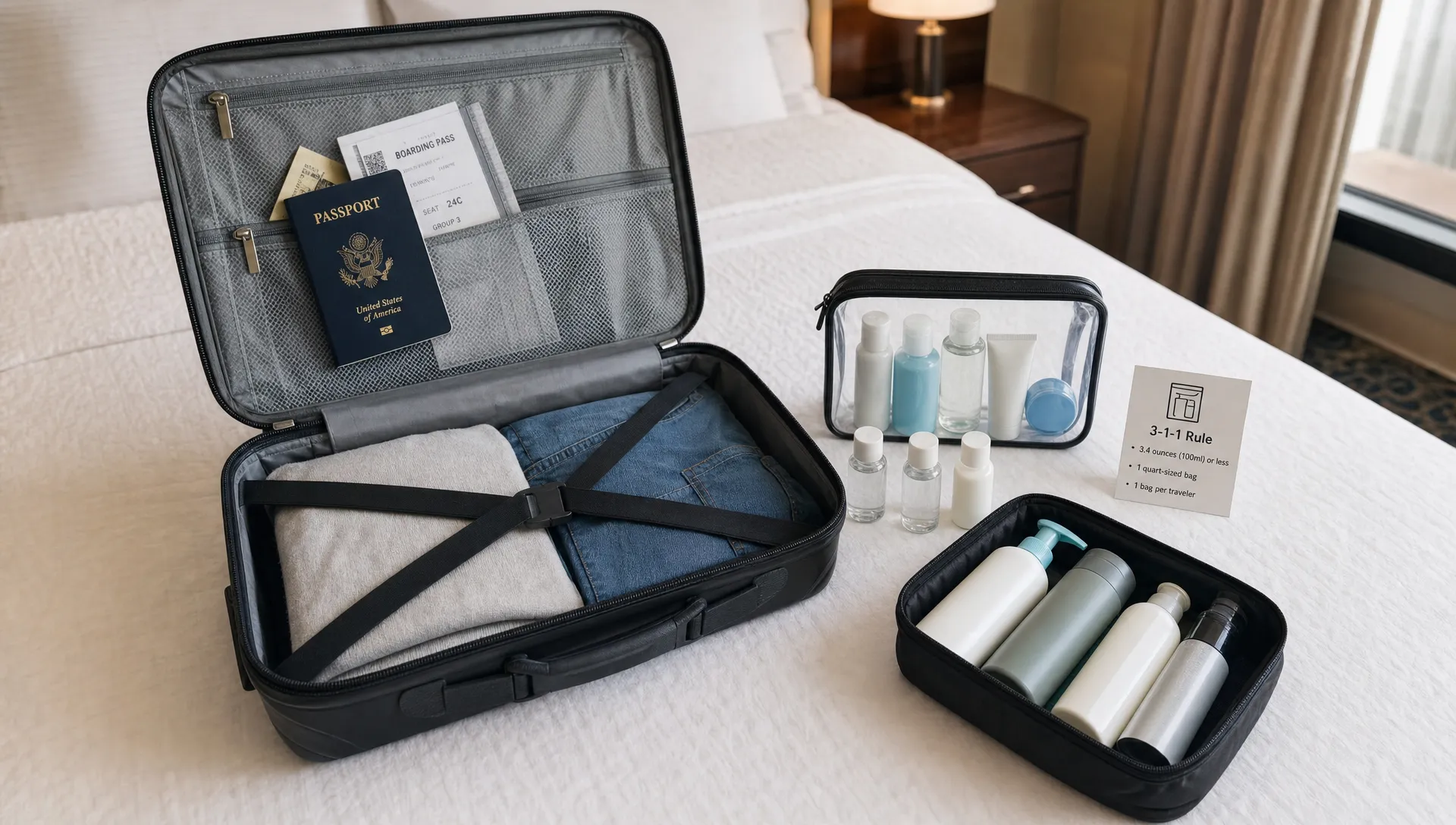
What counts as a liquid on flights?
Airport liquid rules do not only apply to water, shampoo, or perfume. Security usually treats gels, aerosols, creams, pastes, foams, and semi-liquid foods as liquids too. If an item can be poured, squeezed, sprayed, smeared, or spread, assume it may be treated as a liquid at screening.
Common examples include toothpaste, mascara, lip gloss, sunscreen, shaving foam, deodorant sprays, peanut butter, jam, honey, yogurt, soft cheese, hair gel, foundation, and hand sanitizer. Frozen liquids can be tricky because a frozen item may become partially liquid by the time you reach security.
Borderline products are where route checks help. A solid stick deodorant is usually easier than an aerosol. Powder makeup is usually easier than liquid foundation. Solid shampoo bars are often simpler than bottled shampoo. When in doubt, pack the item in your liquids bag or move it to checked baggage.
For details on checkpoint behavior, including how staff apply rules when an item is borderline, see this guide to how airport liquid rules are actually enforced.
Exceptions you should plan before the return flight
Several categories may be allowed above the normal 100ml cabin limit, but exceptions are not a free pass. They often require separate screening, and officers may ask questions or inspect the item.
Medical liquids are the most important example. Prescription medicines, medically necessary liquids, liquid nutrition, and related supplies may be permitted in larger quantities. Keep them accessible, carry prescriptions or supporting documents where appropriate, and do not bury them inside your main liquids bag.
Baby and child-related items may also receive special treatment. Formula, breast milk, baby food, and sterilized water are commonly handled separately from standard toiletries, but the exact screening process can vary by country and airport.
Duty-free liquids are another common return-trip issue. If you buy alcohol, perfume, or cosmetics after security, they may be sealed in a tamper-evident bag with a receipt. That helps, but it does not guarantee smooth passage through every transfer checkpoint. If you have a connection, especially an international connection, confirm whether your duty-free purchase will remain allowed through transit screening.
These rules are for passenger baggage, not cargo or household moves. If you are transporting product inventory, event materials, or large volumes that do not belong in airline baggage, consider freight, storage, or suppliers of shipping containers for sale instead of trying to solve a bulk transport problem at airport security.
A practical return-trip packing plan
The easiest way to avoid losing liquids at security is to pack for the way home before you leave home. That sounds cautious, but it prevents the most common mistake: flying out with a relaxed rule, buying full-size items, and then facing a stricter checkpoint on the return.
Before your trip, check each departure airport, each connection where rescreening may happen, and the return airport. If you are not sure whether you will be rescreened during a connection, assume you might be. This is especially useful on itineraries with separate tickets, terminal changes, or international-to-domestic transfers.
A simple plan works well:
- Bring a clear liquids bag that fits the 100ml rule, even if your outbound airport allows more.
- Pack refillable 100ml containers for toiletries you use daily.
- Put non-essential full-size liquids in checked baggage from the start.
- Leave space in checked baggage for liquids you might buy during the trip.
- Keep receipts and sealed duty-free bags together until your final destination.
- Choose solid alternatives for shampoo, deodorant, perfume, and sunscreen when practical.
If you are traveling carry-on only, be stricter. A full-size moisturizer bought on day three may be easy to purchase and hard to bring home. Consider buying small sizes, using hotel amenities, or planning to finish the item before your return flight.
How Liquid Limits helps with round-trip liquid rules
Liquid Limits is built for the problem travelers actually face: liquid rules are not always the same on every leg of a trip. Instead of checking one airport and hoping the answer applies everywhere, you can check your route on Liquid Limits and compare the strictest cabin liquid rule for your whole trip, including the return flight.
The tool is designed to support airport lookups, item-specific checks, and route-based liquid checks. It also includes verified source links, last-checked dates, and daily updates, so you can see when guidance was reviewed. When a rule is unknown or unclear, Liquid Limits defaults to the stricter 100ml rule, which is the safer choice for cabin packing.
This is especially useful for trips involving different airports on the outbound and inbound legs, open-jaw itineraries, multi-country holidays, work trips with separate tickets, and journeys where you plan to buy liquids before flying home.
Frequently Asked Questions
Do the same liquid rules apply on my return flight? Not always. Your return flight is screened by the airport you depart from on the way home, not by the airport where your trip began. If that return airport has stricter rules, those rules apply to your cabin bag.
Can I bring a 2L bottle if my outbound airport allows it? Only if every security checkpoint that will screen your cabin bag allows it. If your return airport or connection uses the 100ml rule, a 2L container may be refused in cabin baggage.
Are liquids in checked baggage limited to 100ml? Usually no. The 100ml rule is mainly a cabin baggage security rule. Checked baggage can often contain larger toiletries, but you still need to follow airline, hazardous goods, customs, and leak-protection requirements.
What happens if the airport rule is unclear? Pack to the 100ml standard. It is the safest fallback because many airports can enforce the stricter rule, and airport staff have the final say at the checkpoint.
Can I bring duty-free liquids through a connection? Sometimes, but not always. Keep the item sealed in its security bag with the receipt, and check the transit airport rules before buying. A connection with rescreening can create problems for large duty-free liquids.
Check the liquid rule before you pack
The best rule for round-trip travel is simple: pack for the strictest airport that will screen your cabin bag, not the most convenient rule you find first.
Before your next trip, use Liquid Limits to check your departure airport, return airport, route, and specific items. A two-minute check can help you avoid throwing away toiletries, cosmetics, drinks, or duty-free purchases at security.