
Airport liquid rules look simple until your trip includes a connection, a return flight from a different airport, or an item that is not obviously a liquid. The safest way to think about airport requirements for liquids is this: each security checkpoint enforces its own rules, and your whole route matters.
In many airports, the familiar 100ml, or 3.4 oz, container rule still applies for cabin bags. In some airports with newer screening equipment, larger containers may be allowed in certain terminals or lanes. But the permission is not universal, and it can change. If one airport on your itinerary still uses the 100ml rule, that stricter requirement is the one you should pack for.
The quick answer: what most travelers need to know
For carry-on bags, liquids usually need to be in containers of 100ml or less, placed inside a clear resealable liquids bag. The rule applies to liquids, gels, aerosols, creams, pastes, and many semi-liquid foods. The container size matters, not how much product is left inside it. A half-empty 200ml shampoo bottle can still be rejected at security.
Checked luggage is more flexible for ordinary toiletries and drinks, but it is not a free-for-all. Some liquids are restricted because they are flammable, pressurized, alcoholic, medicinal, or controlled by customs rules at your destination.
| Requirement | What it usually means | What to double-check |
|---|---|---|
| Cabin liquid container size | 100ml or 3.4 oz per container in many airports | Whether your departure, connection, and return airports allow larger containers |
| Liquids bag | Clear, resealable, and limited in size under many rules | Local bag size rules, such as 1 quart in the US or similar 1 liter bags elsewhere |
| Exemptions | Medicines, baby food, and special dietary liquids may be allowed in larger amounts | Documentation, screening procedure, and whether quantities are reasonable for the trip |
| Duty-free liquids | Often allowed if sealed in a tamper-evident bag with receipt | Transfer airport rules and whether you must pass security again |
| Checked baggage | Larger toiletries and drinks often allowed | Airline dangerous goods rules, alcohol limits, customs, and leakage prevention |
What counts as a liquid at airport security?
Airport security uses a broader definition of “liquid” than many travelers expect. It is not only water, perfume, and shampoo. If it can be poured, sprayed, squeezed, spread, smeared, or poured after warming, security may treat it as a liquid.
Common examples include:
- Shampoo, conditioner, shower gel, body wash, and liquid soap
- Toothpaste, creams, lotions, sunscreen, and gels
- Perfume, aftershave, sprays, aerosols, and roll-on products
- Mascara, liquid eyeliner, lip gloss, and many cream cosmetics
- Peanut butter, jam, honey, yogurt, sauces, dips, and soft cheese
- Contact lens solution, hand sanitizer, and mouthwash
Solid versions of products are usually easier to pack. A solid shampoo bar, stick deodorant, powder blush, or bar soap is generally not handled like a liquid. If you are unsure whether an item is liquid enough to trigger screening rules, it is worth checking an item-specific guide, such as Liquid Limits’ breakdown of which liquids you can bring on a plane.
Personal-care products deserve extra caution because labels can make them look solid when security treats them as liquids. Travelers may buy skincare, wellness, or beauty items after reading health and lifestyle resources such as Greek health, beauty, and wellness guidance, but if the product is a cream, serum, gel, spray, roll-on, balm, or paste, pack it according to the airport liquid rule.
Cabin bag liquid requirements: the details that cause problems
The most common carry-on liquid rule is often summarized as “100ml containers in a clear bag.” That summary is helpful, but the details matter.
The TSA 3-1-1 liquids rule in the United States allows travel-size containers of 3.4 oz, or 100ml, that fit in one quart-size bag. The UK government hand luggage restrictions also explain the standard 100ml container approach, with liquids placed in a transparent resealable plastic bag unless a different airport-specific process applies.
The same general pattern appears across many international airports, but the exact wording and enforcement can vary. Some airports specify the dimensions of the bag. Some require liquids to be removed from your cabin bag during screening, while others with newer scanners may tell you to leave them inside. Some allow larger containers in certain terminals, while another terminal at the same airport may still use older procedures.
The most important rule is that the container must usually be 100ml or smaller. Security officers normally look at the printed capacity on the bottle or tube. If the container says 150ml, it may fail even if only a small amount remains.
Airports with newer scanners: why you still should not assume
New computed tomography screening equipment can make liquid screening easier. At airports where these scanners are fully approved and the local authority permits it, passengers may be allowed to carry larger liquid containers and keep liquids inside their bags.
That does not mean the 100ml rule has disappeared everywhere. Scanner rollouts are uneven, rules can differ by country, airport, terminal, and lane, and temporary restrictions can be reinstated. If your outbound airport allows larger liquids but your return airport does not, you could be forced to throw away the same item on the way home.
This is why route checking matters more than a single airport search. Before packing full-size toiletries in your cabin bag, check every security point you expect to pass through, including your connection and return. Liquid Limits keeps an airport liquid rules directory with airport-level guidance, source links, and last-checked dates so you can see the rule that applies before you pack.
Exemptions for medicine, baby food, and dietary needs
Most liquid rules include exemptions for essential items. These exemptions are important, but they are not blank checks.
Medicines in liquid, gel, cream, spray, or injectable form may be allowed above the usual 100ml limit when they are needed for the trip. Examples include prescribed liquid medicine, insulin, medical gels, and some over-the-counter products. It is wise to keep medicine in original packaging when possible and carry a prescription, doctor’s note, or pharmacy label if the item could raise questions.
Baby milk, formula, sterilized water, baby food, and breast milk are commonly treated separately from ordinary liquids. Security may screen them with additional equipment, and officers may ask you to remove them from your bag. Rules for frozen breast milk, cooling packs, and traveling without a child can vary, so check official guidance for the airports on your route.
Special dietary liquids may also qualify in some cases, especially when medically necessary. However, “I prefer this drink” is not the same as “I need this for medical or dietary reasons.” Pack only reasonable quantities, separate them for screening, and expect additional checks.
Duty-free liquids and airport purchases
Liquids bought after security are usually allowed onto the plane because they were purchased in the secure area. The complication appears when you have a connecting flight and must pass through security again.
Many international airports use sealed security tamper-evident bags, often called STEBs, for duty-free liquids. These bags typically include the receipt and should remain sealed until you reach your final destination. If you open the bag during your journey, transfer security may treat the contents like ordinary liquids.
Duty-free alcohol, perfume, and cosmetics can still be subject to airline, customs, or destination rules. A bottle that is allowed through airport security may still be restricted for import, especially if it contains alcohol or food ingredients. If you are connecting through another country, check both the transfer airport rules and your final destination allowances.
Checked baggage liquid rules
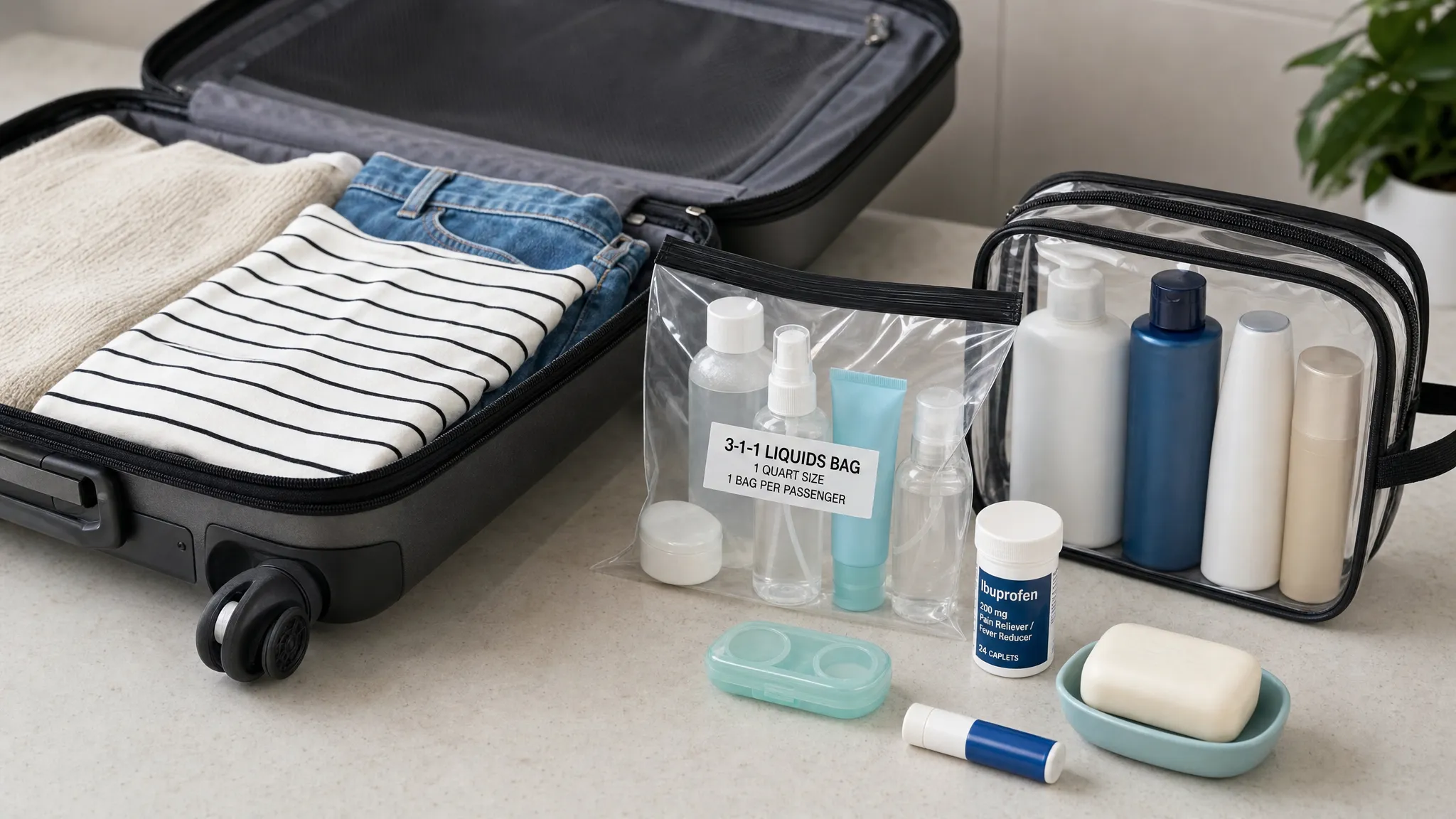
Checked baggage is usually the best place for full-size shampoo, conditioner, sunscreen, sauces, and other nonessential liquids that exceed 100ml. Since checked bags do not pass through the same passenger checkpoint, the cabin liquids bag rule does not apply in the same way.
Still, checked luggage has its own restrictions. Flammable liquids, fuels, paint thinners, many chemical products, and some high-proof alcohols may be banned or limited. Aerosols can be restricted because they are pressurized, even if they are ordinary toiletries. Alcoholic drinks may be limited by alcohol percentage and total quantity, depending on the airline, country, and aviation safety rules.
Leakage is another practical issue. Pressure and rough handling can cause bottles to open. Use caps that close tightly, place liquids in sealed bags, and avoid packing fragile glass bottles near the edge of your suitcase. For valuable clothing, double-bag anything that could stain.
| Liquid type | Cabin bag approach | Checked bag approach |
|---|---|---|
| Shampoo and conditioner | Use 100ml travel containers unless your airport clearly allows more | Usually fine in larger bottles if sealed well |
| Sunscreen and lotion | Treated as liquids or creams | Usually fine, but pack to prevent leaks |
| Aerosol deodorant or hairspray | Must meet cabin liquid and aerosol rules | Often allowed in limited personal-use quantities, but check airline rules |
| Perfume | 100ml container limit usually applies in cabin bags | Usually allowed, but protect glass bottles |
| Alcohol | Small bottles must meet cabin liquid rules unless duty-free rules apply | Subject to alcohol strength, quantity, airline, and customs rules |
| Sauces, honey, jam, and spreads | Treated as liquids, gels, or pastes | Often better in checked luggage, but check customs restrictions |
Why your route matters more than your origin airport
A common packing mistake is checking only the departure airport. That may work for a nonstop one-way trip, but it is risky for round trips and connections.
Consider a traveler flying from Airport A to Airport B, then returning from Airport B a week later. Airport A may allow larger liquids because it uses approved scanners, while Airport B may still enforce the 100ml rule. If the traveler brings a 250ml sunscreen in the cabin bag on the outbound flight, it may be confiscated on the return.
Connections create another layer. If you land, leave the secure transit area, change terminals, or enter a country before your next flight, you may need to clear security again. That second checkpoint may apply a stricter rule than your first airport. This is especially important for duty-free liquids and full-size toiletries bought during a layover.
For a deeper explanation of how checkpoint enforcement works, including why “the same item” can pass one airport and fail another, see Liquid Limits’ guide to how the liquid rule at the airport really works.
A simple packing strategy that works in 2026
If you want the lowest-risk approach, pack as if the strictest airport on your route still applies the 100ml rule. That may feel conservative, but it protects you from scanner differences, unclear airport guidance, sudden operational changes, and return-flight surprises.
Use this practical approach before each trip:
- Put essential cabin liquids in containers marked 100ml or smaller.
- Place liquids, gels, creams, pastes, aerosols, and spreadable foods in a clear resealable bag if your airport requires one.
- Move full-size toiletries, sauces, and nonessential liquids to checked luggage.
- Keep medicines and baby liquids separate and easy to present for screening.
- Leave duty-free liquids sealed in the official tamper-evident bag with the receipt.
- Check connection and return airports, not just the first departure airport.
- When rules are unclear, assume the stricter 100ml limit.
The final point is the one that saves the most stress. Airport websites, airline pages, and government guidance are not always updated at the same time. If you cannot verify a larger allowance from an official source close to your travel date, packing to the 100ml standard is the safer choice.
Common items travelers get wrong
Some items are surprisingly easy to mispack because they do not look like ordinary liquids. Mascara is small, but it is still generally treated as a liquid or gel. Peanut butter feels like food, but it spreads, so it can fall under liquid rules. Snow globes contain liquid. Gel ice packs may be allowed only when needed for medical or baby items, or when frozen solid under certain rules.
Food is another frequent problem. Solid snacks are usually easier than dips, sauces, soups, yogurt, or soft cheese. Even if security allows a food item, customs may restrict it when you arrive, especially for meat, dairy, fruit, seeds, and plant products.
Makeup also needs sorting. Powder products are usually simpler. Liquid foundation, cream blush, lip gloss, mascara, setting spray, and gel products should be packed with liquids. If you are trying to save space in your liquids bag, swap liquid products for solid versions where possible.
Frequently Asked Questions
Are airport requirements for liquids the same everywhere? No. Many airports still use the 100ml cabin liquid rule, but some airports or terminals may use newer scanners and apply different procedures. Always check your departure, connection, and return airports.
Does the 100ml rule apply to the amount inside the bottle or the bottle size? It usually applies to the container size. A 200ml bottle that is almost empty can still be rejected because the printed capacity is over the limit.
Can I bring medicine over 100ml in my cabin bag? Often yes, if it is needed for your journey, but it may require additional screening. Keep it accessible, carry supporting documentation when useful, and check the airports on your route.
Can I take full-size shampoo in checked luggage? In most cases, yes. Ordinary toiletries are usually better in checked baggage if they exceed 100ml, but you should seal them carefully and check airline rules for aerosols or restricted products.
What should I do if one airport says 2L is allowed and another says 100ml? Pack for the stricter 100ml rule if the item must stay in your cabin bag for the whole trip. A larger allowance at one airport does not guarantee acceptance at another checkpoint.
Check before you pack
Liquid rules are no longer something you can safely judge from memory. Scanner upgrades, local procedures, return flights, and item-specific exceptions all affect what you can bring.
Before your next trip, use Liquid Limits to check airport liquid rules by airport, item, and route. It shows the stricter rule for your trip, includes source links and last-checked dates, and defaults to the safer 100ml rule when requirements are unclear.