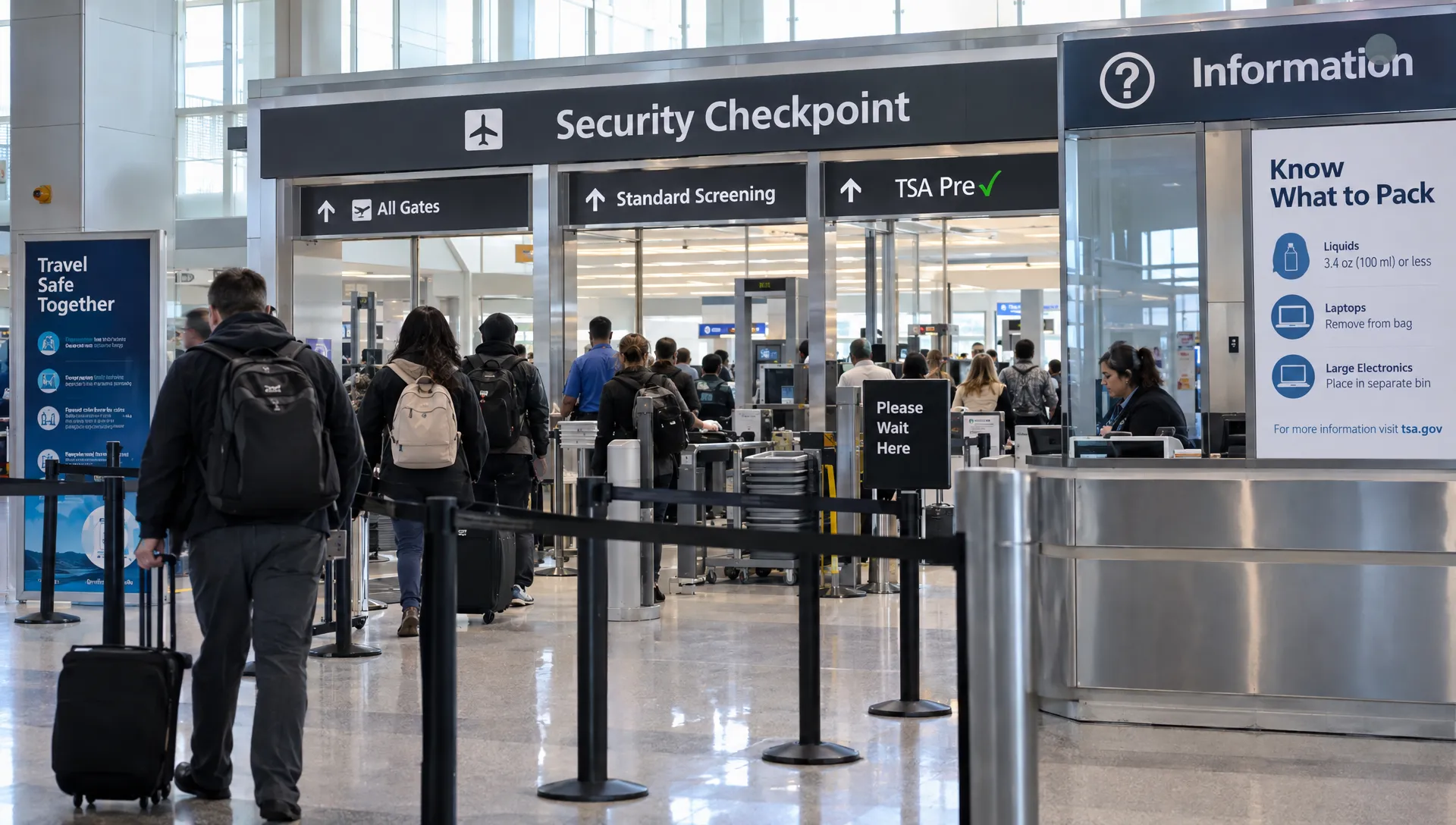
A shampoo bar and a shampoo bottle do the same job in your bathroom, but airport security may treat them differently. Airport rules for toiletries depend on the product’s physical form, its container and sometimes its ingredients, not simply whether you call it shampoo, deodorant or skincare. A solid stick can fall outside the liquid allowance, while a gel version of the same product belongs inside it.
The most useful packing approach is to compare formulations before choosing travel sizes. This guide explains the differences that affect everyday toiletries, separates security restrictions from aviation safety rules and shows how to pack for every checkpoint on your trip.
Start with two different sets of rules
Toiletries can be subject to two separate checks: security rules about liquids in cabin baggage and dangerous-goods rules about what can safely travel on an aircraft.
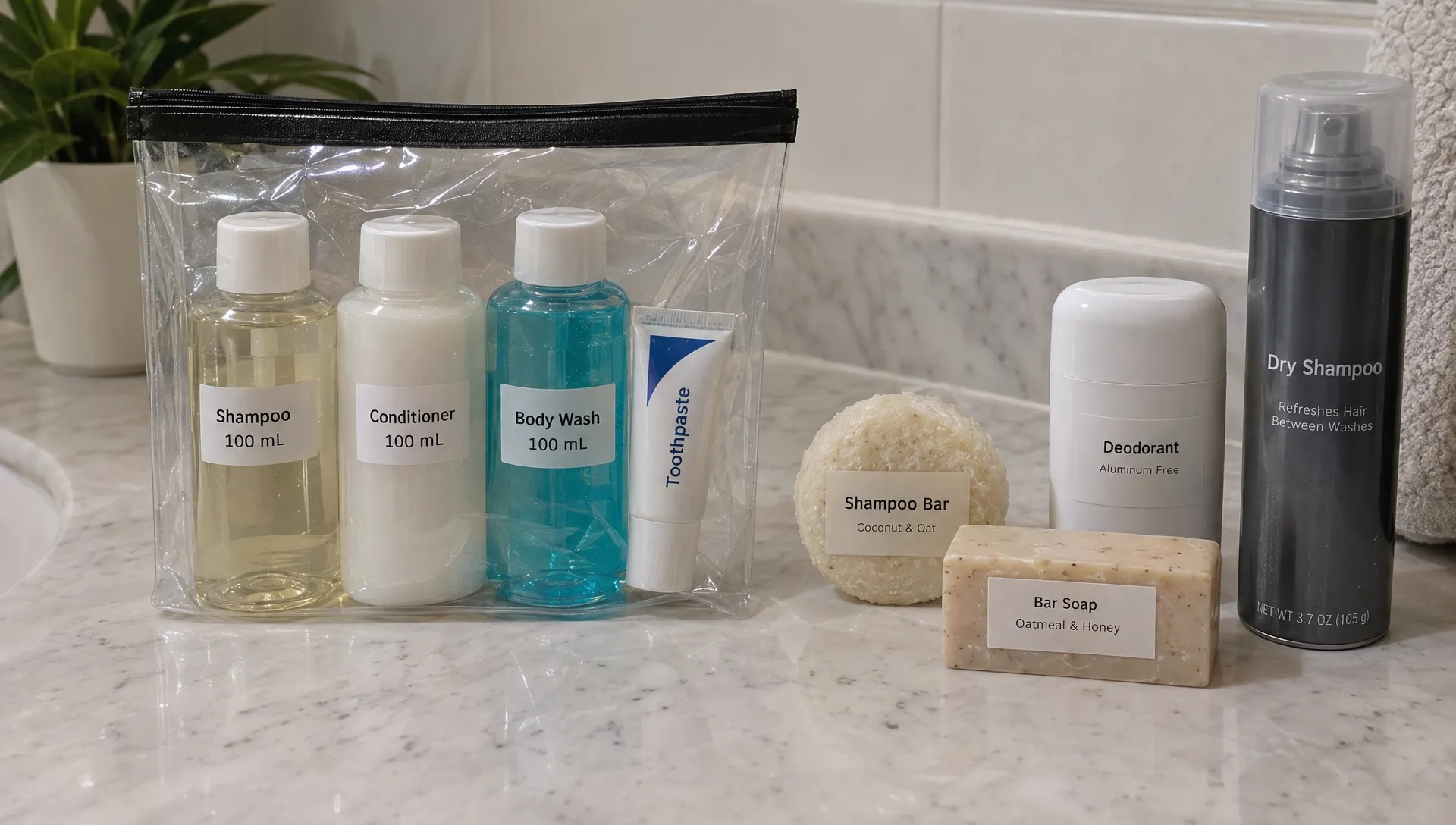
Under the standard TSA liquids rule, liquids, aerosols, gels, creams and pastes must fit in containers of 3.4 fluid ounces (100 mL) or less. Those containers go in one quart-sized, clear, resealable bag per passenger. Other countries may specify a one-liter bag instead, so the bag requirement is not identical everywhere.
Aviation safety rules address hazards such as pressurized containers and flammable substances. These can apply to both carry-on and checked baggage. Moving something into a checked suitcase does not automatically make it permissible.
When checking airport rules for toiletries, establish both whether the product counts toward the cabin liquid allowance and whether it has separate transport restrictions. Liquid capacity alone cannot answer both questions. The broader distinction is explained in our guide to airport rules that affect what you can pack.
Compare formulations, not just product names
“Deodorant,” “cleanser” and “sunscreen” describe a purpose, not a security category. The same product family can contain solids, liquids, gels or aerosols.
The table below assumes a checkpoint using the standard 100 mL liquid restriction. Where an airport permits larger containers, its local allowance takes precedence, but the product’s classification still matters.
| Product family | Usually outside the liquid allowance | Usually inside the liquid allowance | Detail to check |
|---|---|---|---|
| Hair washing | Solid shampoo bar | Liquid shampoo, conditioner or conditioning cream | A thick formula is not necessarily solid |
| Deodorant | Truly solid stick or crystal | Roll-on, gel, cream or aerosol | A twist-up package can contain gel |
| Sun protection | Truly solid sunscreen stick | Sunscreen lotion, cream or spray | Spray products may have additional safety rules |
| Lip care and makeup | Solid lipstick or solid lip balm | Lip gloss, mascara, liquid lipstick or soft cream balm | “Balm” does not identify the physical form |
| Facial cleansing | Bar soap or dry cleansing powder | Cleansing milk, gel cleanser or cleansing oil | A product mixed with water before screening becomes liquid |
| Dental care | Dry toothpaste tablets | Toothpaste, tooth gel or mouthwash | A nearly empty oversized tube can still fail the size rule |
| Shaving | Solid shaving soap | Shaving gel, foam or cream | Pressurized foam is also an aerosol |
For airport rules for toiletries, the practical question is what is inside the package at screening, not what the label calls it. A product advertised as “waterless” can still be a paste, cream or oil.
Creams, balms and thick products
Thickness does not create an exemption. Toothpaste, body butter, hair pomade and cream cleanser can be subject to liquid restrictions even when they do not pour.
Treat spreadable creams, gels and pastes as part of your liquid allowance unless the relevant authority explicitly says otherwise. A genuinely solid lotion bar is different from lotion in a jar, but “solid” should describe the product itself, not merely its packaging.
Container shape is especially misleading with deodorants and lip products. A twist-up tube may hold a solid stick, an extruded gel or a soft cream. Read the formulation description before buying a supposedly security-friendly replacement.
For dental products, our explanation of toothpaste tube sizes and airport checks covers why an oversized tube with only a little paste remaining can still be a problem.
Dry powders and products activated with water
Dry shampoo powder, loose face powder and powdered cleanser are not liquids simply because you use them on your body. Keep them dry until after screening if you want them assessed in that form.
However, being outside the liquid allowance does not mean a product is exempt from inspection. The TSA’s powder guidance says powder-like substances larger than 12 oz (350 mL) must be placed in a separate bin for X-ray screening and may require additional inspection. That is a separate screening threshold, not the familiar 100 mL liquid-container limit.
Airport rules for toiletries can therefore treat two versions of a cleanser differently: a dry powder may receive powder screening, while the same powder mixed into a liquid cleanser must meet the applicable liquid rules. Original packaging can help identify the product, although it does not guarantee clearance.
Aerosols have an extra layer of restrictions
Spray deodorant, aerosol dry shampoo and pressurized shaving foam require more than a liquid-bag check. Their pressurized packaging also brings aviation safety limits into play.
For travel covered by US rules, the FAA’s guidance on medicinal and toiletry articles sets a maximum of 0.5 kg or 500 mL for each qualifying article and a combined maximum of 2 kg or 2 L per person. Aerosol release devices must be protected by a cap or another suitable means to prevent accidental discharge.
These are dangerous-goods limits, not permission to take a 500 mL aerosol through a standard 100 mL cabin checkpoint. At that checkpoint, a permitted toiletry aerosol still needs to satisfy the smaller cabin-container limit and fit in the liquid bag.
A pump spray is different from a pressurized aerosol, but its liquid contents still count toward the cabin allowance. Ingredients can also affect transport restrictions. Do not assume that every spray sold alongside toiletries qualifies for the same exemption.
Applying airport rules for toiletries correctly means checking both layers. A small aerosol might meet the cabin size limit yet need a protective cap, while a larger qualifying aerosol might be suitable only for checked baggage under the applicable rules.
Container capacity matters more than the amount left
At checkpoints applying the standard restriction, use containers with a capacity of 100 mL or less. A 200 mL bottle holding 40 mL of shampoo is still a 200 mL container.
This distinction matters with nearly empty moisturizer jars, oversized toothpaste tubes and refillable travel bottles. Buy containers with clearly marked capacities rather than relying on how small they look. Keep any manufacturer markings readable.
For ordinary toiletries that may safely be decanted, transfer enough for the trip into suitable smaller containers. Do not attempt to refill a pressurized aerosol can or transfer a product whose packaging carries handling instructions that make decanting unsuitable. For medication, retaining its labeled packaging can help with identification and correct use.
Bag capacity also matters. Ten individually compliant bottles may still be unsuitable if the required resealable bag cannot close. Choose what fits comfortably rather than treating every empty corner as an allowance to fill.
Airport rules for toiletries are easiest to follow when each container’s capacity is clear and the complete collection fits the checkpoint’s required bag. A “travel-size” label by itself is not proof of compliance.
Medicated toiletries need a purpose-based check
Some bathroom products are also medically necessary liquids, such as certain prescribed skin treatments. That can change how they are handled, but a medical-sounding label does not automatically exempt a product.
TSA allows medically necessary liquids in reasonable quantities exceeding 3.4 ounces for the trip. They do not need to go in the standard quart-sized liquids bag, but you must tell the officer about them at the start of screening. Additional screening may be required.
Other jurisdictions have their own exemption conditions and may require supporting evidence. Check the departure authority’s instructions before relying on an exception, particularly if you need a large container of a prescribed cream or treatment shampoo.
Do not assume ordinary sunscreen, acne cleanser or cosmetic moisturizer qualifies simply because it has a health-related benefit. For airport rules for toiletries, the relevant distinction is whether the product meets the local medical exemption, not whether its branding says “clinical” or “therapeutic.”
Keep essential treatment accessible and identifiable. If you are uncertain about whether you can decant it, ask a pharmacist rather than changing its packaging solely to save space.
Your departure airport is only one checkpoint
Some airports permit larger liquid containers under their local screening arrangements, while others retain the standard 100 mL restriction. Equipment upgrades do not justify assuming a particular allowance. Follow the airport’s published passenger guidance.
For example, UK government guidance on hand-luggage restrictions directs travelers to check the airport because liquid allowances and screening procedures can differ. Whether liquids must be removed from your bag is also a separate question from how much you can carry.
Map your toiletries against every airport where you will pass through security. A connection may involve another check, and your return airport may apply a stricter rule than your outbound airport. If you stay airside without further screening, that connection does not necessarily introduce another checkpoint.
The safest way to apply airport rules for toiletries across a trip is to pack for the strictest confirmed checkpoint. A larger bottle allowed outbound may still be unsuitable for the flight home. When the rules are unclear, choosing containers of 100 mL or less avoids relying on an unverified larger allowance.
Build a kit that works across product types
Start with what you actually need, then choose formulations that reduce pressure on the liquid bag without compromising use. Solid soap, a solid shampoo bar and a genuinely solid deodorant may leave room for products you prefer in liquid form, such as sunscreen or conditioner.
Keep products that require special handling separate in your planning: medically necessary treatments, powders that could receive extra screening and aerosols with caps or quantity restrictions. They should not be evaluated solely by whether they fit in a toiletries pouch.
Before packing, check the product’s physical form, the container’s marked capacity and any safety instructions. Then confirm the allowance at each relevant airport. These checks are more dependable than buying everything from a store’s travel section.
Choosing a solid alternative is optional, not a requirement. The goal is a kit that meets the rules and remains useful throughout your trip, including the journey home.
Frequently asked questions
Does stick deodorant count as a liquid? A genuinely solid stick generally does not count toward the liquid allowance. Gel deodorant can still count even when it comes in a similar twist-up package, so check the contents rather than the container shape.
Do airport rules for toiletries allow a half-empty bottle larger than 100 mL? Not at a checkpoint applying the standard 100 mL container limit. The container’s capacity matters, not the quantity remaining. Use a compliant smaller bottle or check whether the item can travel in checked baggage.
Are all toiletries unrestricted in checked baggage? No. The cabin liquid-bag restriction generally does not apply there, but dangerous-goods restrictions still do. Qualifying aerosols have quantity and accidental-discharge requirements, and some substances may be prohibited entirely.
Does a new scanner mean I can bring full-size toiletries? No. Scanner equipment alone does not establish the passenger allowance. Check the airport’s published container limits and packing instructions for your departure, any connection requiring security and your return flight.
Check your whole trip before packing
Use Liquid Limits to check your route’s liquid rules before choosing your toiletries. Compare outbound and return airports, review item-specific guidance and follow the linked sources and last-checked dates. Where rules are unclear, Liquid Limits defaults to the stricter 100 mL rule so your packing plan does not depend on an uncertain allowance.