
Airport rules affect your packing long before you reach the X-ray belt. A bag that looks perfectly reasonable at home can become a problem at security, during a connection, at customs, or on the return flight. The tricky part is that “airport rules” are not one single rulebook. They are a stack of security, airline, safety, customs, and local airport requirements that can change depending on where you fly.
For most travelers, the safest packing mindset is simple: pack for the strictest checkpoint and the most restrictive leg of your trip, not just your departure airport. That matters for liquids, but also for batteries, food, medicines, duty-free shopping, sports gear, and everyday items that seem harmless until they are screened.
Below is a practical guide to the airport rules that most often affect what you can pack, how to decide between carry-on and checked baggage, and what to verify before you leave for the airport.
The rule layers that decide what can go in your bag
When an item is removed at the airport, travelers often blame “the airline.” In reality, the airline is only one piece of the decision. Several rule layers can apply to the same item.
| Rule layer | What it controls | Packing impact |
|---|---|---|
| Airport security | Screening of passengers and cabin bags | Liquids, gels, aerosols, sharp items, powders, tools, electronics |
| Aviation safety rules | Hazardous materials on aircraft | Lithium batteries, fuel, compressed gases, flammable items |
| Airline baggage policy | Size, weight, cabin bag allowance | Whether an item can travel in the cabin or must be checked |
| Customs and agriculture rules | What can enter a country | Food, plants, seeds, animal products, high-value goods |
| Local airport procedures | How rules are enforced at that airport | Scanner rules, bag removal instructions, temporary restrictions |
This is why an item can be legal to own, legal to fly with in checked baggage, but still not allowed through the cabin security checkpoint. It is also why a route with two airports can be more restrictive than a simple one-way flight.
A good rule of thumb is to ask: Where will this item be screened, and by whom? If it goes through passenger security, cabin rules matter. If it goes in the hold, checked baggage and dangerous goods rules matter. If it crosses a border, customs rules may matter even if security allows it.
Carry-on and checked bags follow different logic
Airport packing mistakes often happen when travelers assume “allowed on a plane” means “allowed in my carry-on.” These are not the same thing.
Carry-on rules focus on what passengers can access during the flight. Checked baggage rules focus more on aircraft safety, baggage handling, and hazardous materials. Some items are safer in checked baggage because passengers cannot access them. Others must stay in the cabin because crew members can respond if there is a problem.
| Item type | Usually best in carry-on | Usually best in checked baggage | Why it matters |
|---|---|---|---|
| Travel-size liquids | Yes, if within the local liquid limit | Yes, often with more flexibility | Cabin liquid rules are stricter at security |
| Full-size toiletries | Usually no | Often yes | Containers over the cabin limit may be refused at screening |
| Spare lithium batteries and power banks | Yes | Usually no | Spare batteries are generally kept in the cabin for safety monitoring |
| Knives and many sharp tools | No | Often yes | Sharp items are restricted in the cabin |
| Prescription medicine | Yes | Only if you can afford separation risk | You may need it during travel or if checked baggage is delayed |
| Dry snacks | Often yes | Often yes | Customs or agriculture rules may still apply on arrival |
In the United States, the TSA “What Can I Bring?” database is a useful reference for many item categories. For batteries, the FAA PackSafe guidance explains why spare lithium batteries and power banks usually belong in carry-on baggage rather than checked bags.
Liquid airport rules still cause the most packing problems
Liquids, gels, aerosols, creams, and pastes are the classic airport rules problem because they include more items than many travelers expect. Shampoo is obvious. Toothpaste, mascara, peanut butter, sunscreen, lip gloss, shaving gel, and some soft foods are less obvious.
At many airports, the standard cabin rule is still based on small containers, commonly 100 ml or 3.4 oz each, placed in a clear resealable bag. Some airports with newer screening equipment may allow different handling or larger containers, but that does not mean every airport on your route will do the same. If your return airport or connecting airport applies the stricter rule, your full-size bottle can still be refused.
This is where route planning matters. If you are packing toiletries for a round trip, check both directions before choosing container sizes. Liquid Limits lets you compare airport liquid limits for carry-ons in 2026 and understand when the stricter 100 ml approach is still the safer choice.
The most reliable packing strategy is to put anything spreadable, pourable, sprayable, squeezable, or gel-like into one of three categories: cabin-safe travel size, checked baggage, or buy after security. If the rule is unclear for any airport on your route, assume the smaller cabin limit applies.
Batteries, power banks, and electronics have safety rules, not just security rules
Modern packing lists are full of batteries: phones, laptops, tablets, cameras, e-readers, headphones, vapes, smart luggage, portable chargers, and spare camera batteries. These items are governed by aviation safety rules because lithium batteries can overheat if damaged or defective.
The practical airport rule is that spare lithium batteries and power banks generally need to travel in carry-on baggage, with terminals protected from short circuiting. Installed batteries in devices are often allowed in carry-on and checked baggage, although airlines may set limits and may require devices to be powered off in checked bags.
Smart luggage deserves extra attention. If the bag has a removable lithium battery, many airlines require the battery to be removed before the bag is checked. If the battery cannot be removed, the bag may be refused. Since airline policies can differ, verify this before buying or packing a smart suitcase.
Vapes and e-cigarettes are another common issue. They are typically not allowed in checked baggage because of battery and fire risks, and they cannot be used on board. Liquids or pods for vaping may also be subject to cabin liquid limits.
Sharp objects, tools, sports gear, and outdoor items
Some airport rules are based on whether an item could be used as a weapon in the cabin. This is why small differences in item type, blade length, or tool design can change the decision at screening.
Knives, box cutters, multi-tools with blades, corkscrews with blades, darts, ice axes, and many martial arts items should usually go in checked baggage. Scissors, nail clippers, knitting needles, and small tools may be treated differently depending on the country and airport, so do not rely on assumptions from a previous trip.
Tools are especially easy to mispack. A screwdriver or wrench that seems harmless in a home repair kit may be restricted in the cabin if it exceeds local limits or looks like it could be used as a weapon. If you are traveling for work with tools, pack them in checked baggage when possible and verify airline weight limits.
Sports and outdoor items can create a second problem: they may be allowed by security but restricted by the airline because of size or special handling requirements. Hiking poles, ski poles, tent stakes, scuba gear, fishing rods, and camping stoves all need extra checking. Fuel, lighter fluid, and many compressed gas canisters are usually much more restricted than the equipment itself.
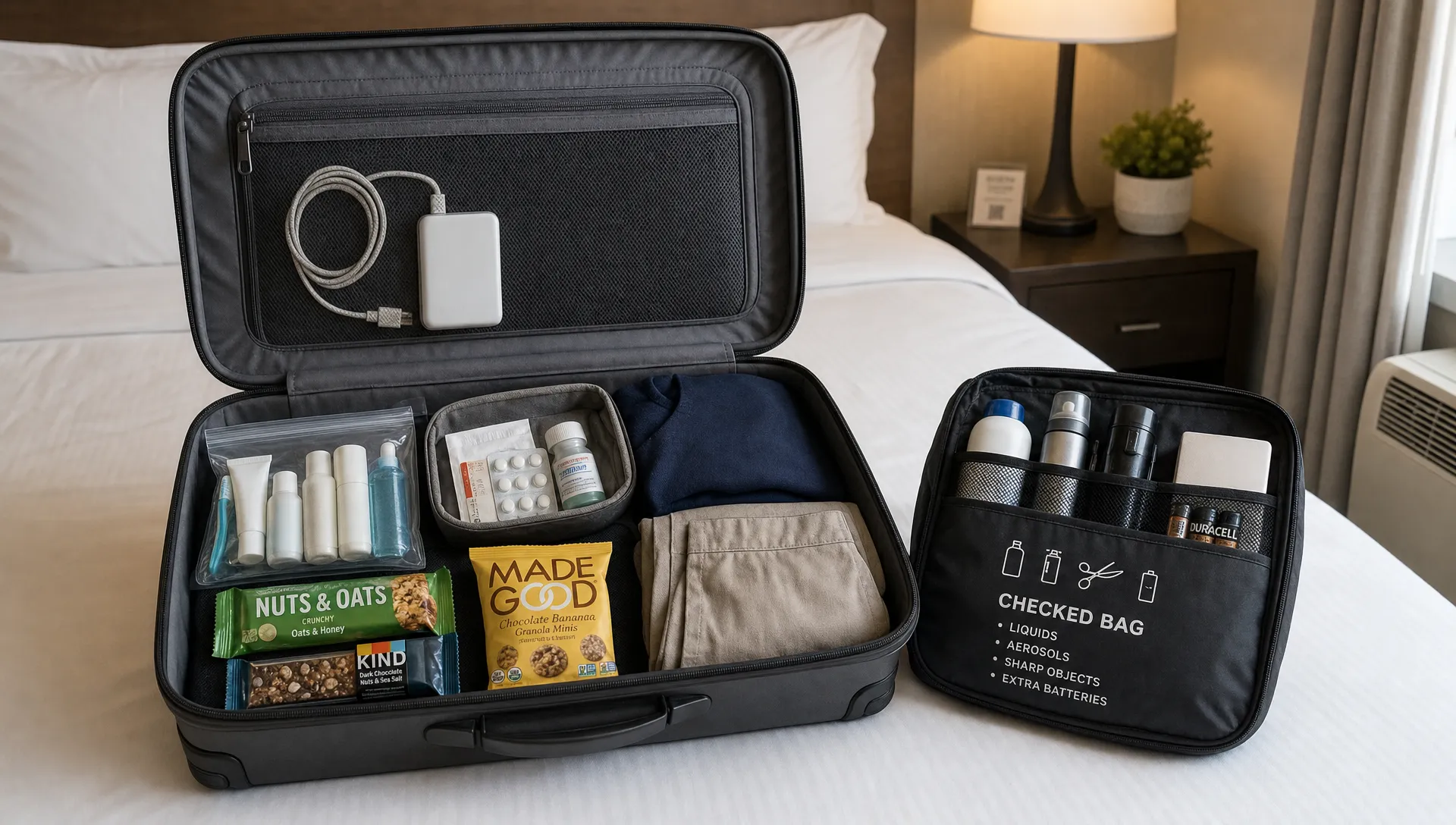
Food, powders, and agricultural rules can surprise travelers
Food often passes airport security if it is solid, but that does not mean it can enter the destination country. The difference between security rules and customs rules is important.
Solid snacks like crackers, granola bars, candy, and sealed dry foods are generally easier to travel with than spreads, sauces, soups, yogurts, jams, and dips. Anything that behaves like a liquid or paste may be treated as a liquid at cabin screening. Powders can also receive extra screening in some countries, especially in larger quantities.
Customs and agriculture rules are a separate issue. Fresh fruit, meat, dairy, seeds, plants, and homemade foods may be restricted or require declaration when entering another country. Even if an item was sold at the departure airport, it may still be subject to arrival rules.
If you are unsure about food, keep it sealed, keep receipts when possible, and declare it when required. Failure to declare agricultural items can lead to delays, confiscation, or fines in some countries.
Medicines, baby items, and accessibility supplies often have exceptions
Airport rules usually include exceptions for medically necessary liquids, baby food, infant formula, breast milk, and certain accessibility-related items. However, “exception” does not mean “no screening.” It usually means the item can exceed ordinary cabin liquid limits if it is reasonable for the trip and presented properly at security.
Pack essential medicine in your carry-on, not in checked baggage. Keep prescriptions in original packaging when practical, and bring supporting documentation for items that may raise questions, such as injectable medication, cooling packs, liquid nutrition, or medical equipment.
For baby travel, formula, breast milk, baby food, and cooling accessories may be allowed in quantities above standard liquid limits, but they may be screened separately. Give yourself extra time and tell the security officer what you are carrying before screening begins.
Accessibility supplies should also be packed with screening in mind. CPAP machines, mobility aids, medically necessary gels, and dietary liquids may need separate inspection. If an item is essential, do not bury it at the bottom of a tightly packed bag.
Duty-free liquids and connecting flights are a common trap
Duty-free shopping can make liquid rules feel more flexible than they really are. You may be allowed to buy a bottle of perfume, alcohol, or cosmetics after security, but the rules can change if you have a connecting flight and must pass through security again.
Many airports use tamper-evident security bags for duty-free liquids, often with a receipt inside. These can help during transfers, but they are not a universal guarantee. If your itinerary includes a connection, especially between countries or terminals, check whether you will need to clear security again.
The safest approach is to buy duty-free liquids only when you are confident they will not be rescreened under stricter rules. If your journey includes multiple airports, your final security checkpoint is just as important as your first one.
Return flights can have different airport rules
A common packing mistake is checking only the outbound airport. Your return airport may use different scanners, enforce different liquid limits, or apply different local procedures. This matters if you plan to bring back full-size toiletries, cosmetics, alcohol, sauces, souvenirs, or gifts.
For round trips, check both legs before you pack. If Airport A allows a larger liquid container but Airport B follows the 100 ml rule, the return flight can be the limiting factor. The same logic applies to connections: one strict transfer checkpoint can determine what belongs in your cabin bag for the whole journey.
Liquid Limits is built around this exact problem. You can check rules for liquids on flights and return trips so you are not surprised by a different rule on the way home.
A simple packing workflow before you fly
Before closing your bag, run through a quick airport rules check. This takes a few minutes and can prevent expensive or frustrating confiscations.
- Separate cabin items from checked items first, then apply security rules to the cabin pile.
- Treat anything liquid, gel, paste, cream, spray, or spreadable as a liquid unless a current airport source says otherwise.
- Put spare batteries, power banks, vapes, essential medicine, travel documents, and valuables in carry-on baggage.
- Put sharp items, large tools, and most full-size toiletries in checked baggage when allowed.
- Check food, plant, animal, and agricultural items against destination rules, not only departure security rules.
- Verify duty-free plans if your route includes a connection or security rescreening.
- Recheck rules close to departure, because airport procedures can change.
If you want one place to start, use Liquid Limits to check airport liquid rules by trip and compare the stricter rule across your route. The tool includes airport, item, and route checks, with source links and last-checked dates so you can pack with current guidance rather than old assumptions.
Frequently Asked Questions
Do airport rules depend on the country or the airport? Yes. Many rules are set at the national or regional level, but local airport equipment and procedures can affect how those rules are applied. Always check the airports on your actual route.
Can I pack full-size liquids in checked baggage? Often yes, but not always. Ordinary toiletries are usually easier in checked baggage, while hazardous liquids, flammable products, and pressurized items may be restricted. Cabin bags are usually where the strict 100 ml style rules apply.
Are power banks allowed in checked luggage? In general, spare lithium batteries and power banks should travel in carry-on baggage, not checked baggage. Airlines may also set capacity limits, so verify before flying with large power banks.
Why was an item allowed on one flight but not another? Different airports, countries, scanners, and security officers can apply different rules or levels of screening. A connecting airport or return airport may also be stricter than your departure airport.
What should I do if an airport rule is unclear? Pack conservatively. For liquids, that usually means using travel-size containers that comply with the stricter 100 ml approach, or placing the item in checked baggage if it is allowed there.
Pack for the strictest airport, not the easiest one
The best packing decisions come from thinking about your whole trip, not just the first airport. Liquids, batteries, food, sharp objects, medicines, and duty-free purchases can all be affected by different rule layers.
Before you pack, check the exact airports, route, items, and return flight. If a rule is unclear, choose the stricter option. That small step can save you from repacking at security, losing an expensive item, or discovering too late that your return airport follows different rules.