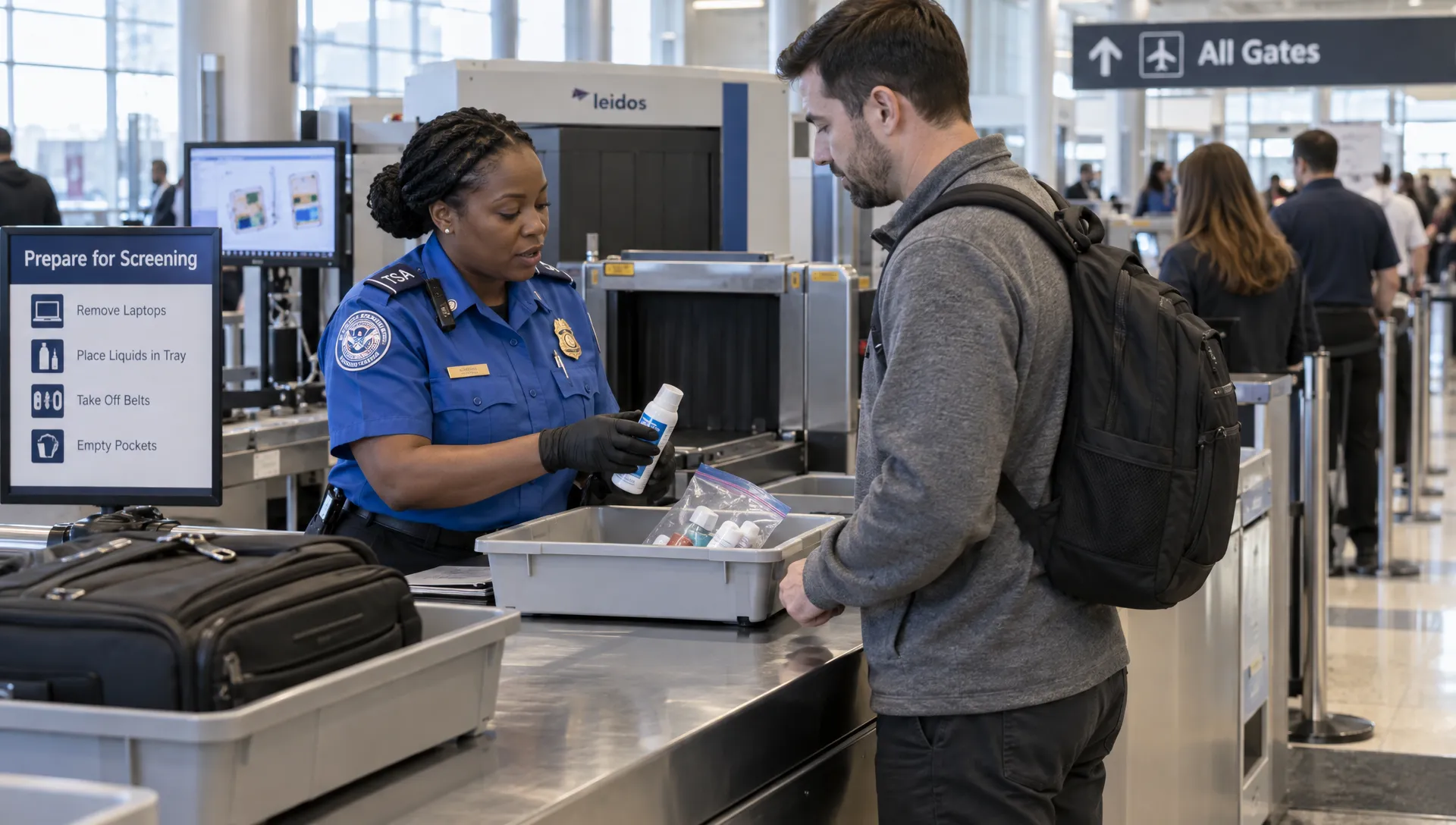
Are carry on luggage toiletries allowed in any size? No, not as a general rule. At a checkpoint applying the standard liquid restriction, shampoo, lotion, toothpaste and similar products must be in containers holding no more than 100 ml (3.4 fl oz). Some airports permit larger containers, while qualifying medical supplies may receive an exemption. The right answer depends on the product, the bottle’s capacity and every security checkpoint on your trip, including the return journey.
The quick answer: check the container, not just the contents
For ordinary liquid toiletries, a bottle’s maximum capacity determines whether it meets a container-size restriction. How much product remains inside does not change that capacity.
| What you want to pack | At a checkpoint applying a 100 ml container limit |
|---|---|
| A 100 ml shampoo bottle | Meets the container-size requirement, subject to the liquids-bag rule |
| A 250 ml shampoo bottle containing only 50 ml | Does not meet the container-size requirement |
| A 75 ml tube of toothpaste | Meets the container-size requirement and belongs with your liquids |
| A genuinely solid soap bar | Is not subject to the liquid-container limit |
| A medically necessary liquid above 100 ml | May qualify for an exemption, with additional requirements |
| A full-size toiletry aerosol | Must meet both the liquid rule and separate aerosol safety restrictions |
A compliant bottle is only part of the check. Your liquid containers must also fit within the applicable bag allowance. The total liquid allowance in a carry-on is a separate question from whether one bottle is small enough.
“Travel size” on a label is not a security approval. Check the stated capacity before buying or packing it.
When are carry on luggage toiletries allowed above 100 ml?
Larger bottles can be permitted when the screening airport explicitly publishes a higher limit or when the item qualifies for an exemption. Neither situation creates a worldwide allowance.
At checkpoints using the standard liquid rule
For US screening, the TSA liquids rule allows containers of 3.4 ounces (100 ml) or less in one quart-sized, clear, resealable bag, with one bag per passenger. Gels, creams, pastes and aerosols count alongside pourable liquids.
Other airports commonly use a one-liter bag under their standard restrictions. A quart and a liter are not identical, so follow the bag specification given by the authority screening you.
Several small bottles may be acceptable, but each must comply individually and the bag must close properly. A larger bag is not a workaround.
At airports publishing a higher allowance
The UK government’s guidance on hand-luggage liquids directs travelers to check the airport because rules can differ. Where an airport explicitly permits containers up to 2 liters, that permission applies to its published screening arrangements. It does not automatically apply at your next airport.
New scanners alone are not proof that larger bottles are allowed. Check the stated container limit, bag requirements and screening instructions close to departure. Where the rule is unclear, packing to the stricter 100 ml limit is the safer approach.
Why a nearly empty full-size bottle still fails
Are carry on luggage toiletries allowed if a large bottle is almost empty? At a checkpoint with a 100 ml container limit, no. A 200 ml bottle remains a 200 ml container even if it holds just enough shampoo for one shower.
Compare these three packing choices:
- 90 ml of shampoo in a 100 ml bottle: Meets the container-size requirement.
- 90 ml of shampoo in a 200 ml bottle: Does not meet a 100 ml container limit.
- Two 100 ml bottles: Can meet the individual limit if both fit in the permitted liquids bag with your other products.
Decanting into clearly marked, leak-resistant travel containers is a practical solution. Leave room for the lid to close securely and avoid taking an unmarked oversized bottle that requires an explanation at security.
Watch for grams, ounces and milliliters
A weight label is not always a volume label. Grams measure mass, while milliliters measure volume, so a tube marked 100 g is not automatically a 100 ml container.
This matters particularly for toothpaste and thick creams. Choose packaging with a clear capacity marking or check the authority’s item guidance rather than assuming the numbers are interchangeable. Our guide to toothpaste in hand luggage explains why toothpaste goes through screening as a paste rather than as a solid.
Full-size solids and aerosols need different checks
There is no universal list of carry on luggage toiletries allowed in every size: a solid soap bar and a bottle of shower gel are treated differently, even when they serve the same purpose.
Solid toiletries avoid the liquid-volume restriction
Genuinely solid shampoo bars, soap bars and solid deodorant sticks are generally not subject to the liquid-container limit. They can reduce the number of bottles competing for space in your liquids bag.
The product’s actual form matters. Gel deodorant, liquid roll-on deodorant, cream cleanser and toothpaste remain within liquid, gel or paste screening rules. A thick consistency does not make something a solid.
“Not subject to the liquid limit” also does not mean unlimited luggage. Airline cabin-bag size and weight rules still apply, and other security restrictions may affect separate grooming items.
Aerosols have a second set of restrictions
Hairspray, spray deodorant and similar toiletry aerosols must satisfy the checkpoint’s liquid rule and applicable dangerous-goods requirements. A higher airport liquid allowance does not cancel aerosol safety limits.
For US-regulated flights, the FAA’s guidance on medicinal and toiletry articles sets quantity limits for covered articles and requires aerosol release devices to be protected against accidental discharge. Check the airline’s instructions too, especially when taking larger sprays.
Putting an aerosol in checked baggage can resolve a cabin liquid-size problem, but it does not remove dangerous-goods restrictions.
When an exemption can cover a larger container
For carry on luggage toiletries allowed under a medical exemption, additional screening may apply instead of the usual container-size restriction. The exemption still has conditions, so it should not be treated as permission to pack any oversized skincare product.
TSA permits medically necessary liquids, gels and aerosols above the normal limit in reasonable quantities for the trip. Travelers should inform the officer and present those items separately for screening. Other authorities may have different declaration or documentation requirements.
A prescribed liquid treatment or medically necessary cream may qualify. Ordinary shampoo, cosmetic moisturizer or sunscreen does not automatically qualify just because you use it daily. Confirm how the relevant screening authority handles your specific item before relying on an exemption.
Baby milk, formula and certain related supplies can also receive special allowances. Those allowances apply to qualifying supplies, not automatically to every toiletry packed for a child.
Pack for the return flight, not only departure
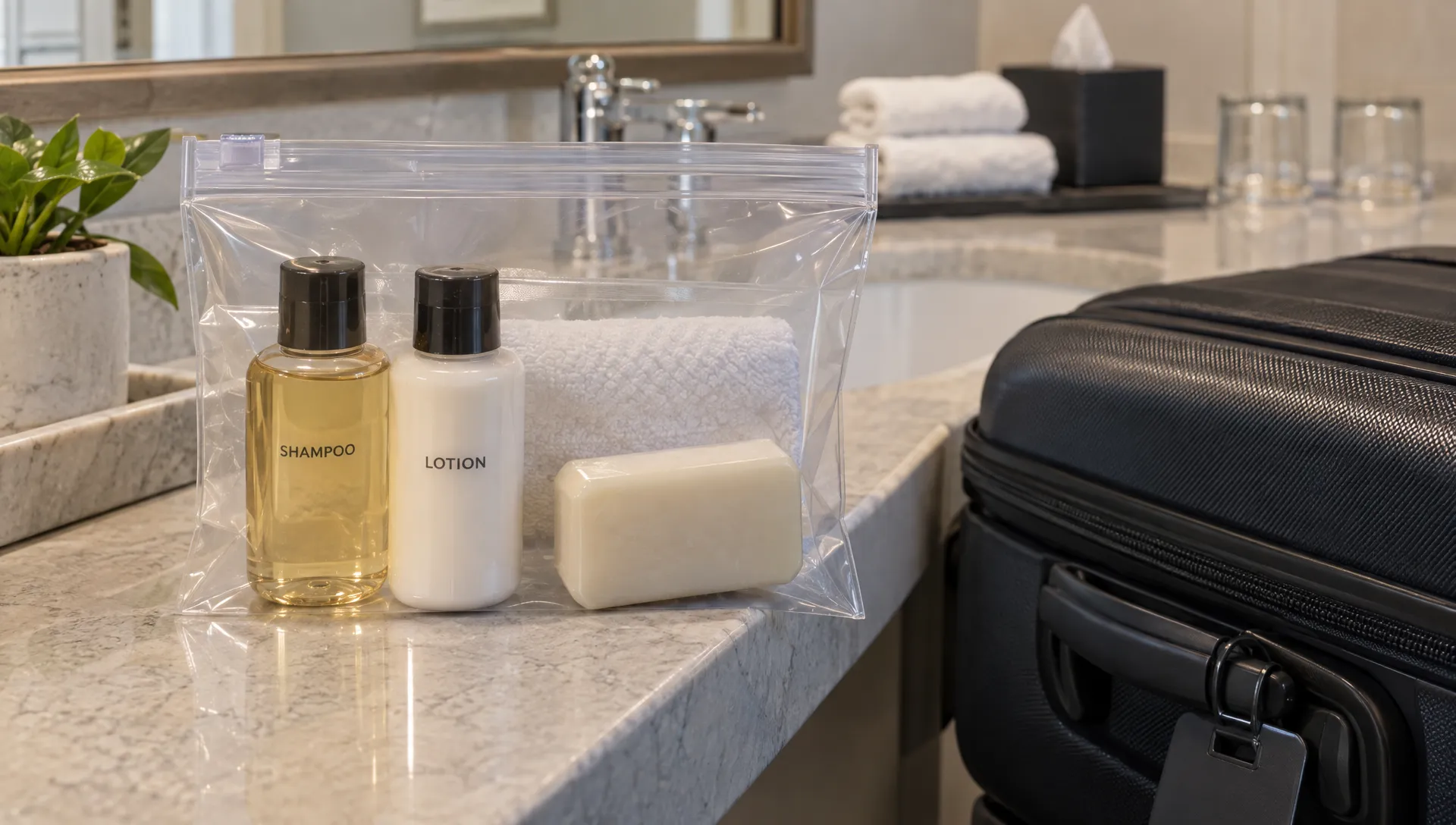
A full-size bottle can pass your first checkpoint and still be too large for the next one. This is especially relevant when the departure airport publishes a higher allowance but the return airport uses the standard restriction.
Consider a hypothetical round trip: your outbound airport permits a 250 ml shampoo bottle, but your return airport limits containers to 100 ml. Unless an exemption applies, that bottle cannot pass the return checkpoint in your cabin bag, even if you have used most of the shampoo during your stay.
Connections need attention as well. If you pass through security again, the next checkpoint’s rules matter. Do not assume remaining within an airport or holding a connecting ticket guarantees that your original screening allowance carries over.
If you want carry on luggage toiletries allowed throughout the trip, pack to the strictest applicable restriction across departure, any connecting security checks and return. Otherwise, plan to use up, check or leave behind products that exceed a later limit.
A size-first check before you close your bag
Start with the largest liquid container you intend to bring. It is often quicker to resolve that bottle’s eligibility before arranging everything else in the liquids bag.
- Check the maximum capacity printed on each liquid, gel, cream, paste or aerosol container.
- Confirm the published liquid rule at every airport where you will undergo screening.
- Make sure compliant containers fit comfortably inside the required resealable bag.
- Verify exemptions and aerosol restrictions separately rather than assuming they follow the ordinary liquid rule.
- Recheck your return-flight plan before buying full-size replacements during the trip.
For routine toiletries, 100 ml containers and a correctly sized liquids bag reduce uncertainty. Solid alternatives can save bag space without relying on an airport-specific higher allowance.
Frequently asked questions
Are carry on luggage toiletries allowed in a 150 ml bottle if it is half empty? Not at a checkpoint applying a 100 ml container limit. The bottle’s capacity is what matters, so transfer the contents into a compliant container or pack it in checked baggage if otherwise permitted.
Does a 2-liter airport allowance mean every toiletry can be that size? No. Follow the airport’s published conditions, and check separate restrictions for aerosols or other regulated products. A higher screening allowance also does not apply automatically to another airport.
Can I bring full-size toiletries bought after security? Ordinary airside purchases generally avoid that airport’s initial screening checkpoint, but they may face restrictions at a later security check or on your return. Duty-free liquids can have separate sealed-bag and receipt requirements. Do not assume an ordinary shop purchase receives the same protection.
Can I put oversized toiletries in checked luggage instead? Many ordinary liquid toiletries can go in checked luggage, but aerosols and other regulated products still have safety limits. Protect containers against leaks and check the airline’s baggage rules.
Check your whole trip before packing
Use Liquid Limits to compare liquid rules for your departure and return airports, check specific items and review source links and last-checked dates. The trip checker uses the stricter 100 ml fallback when a rule is unclear, helping you avoid packing a bottle that works outbound but creates a problem on the way home.