
Yes, you can bring toothpaste in hand luggage, but airport security usually treats it as a liquid, gel, or paste. That means the standard cabin rule applies: each toothpaste container must be 100 ml / 3.4 oz or smaller and must fit inside your allowed clear liquids bag, unless your departure airport has a verified relaxed rule.
The most common mistake is packing a half-used full-size tube. Security checks the container size printed on the tube, not how much toothpaste is left inside. A 125 ml tube with only a little toothpaste remaining can still be refused at the checkpoint.
Quick answer: toothpaste in hand luggage
For most travelers, the safest rule is simple: pack a travel-size toothpaste tube in your liquids bag, or put a larger tube in checked baggage.
| Toothpaste situation | Hand luggage allowed? | What to know |
|---|---|---|
| Travel-size toothpaste, 100 ml / 3.4 oz or less | Yes | Put it in your clear liquids bag if required at that airport. |
| Full-size toothpaste over 100 ml / 3.4 oz | Usually no | Pack it in checked baggage or buy toothpaste after security. |
| Half-empty large tube | Usually no | The printed container capacity matters, not the amount left. |
| Toothpaste tablets | Usually yes | Solid tablets are not treated like liquid toothpaste. |
| Prescription or medical toothpaste | Often allowed with conditions | Be ready to declare it and show why it is medically necessary. |
| Toothpaste in checked baggage | Yes | Normal personal-use amounts are fine, subject to airline baggage limits. |
In the United States, the TSA liquids rule allows liquids, aerosols, gels, creams, and pastes in containers of 3.4 oz / 100 ml or less in carry-on bags. The TSA also lists toothpaste as allowed in carry-on bags only when it meets that size limit.
In the UK and many other countries, toothpaste is also treated as a paste and must follow the standard liquids rule. GOV.UK’s hand luggage restrictions specifically include pastes among the items covered by liquid restrictions.
Why toothpaste counts as a liquid at airport security
Toothpaste does not pour like water, but airport security rules are broader than “liquids” in the everyday sense. They usually cover liquids, gels, creams, aerosols, and pastes because these items have similar screening concerns.
That is why items like toothpaste, shampoo, peanut butter, lip gloss, mascara, roll-on deodorant, sunscreen, and hair gel are commonly treated under the same cabin liquid rules. If an item can be squeezed, spread, sprayed, smeared, or poured, it may be treated as a liquid or gel at the checkpoint.
This is also why toothpaste can be flagged even when it looks harmless. A full-size tube is easy to pack without thinking, especially for a longer trip, but it is one of the classic toiletries that gets caught during hand luggage screening. If you want a broader overview of similar items, Liquid Limits has a guide to liquids at airport security and what gets flagged.
TSA, UK, and EU-style rules for toothpaste
Toothpaste rules are broadly similar across many major airports, but the exact process can vary by country, airport, and screening technology. This matters most when you are flying internationally, connecting through another airport, or returning from a different country.
| Region or rule type | Typical cabin rule for toothpaste | Practical packing advice |
|---|---|---|
| United States, TSA | 3.4 oz / 100 ml or less in the liquids bag | Choose a tube labeled 3.4 oz or smaller. |
| UK airports | 100 ml or less, usually in a clear resealable liquids bag | Do not rely on the amount left in a larger tube. |
| Many EU airports | 100 ml or less under standard liquids rules | Check your exact airport, especially if it advertises newer scanners. |
| Airports with relaxed liquid screening | Some may allow larger containers when verified | Confirm before packing, and check your return airport too. |
| Checked baggage | Larger toothpaste is generally allowed | Keep caps tight and place tubes in a leakproof pouch. |
The key word is “typical.” Some airports have introduced newer security scanners that may relax liquid limits in certain lanes or terminals. Others still enforce the 100 ml rule. Some airports have changed policies more than once as technology, regulation, and staffing have evolved.
For toothpaste, the safest approach is to plan around the strictest rule for the whole trip. A route that begins at an airport with relaxed rules may still include a return airport, transfer airport, or connecting security checkpoint that enforces 100 ml.
How to pack toothpaste in hand luggage
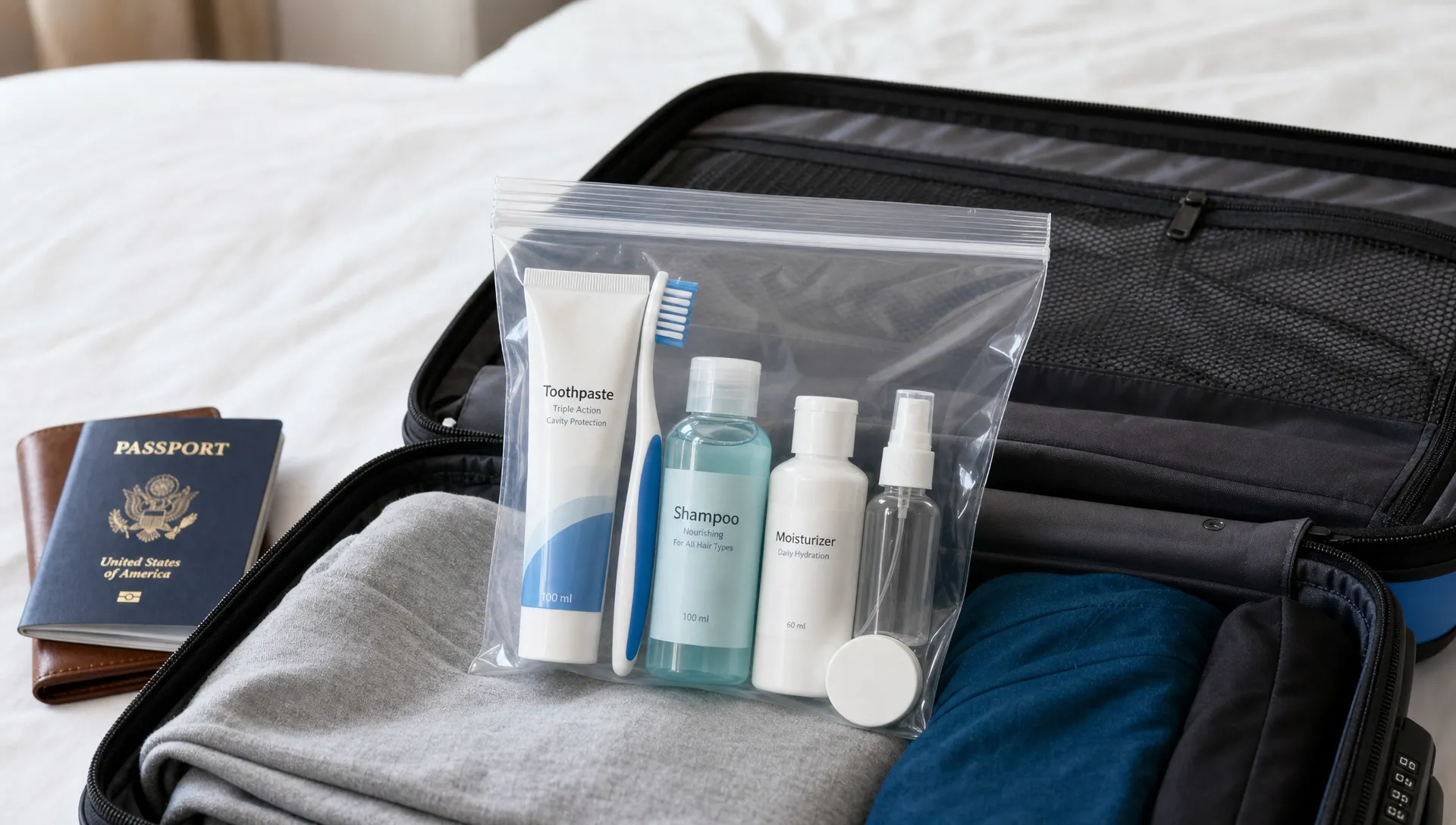
The easiest option is a small tube labeled 100 ml / 3.4 oz or less. Place it with your other liquid and gel toiletries in the clear bag required by your airport. If your airport no longer asks passengers to remove liquids from bags, still keep toothpaste easy to access. Security staff can always request a closer look.
If you are flying from the United States, look for travel-size toothpaste marked 3.4 oz or smaller. If you are flying from the UK, Europe, or many other regions, look for 100 ml or smaller. A tube marked 4 oz, 125 ml, 150 ml, or larger is not cabin-safe under the standard rule.
For longer trips, consider packing a travel-size tube in your hand luggage and a full-size tube in checked baggage. If you are hand-luggage-only, toothpaste tablets or tooth powder can be a useful alternative because they are usually treated as solids, though any unusual item can still be inspected.
You should also think about the return journey. A toothpaste tube bought abroad may be larger than the limit at your return airport. If you are not sure which airport rules apply, check your exact route with Liquid Limits before you pack. The site is designed to show the stricter cabin liquid rule for your trip, including the return flight.
Common toothpaste scenarios travelers get wrong
A few toothpaste situations cause most of the confusion at airport security. The rule usually comes down to container size, item form, and whether the toothpaste is medically necessary.
A half-empty full-size tube is still over the limit
Security officers look at the container’s maximum capacity. If the tube says 125 ml, 150 ml, 4 oz, or 6 oz, it may be refused even if it is almost empty. This is one of the most frustrating checkpoint surprises because the tube may feel clearly “small enough” in your bag.
If you want to finish a larger tube on vacation, pack it in checked baggage. If you are traveling with only hand luggage, transfer what you need into a properly sized travel container if the product can be stored safely that way, or buy a compliant travel tube.
Children’s toothpaste follows the same liquid rule
Children’s toothpaste is still a paste. A small kids’ toothpaste tube is fine if it is within the limit and packed correctly. A larger family-size tube is not usually allowed in cabin baggage under the standard 100 ml / 3.4 oz rule.
If you are traveling as a family, each passenger’s liquids allowance may help you distribute toiletries, but do not assume one person can carry multiple large tubes. Standard limits still apply per container.
Prescription toothpaste may be treated differently
Some travelers use prescription-strength fluoride toothpaste or a dentist-recommended product for a medical condition. Medical liquids can sometimes be exempt from the normal size limit, but you should not treat regular toothpaste as a medicine just because you prefer a particular brand.
If the toothpaste is genuinely medically necessary, keep it in its original packaging if possible, bring supporting documentation when practical, and declare it at the checkpoint. The final decision still belongs to security staff.
Whitening gel and dental gels can count too
Whitening gels, dental gels, mouth ulcer gels, and similar oral-care products are usually treated like gels or pastes. If they are not medically exempt, keep each container within the cabin liquid limit and pack them with your other liquid toiletries.
For at-home whitening kits, pay attention to the size of each syringe or tube. The outer kit box is less important than the capacity of the actual gel containers.
Toothpaste tablets are a good hand-luggage-only alternative
Toothpaste tablets are typically solid. You chew one, brush with a wet toothbrush, and it foams like toothpaste. Because they are not a gel or paste, they can make packing easier for carry-on-only trips.
That said, security officers can inspect any item. Keep tablets in clearly labeled packaging if you can, especially when traveling internationally.
What if your airport allows larger liquids?
Some airports and terminals use screening technology that can allow passengers to keep larger liquids in hand luggage. This is where toothpaste rules become less obvious. You might see one airport advertising relaxed limits while another airport on the same trip still follows 100 ml.
Do not assume that a relaxed rule at your departure airport applies everywhere. It may not apply to your connection, your return flight, a different terminal, or a secondary screening point. It may also depend on whether the specific security lane you use has the relevant equipment operating that day.
This is exactly why the “strictest rule” mindset works best. If every airport on your route allows larger liquids, a full-size toothpaste tube may be possible. If even one airport enforces 100 ml, pack the smaller tube or check the larger one.
For a deeper explanation of how cabin liquid limits work across toiletries and routes, see Liquid Limits’ guide to hand luggage liquid limits every flyer should check.
Can toothpaste go in checked baggage?
Yes, toothpaste can go in checked baggage. If you want to bring a full-size tube, checked luggage is usually the simplest place for it. There is no standard 100 ml security limit for toothpaste in checked bags, although your airline’s baggage weight rules still apply.
To avoid leaks, tighten the cap, squeeze out excess air if the tube is partly used, and place it in a zip-top pouch or toiletry bag. Pressure changes and rough baggage handling can make even well-sealed toiletries leak.
If you are packing several toiletries together, separate toothpaste from clothing and electronics. A small leak is easier to clean from a plastic pouch than from a shirt or charger cable.
A simple packing checklist
Before you leave for the airport, use this quick check:
- Is the toothpaste container labeled 100 ml / 3.4 oz or less?
- Is it packed with your other liquids, gels, creams, and pastes if your airport requires a liquids bag?
- Have you checked the return airport’s rules, not just the departure airport’s rules?
- Is any full-size toothpaste packed in checked baggage instead of hand luggage?
- Are prescription dental products clearly labeled and easy to declare if needed?
This small check can save time at security and prevent you from losing a nearly new tube at the checkpoint.
Frequently Asked Questions
Can I bring toothpaste in hand luggage on a plane? Yes. Toothpaste is allowed in hand luggage, but it usually must be in a container of 100 ml / 3.4 oz or less and packed according to your airport’s liquids rules.
Does toothpaste count as a liquid for TSA? Yes. TSA treats toothpaste as a paste under its liquids, gels, creams, and pastes rule. Carry-on toothpaste must be 3.4 oz / 100 ml or smaller unless it qualifies for a specific exception.
Can I take a 125 ml toothpaste tube if it is almost empty? Usually no. Airport security normally checks the printed container capacity, not the remaining amount inside. A half-empty 125 ml tube is still over the standard cabin limit.
Can toothpaste go in my checked bag? Yes. Full-size toothpaste can generally go in checked baggage. Pack it in a sealed pouch to prevent leaks.
Do toothpaste tablets count as liquids? Usually no. Toothpaste tablets are solid and are generally easier to pack in hand luggage than paste toothpaste. Keep them in labeled packaging if possible.
Can I buy toothpaste after airport security? Yes, if a shop is available after security. Toothpaste bought airside can usually be taken onto your flight, but be careful if you have a connection or return flight where another security screening may apply.
Check the rule before you pack
For most trips, the safest answer is: yes, bring toothpaste in hand luggage, but keep it at 100 ml / 3.4 oz or less. If you want to pack a larger tube, put it in checked baggage or confirm that every airport on your route allows it.
Because liquid rules can vary by airport, route, and return journey, it is worth checking before you zip up your bag. Use Liquid Limits to look up toothpaste, your airports, and your route so you can pack based on the strictest rule for the whole trip.