
Airport security rarely flags liquids at random. Most problems come from a handful of predictable items: oversized bottles, liquid-like foods, toiletries that travelers think are solids, aerosols, duty-free bags, and legitimate exemptions that need extra screening.
The confusing part is that flagged does not always mean banned. A baby bottle, prescription medicine, or sealed duty-free purchase may be allowed, but still pulled aside because the officer or scanner needs to verify it. A half-empty 200 ml shampoo bottle, on the other hand, is likely to be refused under standard 100 ml rules because the limit applies to the container size, not the amount left inside.
Here is what tends to get flagged at liquids airport security checks, why it happens, and how to pack so you are not forced to choose between delaying the line and losing something you wanted to keep.
Why liquids get flagged at security
Airport liquid screening is designed to catch items that could conceal restricted substances or create a safety risk in the cabin. The common baseline is the 100 ml / 3.4 oz container rule for carry-on liquids, gels, aerosols, creams, and pastes. In the United States, the TSA 3-1-1 liquids rule still uses this standard for most passengers. Many other countries apply a similar rule, though airports with newer scanners may sometimes publish different limits.
An item gets flagged when it creates one of three questions. Is it a liquid, gel, paste, aerosol, or spread? Is the container over the allowed cabin limit? Does it qualify for an exception that needs separate screening?
That is why two items that look harmless to you can be treated very differently. A solid bar of soap is usually simple. A tub of body butter is treated more like a cream. A sealed water bottle is still a drink. Peanut butter, hummus, and jam behave like spreads, so they often fall under liquid rules even though they are food.
If you want a deeper look at how officers apply these rules at the checkpoint, Liquid Limits has a separate guide on how the liquid rule at the airport really works.
The quick test: pour, spread, spray, squeeze, smear
A useful rule of thumb is this: if the item can pour, spread, spray, squeeze, smear, foam, or ooze, assume airport security may treat it as a liquid or liquid-like item.
This test catches many of the things travelers forget. Toothpaste, lip gloss, mascara, gel deodorant, hair wax, sunscreen, foundation, hand sanitizer, sauce packets, soup, honey, and yogurt can all trigger screening. Security officers are not judging whether the item is useful, edible, or expensive. They are judging how it behaves and whether it fits the rule at that airport.
The second test is container size. Under the standard 100 ml rule, a 150 ml tube with only 20 ml left can still be flagged because the container itself is too large. Decanting into a smaller travel container before you leave home is usually safer than hoping an officer accepts that the bottle is mostly empty.
The third test is route. Your departure airport, transfer airport, and return airport may not apply the same limit. Newer CT scanners can change local procedures, but those procedures can also be paused, reversed, or limited to certain lanes. When in doubt, pack to the strictest checkpoint on the whole trip.
Common items that get flagged at airport security
The items below are not always confiscated, but they are among the most likely to be inspected, questioned, or rejected if they do not meet the applicable rule.
| Item type | Why it gets flagged | Safer way to pack |
|---|---|---|
| Water, coffee, juice, soda, sports drinks | Drinks are obvious liquids and full-size bottles usually exceed cabin limits | Empty the bottle before security and refill it after screening |
| Shampoo, conditioner, shower gel, lotion | Toiletries are classic liquid or gel items | Use containers of 100 ml / 3.4 oz or less, or pack full-size bottles in checked luggage |
| Toothpaste, mascara, lip gloss, gel deodorant | Travelers often think of these as small personal items, but they are pastes, gels, or liquids | Put them in your liquids bag unless your airport clearly says otherwise |
| Peanut butter, hummus, jam, honey, dips, sauces | Spreadable foods are usually treated like liquids or gels | Use small containers within the limit, buy after security, or pack in checked luggage |
| Yogurt, soup, pudding, soft cheese | Semi-liquid foods can spill, spread, or pour | Keep portions within the cabin limit or avoid carrying them through security |
| Aerosol deodorant, hairspray, shaving foam | Aerosols are both liquid-like and pressurized | Check size limits and avoid flammable or industrial aerosols |
| Snow globes and liquid souvenirs | They contain liquid, and the volume is not always clear | Keep them small, sealed, and easy to inspect, or pack in checked luggage |
| Ice packs and gel packs | If melted or slushy, they may be treated as liquids | Freeze solid before screening, or keep them with a permitted medical or baby item if applicable |
| Duty-free alcohol and perfume | Larger liquids may need proof of purchase and a sealed tamper-evident bag | Keep the receipt and do not open the security bag before your final security checkpoint |
| Medicines, baby milk, formula, special dietary liquids | Often allowed above 100 ml, but usually need separate screening | Pack them separately, declare them when required, and bring supporting documentation if relevant |
The key takeaway is that security is not only looking for shampoo-sized bottles. Foods, cosmetics, souvenirs, and exception items can all be part of the liquids conversation.
Borderline items that surprise travelers
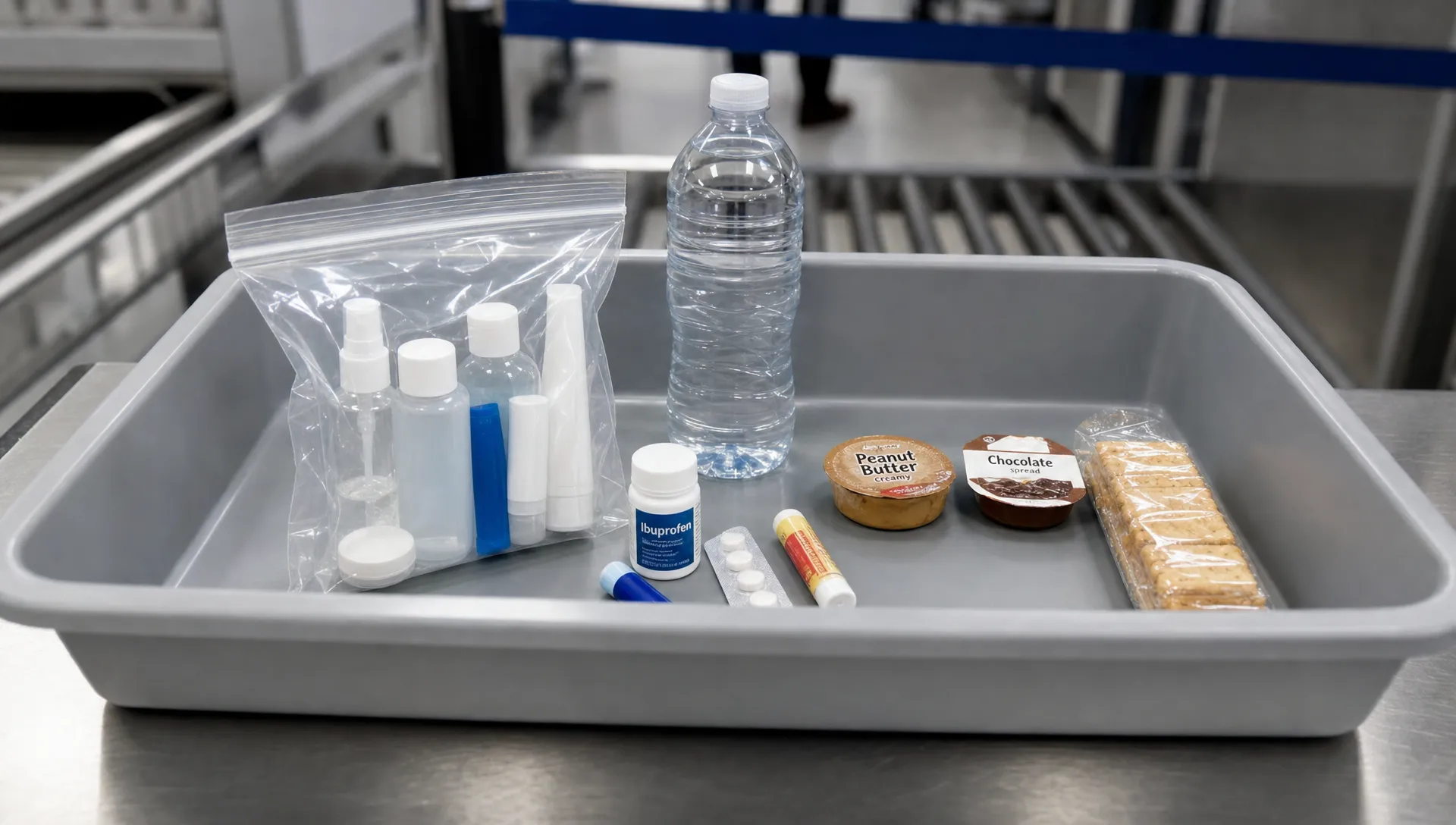
The most frustrating flags often involve items that do not look like liquids at first glance. Food is the biggest category. The TSA database of items, available through What Can I Bring?, lists many foods individually because the answer changes depending on texture. A sandwich is different from a jar of salsa. Crackers are different from a tub of cream cheese.
Cosmetics are another common source of confusion. Powder blush is usually treated differently from liquid foundation. Solid deodorant is different from gel deodorant. A lipstick may pass without attention, while lip gloss belongs with liquids. If your toiletry can be squeezed out of a tube or brushed on wet, it is safer to treat it as a liquid.
Souvenirs also cause trouble because travelers buy them after packing their mental checklist. Olive oil, perfume, hot sauce, maple syrup, wine, skincare, snow globes, and local cosmetics are all easy to forget until you reach the X-ray belt. If you buy them before your final security screening, assume they need to comply with the liquid rule unless they qualify as properly sealed duty-free items.
Allowed liquids that may still get extra screening
Some liquids are allowed in larger quantities because passengers genuinely need them during travel. That does not mean they will glide through security without questions.
Medicines are the most important example. Many airport regimes allow medically necessary liquids above the standard limit, but they may need to be declared, separated from other liquids, and screened. Prescription labels, a doctor note, or pharmacy packaging can help, especially for international travel or unusual medical supplies.
Baby milk, formula, breast milk, toddler drinks, and baby food are also commonly exempted in reasonable travel quantities. The UK government hand luggage restrictions explain that baby food and milk needed for the journey can be carried, while essential medicines over 100 ml may require supporting documentation. Rules vary by country, so parents should check the exact airport guidance before flying.
Duty-free liquids are another category that may be allowed but still flagged. The usual safe pattern is a sealed security tamper-evident bag, a visible receipt, and no signs that the bag has been opened. The risk rises when you have a connecting flight, especially if you must clear transfer security in another country. A bottle bought legally at your first airport can still become a problem at the next checkpoint if the bag is opened, the receipt is missing, or the transfer airport applies a stricter rule.
Frozen liquids sit in a gray area. If an ice pack or frozen drink is completely solid when screened, it may be treated differently from a liquid. If it is slushy, partially melted, or leaking, expect it to be screened as a liquid. Gel packs used for medical cooling may be permitted in contexts where ordinary gel packs are not, but they should be separated and declared when required.
Why an item clears one airport but gets flagged at another
One of the biggest mistakes is assuming that yesterday's checkpoint result guarantees tomorrow's. Liquid rules can differ by country, airport, terminal, scanner type, and route. Even within the same airport, some lanes may use different screening equipment or apply temporary procedures.
This matters most on round trips and connecting flights. You might depart from an airport that allows larger cabin liquids because it uses approved CT scanners, then return from an airport still enforcing 100 ml containers. You might also buy a liquid after your first security checkpoint and then face a second security check during a transfer.
For trip planning, the safest approach is to check the strictest liquid rule across your outbound route, connection, and return. Liquid Limits is built for that exact problem: you can check airports, routes, and specific items before you pack, with verified source links and last-checked dates. If a rule is unclear, the tool defaults to the stricter 100 ml assumption so you are not relying on a risky guess.
For a broader overview of cabin liquid limits, see this plain-English guide to limits on liquids on flights.
What to do if your liquid is flagged
If a security officer pulls your bag aside, stay calm. A flag is often just a request for inspection. The outcome depends on the item, the airport rule, and whether you can show that it qualifies for an exception.
- Let the officer inspect it: Do not repack or reach into your bag unless asked. Security staff need to control the inspection process.
- Explain the item clearly: Say whether it is medicine, baby food, duty-free, a toiletry, or food for the journey.
- Show supporting information: Prescription labels, medical notes, receipts, and sealed duty-free bags can make the decision easier.
- Ask what your options are: Depending on the airport and where you are in the process, you may be able to check the item, hand it to a non-traveling companion, mail it, or surrender it.
- Do not rely on partial contents: If the container is over the standard limit, saying it is almost empty usually will not help.
- Accept final discretion: Security officers can make case-by-case decisions, and local rules control the checkpoint.
The best moment to solve a liquid problem is before you leave for the airport. Once you are in the screening area, your options narrow quickly.
A simple packing plan to avoid liquid flags
Put anything full-size, expensive, or difficult to replace in checked luggage unless you have confirmed it is allowed in the cabin for every airport on your trip. Keep travel-size liquids together and easy to remove if your airport still requires a separate bag. Place medicine, baby supplies, and duty-free liquids where you can access them quickly for inspection.
If an item is borderline, treat it as a liquid. That single habit prevents most surprises. A small toothpaste in your liquids bag is rarely a problem. A large tube loose in a backpack can slow you down or get confiscated.
Before you close your suitcase, it can also help to run through a dedicated travel liquids checklist, especially if you are packing toiletries, food, medicine, baby items, or souvenirs.
Frequently Asked Questions
Does flagged mean my liquid will be confiscated? No. Flagged means the item needs extra attention, inspection, or verification. It may be allowed if it meets the rule or qualifies for an exception.
Will a half-empty 200 ml bottle pass airport security? Usually not under standard 100 ml rules. Security normally looks at the container capacity, not how much liquid remains inside.
Is toothpaste considered a liquid at airport security? Toothpaste is generally treated as a paste or gel, so it belongs with your carry-on liquids and should be in a compliant travel-size container where 100 ml rules apply.
Can I bring medicine over 100 ml? Often yes, if it is medically necessary, but it may need separate screening and supporting documentation. Check the rules for your departure, transfer, and return airports.
Are duty-free liquids safe on connecting flights? They can be, but only if they remain sealed in the proper tamper-evident bag and you keep the receipt. Transfer security can still apply local rules, so check your route before buying.
Do peanut butter, hummus, and jam count as liquids? They are commonly treated as liquid-like spreads. If you want them in a carry-on, use containers within the applicable liquid limit or pack them in checked luggage.
Check what gets flagged before you pack
The safest way to avoid losing liquids at airport security is to check the exact rule for your item and route before you leave home. With Liquid Limits, you can look up airport liquid rules, compare outbound and return restrictions, and see the stricter rule for your trip side by side.
If there is any uncertainty, pack as if the 100 ml rule applies. It is the simplest way to move through security with fewer delays and fewer last-minute decisions at the confiscation bin.