
Flying with 100ml rules sounds straightforward: put small bottles in a clear bag and move on. In practice, travelers lose perfectly good toiletries, baby products, makeup, food, and duty-free purchases because they miss the less obvious parts of the rule.
The biggest problem is that liquid rules are not only about what you pack. They depend on the airport, the security checkpoint, your transfer, your return flight, the item itself, and whether the rule is being applied by old screening lanes or newer scanners. If one checkpoint on your trip still requires 100ml containers, that stricter rule can shape your entire packing plan.
This guide focuses on the details travelers most often overlook when flying with 100ml rules, so you can avoid last-minute repacking, security delays, and expensive throwaways.
The 100ml rule is usually a container rule, not a remaining-liquid rule
The most common mistake is packing a large bottle that is nearly empty. At many security checkpoints, that will still fail.
The rule usually applies to the maximum capacity printed on the container, not the amount of liquid left inside. A 200ml shampoo bottle with 50ml remaining is still a 200ml container. A 150ml face mist with only a few sprays left is still too large where the 100ml rule applies.
That detail is reflected in major official guidance. The TSA 3-1-1 liquids rule describes liquids, gels, and aerosols in containers of 3.4 ounces or 100ml or less for carry-on bags. The UK government hand luggage restrictions also refer to containers holding no more than 100ml.
So the safest interpretation is simple: if the label says the container holds more than 100ml, do not put it in your cabin bag unless you have confirmed that every relevant checkpoint on your trip allows it.
A second container mistake is using unlabeled travel bottles. Many officers will accept clearly small, standard travel containers, but if a bottle has no size marking and looks close to the limit, it can create unnecessary questions. For essentials, use bottles with visible 100ml or 3.4 oz markings.
Travelers underestimate what counts as a liquid
Security rules are not limited to water, perfume, and shampoo. The category usually includes liquids, gels, creams, pastes, aerosols, and spreadable substances. That means many items people think of as solid or harmless can be treated as liquids at the checkpoint.
Commonly missed examples include mascara, lip gloss, toothpaste, hair gel, shaving foam, sunscreen, foundation, peanut butter, jam, soft cheese, hummus, snow globes, liquid-filled souvenirs, and some gel ice packs.
The practical test is not scientific. If it can be poured, sprayed, squeezed, smeared, spread, pumped, or squashed into a paste-like form, assume it may be treated as a liquid unless an official source says otherwise. For more item-specific examples, Liquid Limits has a focused guide on what counts as 100ml of liquid at security.
This is especially important for food. A sealed jar of local honey or a creamy dip bought before security may be a problem in cabin baggage, even if it feels more like a grocery item than a travel liquid. If you want to bring food through security, check whether it is solid, spreadable, or exempt for medical or infant-feeding reasons.
The rule can change by airport, terminal, or checkpoint
Many travelers assume liquid rules are national. Sometimes they are, but airport implementation can still vary.
Newer CT scanners have allowed some airports to trial or introduce more flexible cabin liquid rules. At the same time, other airports, terminals, transfer screening points, and temporary lanes may still enforce the traditional 100ml limit. Even when a country announces a change, rollout can be uneven and subject to delays or reversals.
That is why the question is not only: What country am I flying from? A better question is: What rule applies at each security checkpoint I will actually pass through?
This matters when you have:
- A return flight from a different airport
- A connection that requires transfer security
- A multi-city trip with several cabin-bag screenings
- A departure from an airport with mixed scanner equipment
- A flight from a terminal whose rules differ from another terminal at the same airport
If any one of those checkpoints uses the 100ml rule, packing for the stricter rule is usually the least stressful choice. Liquid Limits is built around this problem: you can check airport, item, and route guidance before you pack, including stricter-rule warnings for round trips.
The overlooked mistakes that cause problems at security
The 100ml rule is simple in theory, but the small exceptions and edge cases are where most mistakes happen.
| What travelers miss | Why it causes trouble | Safer packing move |
|---|---|---|
| A half-empty large bottle still counts as large | Security usually checks container capacity | Decant into a marked 100ml container |
| Creamy foods can count as liquids | Spreads and pastes are often restricted | Pack solid snacks or put spreads in checked baggage |
| Return airports may be stricter | The outbound airport is not the only checkpoint | Check both directions before packing |
| Duty-free bags can still be inspected | Sealed bags are not a universal pass | Keep receipts and do not open the sealed bag |
| Transfers may involve new screening | You may re-enter security after landing | Pack for the strictest transfer point |
| Unmarked travel bottles invite questions | Officers may not know the capacity | Use clearly labeled travel containers |
| Exempt items still need screening | Medicine and baby items are not invisible to security | Separate them and be ready to explain them |
The pattern is clear: most confiscations happen not because the traveler ignored the rule, but because they applied it too narrowly.
Transfers and return flights are where 100ml plans fail
A traveler can pack perfectly for the departure airport and still run into trouble later. This is one of the biggest things people miss.
Imagine your outbound airport allows larger liquids because of newer screening equipment. You buy full-size toiletries after security, use them during your trip, then fly home from an airport that still applies the 100ml rule. If those bottles are now in your cabin bag, they may not make it through.
Connections create a similar problem. Some international itineraries require passengers to pass through transfer security before the next flight. If you bought a drink, perfume, cosmetics, or a regional food item before that transfer point, it may be screened again under the connection airport's rules.
This is why round-trip planning matters more than travelers expect. If your trip includes different airports on the way home, use the strictest checkpoint as your packing baseline. Liquid Limits explains this in more depth in its guide to rules for liquids on flights and return trips.
The simplest rule is this: do not pack for the easiest airport on your route. Pack for the strictest one.
Duty-free is not a guaranteed workaround
Duty-free liquids are another common source of confusion. Many airports allow duty-free liquids over 100ml if they are packed in an approved security tamper-evident bag with proof of purchase. But that does not mean every duty-free liquid will automatically pass every later checkpoint.
There are several things travelers miss:
- The bag usually needs to stay sealed until your final destination
- The receipt may need to remain visible or available
- Transfer security may still inspect or screen the bag
- Local rules can vary by airport and route
- Items bought outside the secure airport environment may not qualify
If you have a direct flight, duty-free liquids are usually easier to manage. If you have a connection, especially an international one, check the transfer airport's policy before buying large bottles. A sealed duty-free bag is helpful, but it is not a promise that every officer in every airport must accept the item.
When in doubt, buy duty-free liquids at the last airport before your final destination, not at the first airport on a complex itinerary.
Exemptions exist, but they still require planning
Medicine, baby milk, baby food, special dietary liquids, and certain medical necessities may be allowed in quantities above 100ml. But travelers often misunderstand what an exemption means.
An exemption does not mean the item can stay hidden at the bottom of your bag. It does not mean it will skip screening. It does not mean every unrelated toiletry can be packed with it.
For smoother screening, keep exempt liquids separate and easy to remove. Bring prescriptions, labels, medical letters, or supporting documents when relevant, especially for larger quantities or unusual items. You may not always be asked for documentation, but having it can reduce delays.
For baby and child-related liquids, pack only what is reasonable for the journey. Security officers may need to inspect the items, and rules can vary by country. If you are traveling with formula, breast milk, sterilized water, or baby food, check the specific airport or government guidance before flying.
Checked baggage avoids the cabin 100ml rule, but not every restriction
Putting liquids in checked baggage can solve many cabin-bag problems. Full-size shampoo, sunscreen, perfume, sauces, and other non-essential liquids often belong in checked luggage if you do not need them during the flight.
But checked baggage is not restriction-free. Aerosols, alcohol, flammable products, lithium-powered devices with liquid components, and other hazardous materials may have separate aviation safety limits. The U.S. Federal Aviation Administration's PackSafe guidance is a useful example of how safety rules can apply beyond the cabin liquid limit.
There is also a practical risk: leaks. If you pack liquids in checked luggage, tighten caps, seal bottles in plastic bags, and cushion fragile containers. Cabin liquid rules may be the reason you check the item, but baggage handling is the reason you protect it.
A practical packing method for flying with 100ml rules
If you want a low-stress approach, pack as though the 100ml rule applies unless you have verified that every relevant checkpoint allows something else. That may feel conservative, but it prevents the most common surprises.
Start by grouping every cabin liquid in one place before you pack. Include toiletries, cosmetics, gels, sprays, pastes, food items, medication, contact lens solution, and liquid souvenirs. Then decide what needs to stay with you and what can go in checked baggage.
Use this quick method:
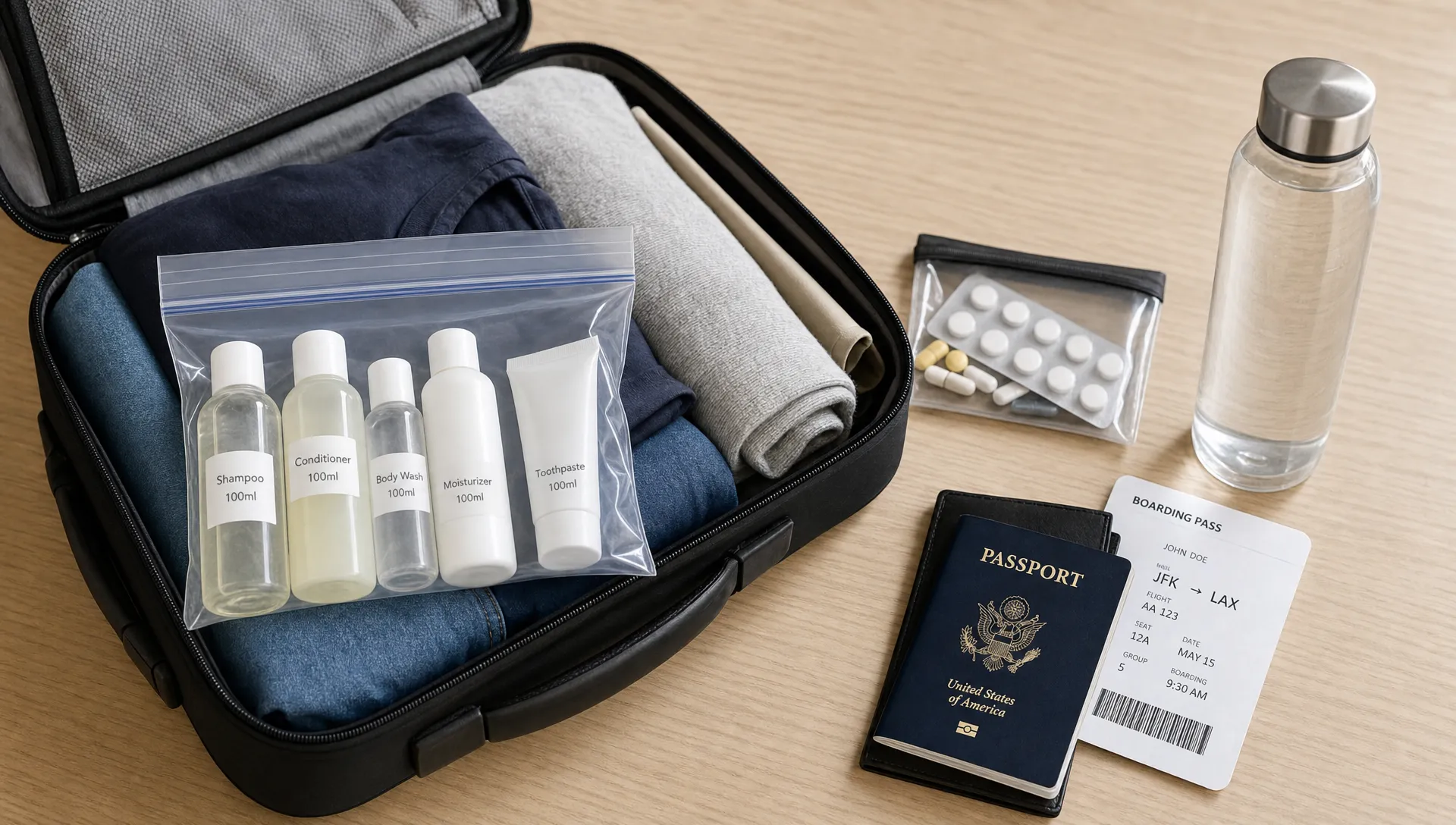
- Choose marked containers of 100ml or 3.4 oz or less for cabin toiletries
- Put all standard liquids in the required clear resealable bag if your airport requires one
- Keep medicine, baby items, and special dietary liquids separate from regular toiletries
- Pack an empty reusable water bottle, then fill it after security
- Avoid buying large liquids before a transfer security checkpoint
- Check your return airport before buying full-size products during your trip
- Treat unclear rules as 100ml rules to reduce risk
This method is especially useful for travelers who move between airports with different technology. It also helps families, business travelers, and carry-on-only travelers avoid repacking under pressure at the security belt.
When the stricter 100ml rule is the best default
The most traveler-friendly rule is not always the safest rule to pack for. If one airport says larger liquids are allowed but another airport on your route says 100ml, your practical trip limit is 100ml for cabin baggage.
The same applies when the rule is unclear. Airport websites are not always easy to interpret, and scanner upgrades can create mixed messages. A news article may say an airport has new screening equipment, while the official passenger guidance still tells travelers to follow 100ml limits. In that situation, follow the current official checkpoint guidance, not assumptions.
Liquid Limits helps solve this by showing side-by-side rule checks for airports, items, and routes, with source links and last-checked dates. When the rule is unknown or unclear, the tool defaults to the stricter 100ml rule so travelers are not encouraged to gamble at security. You can start with the Liquid Limits trip liquid checker before you pack.
Frequently Asked Questions
Does 100ml mean the amount left in the bottle? Usually no. At many security checkpoints, 100ml refers to the container's maximum capacity. A half-empty 200ml bottle can still be rejected.
Can I take multiple 100ml bottles on a flight? Often yes, but many airports require them to fit inside a clear resealable liquids bag. Bag size and presentation rules vary, so check the airport guidance for your trip.
Are makeup and skincare products included in the 100ml rule? Yes, many makeup and skincare items count, including foundation, mascara, lip gloss, primer, creams, gels, sprays, and liquid highlighters.
Do newer airport scanners mean I can ignore the 100ml rule? No. Some airports or lanes may allow more flexibility, but many still enforce 100ml rules. Transfers and return flights may also be stricter than your departure airport.
Can I bring medicine over 100ml? In many cases, necessary medicine may be exempt, but it usually still needs screening. Keep it separate and bring supporting documentation when appropriate.
What is the safest rule for a round trip? Pack for the strictest security checkpoint on the entire route, including your return airport and any transfer airports.
Pack for the checkpoint you will actually face
The 100ml rule is not just a bottle-size rule. It is a route-planning issue. The item, the airport, the terminal, the connection, and the return flight can all affect what makes it through security.
Before your next trip, check the strictest liquid rule for your whole journey, not just your first departure airport. Liquid Limits gives travelers airport, item, and route checks with verified source links, daily updates, and last-checked dates, so you can pack with fewer surprises and fewer abandoned bottles at security.