
Airport liquid rules sound simple until you start asking whether mascara, peanut butter, sunscreen, or a half-empty shampoo bottle counts. The safest working definition is this: if an item can be poured, squeezed, spread, smeared, sprayed, or is packaged as a wet gel, cream, paste, foam, or aerosol, treat it as a liquid at security.
At most checkpoints that still apply the 100ml rule, 100ml of liquid means the maximum capacity of each individual container. It does not mean the amount of product left inside. A 75ml travel tube is usually fine. A 150ml bottle with only 20ml left is still too large where the 100ml rule applies.
The tricky part is that rules can vary by airport, country, scanner type, terminal, connection, and return flight. So this guide focuses on what counts as 100ml at security in practical packing terms, then explains when you should check your exact route before you fly.
The simple answer: 100ml is a container limit
When a security checkpoint applies the 100ml rule, the number normally refers to the maximum capacity printed on the bottle, tube, jar, or aerosol can. Security staff are not usually trying to measure how much product remains inside. They are checking whether the container itself is small enough.
100ml is about 3.4 U.S. fluid ounces. A product marked 3.4 fl oz is generally treated as the U.S. equivalent of 100ml. This is why many travel-size toiletries sold in the United States are labeled 3.4 fl oz or 100ml.
If the container has no capacity marking, it can become a judgment call. For low-value items, that may not matter. For expensive skincare, perfume, medication, or specialty products, use original packaging or a refillable travel bottle with a visible 100ml or 3.4 fl oz marking.
| Container or label | How it is usually treated where the 100ml rule applies | Practical takeaway |
|---|---|---|
| 30ml, 50ml, 75ml, or 100ml bottle | Usually allowed if it fits the liquids bag rules | Good for carry-on toiletries |
| 3.4 fl oz bottle | Usually treated as equivalent to 100ml | Common U.S. travel size |
| 110ml or 125ml container | Too large where the 100ml rule applies | Pack it in checked baggage |
| 150ml bottle with a small amount left | Still too large | The container size matters, not the remaining amount |
| Empty water bottle over 100ml | Usually allowed if truly empty | Fill it after security |
| Jar labeled only in grams | Potentially risky for creams, gels, or spreads | Use a clearly labeled travel container when possible |
Important: the container limit is only one part of the rule. Many airports also require all small liquid containers to fit inside a clear resealable bag, often around 1 liter or 1 quart depending on the country. If you want the broader enforcement picture, Liquid Limits has a separate guide on how the liquid rule at the airport really works.
What counts as a liquid at airport security?
Airport security uses a wider definition of liquid than most travelers do. Official rules commonly group liquids with aerosols, gels, creams, and pastes. The U.S. Transportation Security Administration describes this through its 3-1-1 liquids rule, while the UK government lists similar categories in its hand luggage restrictions.
In everyday terms, the liquid category includes anything that is fluid, wet, spreadable, sprayable, gel-like, creamy, or paste-like. It does not have to be drinkable.
| Category | Common examples | Why it counts |
|---|---|---|
| Drinks and free-flowing liquids | Water, juice, soda, coffee, alcohol, soup | They can be poured |
| Toiletry gels and creams | Shampoo, conditioner, shower gel, lotion, sunscreen, face cream | They are wet, squeezable, or spreadable |
| Pastes | Toothpaste, hair paste, styling clay, some face masks | They can be squeezed or smeared |
| Aerosols and sprays | Hairspray, spray deodorant, dry shampoo, body spray, shaving foam | They are dispensed as spray or foam |
| Liquid makeup | Foundation, mascara, lip gloss, liquid eyeliner, primer | They are liquid, gel, or cream formulas |
| Spreadable foods | Peanut butter, jam, honey, hummus, soft cheese, salsa, yogurt | They can be spread, poured, or spooned |
| Medical and baby liquids | Liquid medicine, contact lens solution, baby formula, breast milk | They are liquids, even when exceptions may apply |
The key point is that security staff are not asking whether the item is a beverage. They are asking whether it behaves like a liquid, gel, cream, paste, aerosol, or spread.
Items travelers often mistake for not liquid
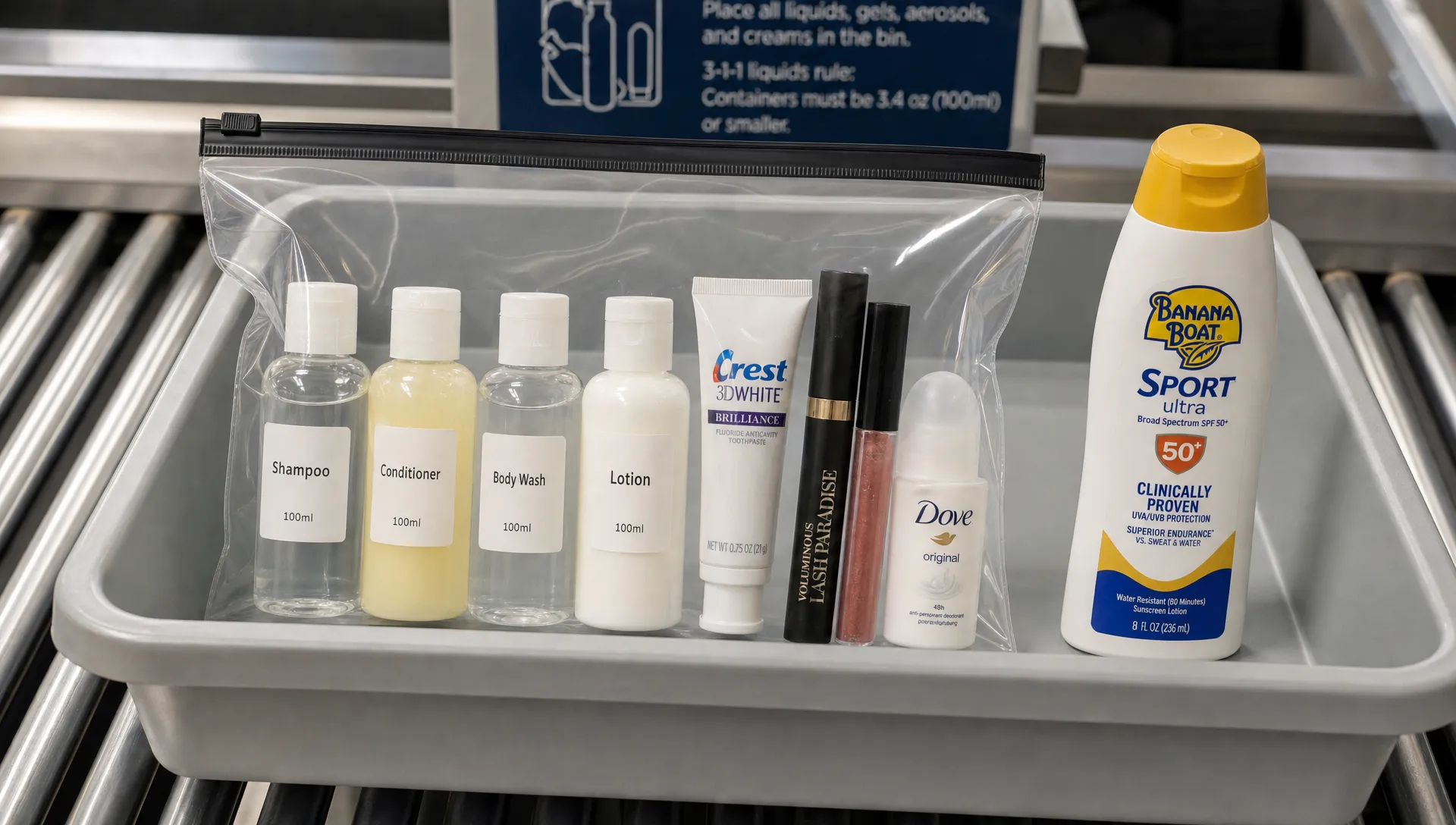
The most confusing products are the ones that feel solid enough at home but are treated as liquid-like at security. These are the items most likely to surprise travelers at the tray.
| Item | Does it usually count as a liquid? | Notes |
|---|---|---|
| Toothpaste | Yes | A standard tube may be 75ml or 100ml, but larger tubes are often too big |
| Solid stick deodorant | Usually no | Solid sticks are generally treated differently from gels and sprays |
| Roll-on deodorant | Yes | The product inside is liquid or gel |
| Gel deodorant | Yes | It is a gel, even if it is not pourable |
| Spray deodorant | Yes | It is an aerosol and must meet both liquid and aerosol safety rules |
| Mascara | Yes | Small, but still usually part of your liquids bag |
| Lip gloss | Yes | Gloss is treated differently from solid lipstick |
| Solid lipstick | Usually no | It is generally treated as a solid cosmetic |
| Peanut butter or nut spread | Yes | Spreadable foods are commonly treated as liquids or gels |
| Honey, jam, or syrup | Yes | These are liquid or gel-like foods |
| Wet wipes | Usually no | Wipes are damp, but they are not usually treated like bottles of liquid |
| Contact lens solution | Yes | It may qualify for medical handling in some places, but it is still a liquid |
How to decide if a borderline item counts
When in doubt, think about how the product behaves at room temperature. Security rules are practical. A product does not need to splash like water to be treated as a liquid.
Use these quick tests before you pack:
- Can you pour it? Drinks, soups, oils, toners, serums, and sauces are liquids.
- Can you squeeze it from a tube? Toothpaste, sunscreen, gel, ointment, and many creams should be treated as liquids.
- Can you spread it with a knife or finger? Peanut butter, jam, hummus, soft cheese, lip balm pots, and thick face masks can be treated as liquid-like.
- Can it spray, foam, or mist? Aerosol deodorant, shaving foam, hairspray, and body spray count.
- Would it lose its shape if the container opened? Yogurt, custard, dip, and thick sauces should be packed as liquids.
One yes is enough to treat the item as a liquid for carry-on packing. If you would be frustrated to lose it, either keep it within 100ml, place it in checked baggage, or check the rule for your exact airport before travel.
Food is a common source of confusion. A sandwich is not a liquid, but a jar of salsa usually is. Crackers are not a liquid, but a tub of hummus usually is. A sealed jar of almond butter may feel like a grocery item rather than a toiletry, but at security it can still be treated as a spreadable gel or paste.
What the 100ml rule does not mean
A lot of airport liquid problems come from small misunderstandings. These are the big ones to avoid.
| Myth | Reality |
|---|---|
| 100ml means 100ml total for my whole bag | Usually, the limit is per container, but all containers may need to fit in the required liquids bag |
| A half-empty 200ml bottle is fine | Usually not where the 100ml rule applies, because the bottle is too large |
| Makeup does not count because it is cosmetic | Liquid, gel, cream, and paste makeup can count |
| Food cannot count because it is not a toiletry | Spreadable, gel-like, and liquid foods can count |
| Airport-bought liquids are always fine | They are safest after your final security check, but connections and duty-free rules matter |
| If one airport allows larger liquids, every airport on my trip will | Liquid rules can differ by airport, terminal, country, and return journey |
This is why packing to the strictest checkpoint on your itinerary is often the least stressful approach. If you have a connection, you may need to pass through security again. If your return airport has stricter rules than your departure airport, the same toiletries that flew out with you may cause trouble on the way home.
Exceptions: when more than 100ml may be allowed
Some liquids can be allowed above 100ml, but they are not treated like ordinary toiletries. They may need to be declared, separated from your regular liquids bag, screened separately, or supported by documentation.
| Exception type | Examples | Practical advice |
|---|---|---|
| Essential medicines | Liquid prescriptions, medically necessary gels, insulin supplies, nutritional liquids | Keep them accessible and in original packaging when possible |
| Baby and toddler items | Breast milk, formula, baby food, sterilized water where permitted | Declare them and expect extra screening |
| Special dietary liquids | Medically required drinks or liquid nutrition | Carry only what is reasonable for the trip and keep proof if available |
| Duty-free liquids | Alcohol, perfume, cosmetics bought after security | Keep them sealed in the approved security bag with the receipt, especially if connecting |
Exceptions vary, so do not assume that an item over 100ml will be accepted everywhere just because it was allowed once. Ordinary shampoo, sunscreen, lotion, and perfume are not usually exempt just because they are expensive, new, or nearly empty.
For medicine, avoid decanting larger medically necessary liquids into unlabeled decorative bottles. Original packaging, pharmacy labels, prescriptions, and a doctor’s note can make screening smoother, especially on international trips.
Why your route matters more than one airport’s rule
In recent years, some airports have introduced newer scanners and trialed more relaxed liquid limits. Others still enforce the familiar 100ml rule. In some places, rules have changed more than once as equipment, approvals, and operating procedures have evolved.
That means a traveler can easily face different rules on the same trip. Your outbound airport might allow larger containers, while your return airport still uses 100ml. Your first flight might not require a liquids bag, while your connection airport might. Your airline may not be the issue at all, because the rule is enforced at the security checkpoint.
For round trips and connections, it helps to review the rules for liquids on flights and return trips before you pack. The safest habit is simple: if any checkpoint on your journey applies the 100ml rule, pack your cabin liquids to that stricter standard.
Practical packing tips for 100ml liquids
You do not need a perfect toiletries system. You need a system that security staff can understand quickly.
- Choose bottles, tubes, and jars clearly marked 100ml, 3.4 fl oz, or smaller.
- Decant products at home, not at the checkpoint.
- Avoid carrying expensive creams in unlabeled containers.
- Use solid alternatives where possible, such as solid shampoo, bar soap, powder makeup, or stick deodorant.
- Put full-size toiletries, large sunscreen, and big food jars in checked baggage.
- Keep medical, baby, and special dietary liquids separate and easy to declare.
- If you buy liquids after security, think about whether you will face another security check before your final destination.
A few minutes of packing discipline can prevent the most common security delays. It also makes it easier for you to repack after screening, especially at busy airports where trays move quickly.
Frequently Asked Questions
Does 100ml mean each bottle or all liquids combined? It usually means each individual container must be 100ml or smaller. Many airports also require all of those containers to fit inside a clear resealable liquids bag.
Can I bring a 200ml bottle if it is almost empty? Usually no where the 100ml rule applies. Security normally looks at the container capacity, not the amount left inside.
Is toothpaste counted as a liquid at security? Yes. Toothpaste is treated as a paste, so the tube should be 100ml or 3.4 fl oz or smaller unless a specific exception applies.
Does makeup count as liquid? Some makeup does. Mascara, liquid foundation, primer, lip gloss, liquid eyeliner, cream blush, and similar products should be treated as liquids, gels, or creams. Powder makeup and solid lipstick are usually different.
Do wet wipes count as liquid? Wet wipes are usually not treated like bottled liquids, even though they are damp. Rules can still vary, so check if you are carrying unusual cleaning wipes or medical wipes in large quantities.
Can I bring baby milk or liquid medicine over 100ml? Often yes, but it depends on the airport and circumstances. These items usually need to be declared and may be screened separately. Carry only what is reasonable for the journey and keep supporting documents when useful.
What if my airport allows 2L liquids? Do not assume every airport on your trip will follow the same rule. Check your departure, connection, and return airports. If any one of them applies 100ml, pack to 100ml for the smoothest trip.
Check before you close your carry-on
If you are unsure whether a specific item counts, or whether your return airport has different rules, check before you pack. Liquid Limits helps travelers look up airport, item, and route liquid rules, with verified source links, last-checked dates, and guidance that defaults to the stricter 100ml rule when information is unclear.
The simplest rule for stress-free travel is this: when an item can pour, squeeze, smear, spread, spray, or foam, treat it as a liquid. If the 100ml rule applies anywhere on your route, keep that item in a clearly marked 100ml or smaller container.