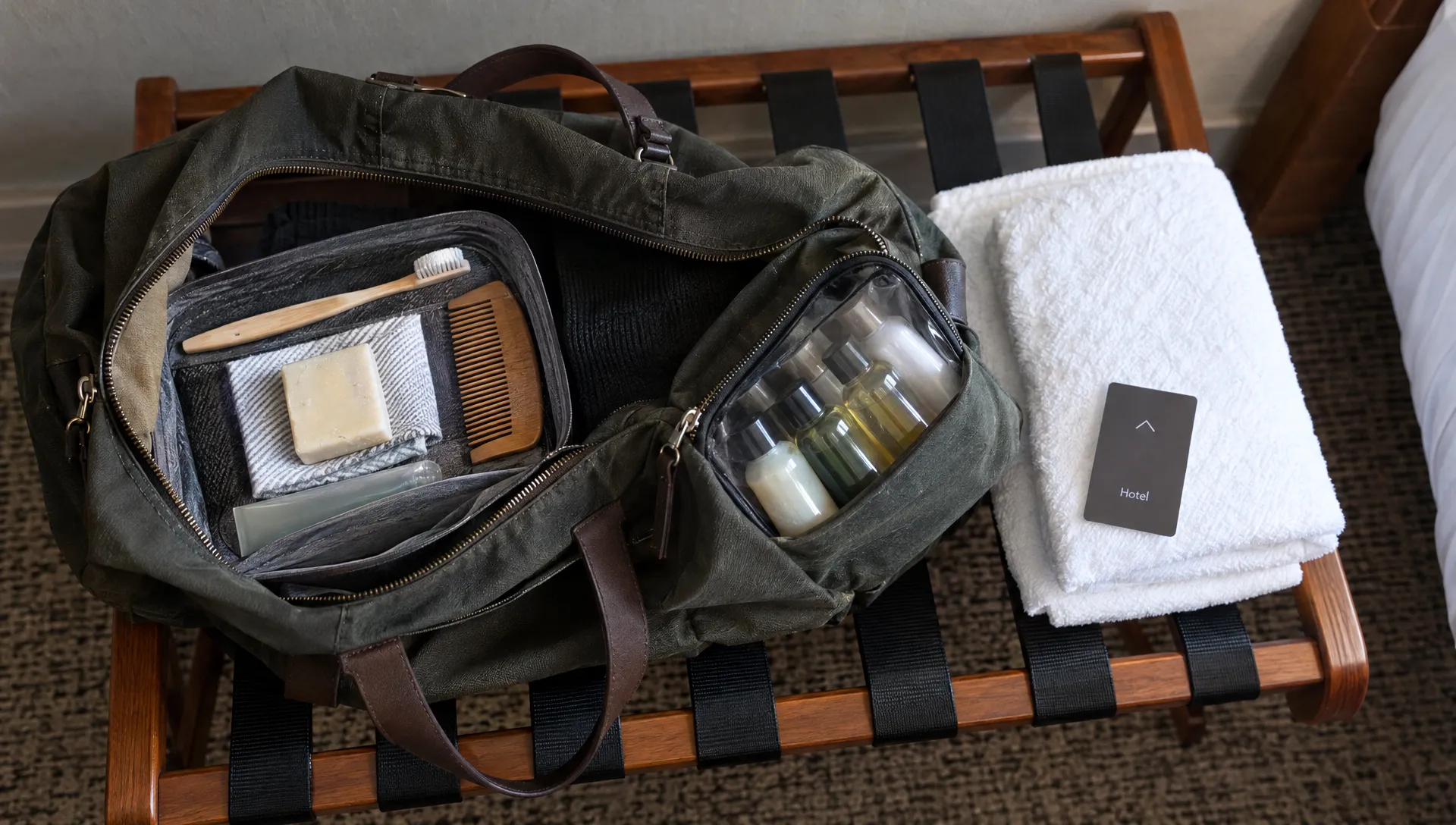
A well-packed airport toiletries bag keeps restricted liquids together, closes without a struggle and comes out of your carry-on without unpacking everything else. The key is to separate your security liquids pouch from your general wash bag, then check that every container meets the rules for your journey.
For a trip involving standard liquid restrictions, that means containers no larger than 100ml (3.4 ounces), packed into the permitted clear bag. But the bag requirements and screening procedure can differ between airports, so start with your route before choosing what to pack.
Check every airport where you will go through security
Check your departure airport, any connection where you must pass through security again and your return airport. Do not assume a larger bottle allowed outbound will be accepted on the way home.
For US checkpoints, the TSA liquids rule allows liquids, gels, creams, pastes and aerosols in containers of 3.4 ounces (100ml) or less, inside one quart-size bag per passenger. Exceptions apply to certain items, including medically necessary liquids.
Elsewhere, follow the airport’s published requirements. For example, UK government guidance on hand-luggage liquids directs travelers to check their departure airport because permitted quantities can vary.
If any checkpoint is unclear, packing ordinary toiletries in containers of 100ml or less is the safer fallback. Our guide to planning toiletries for the return journey explains why checking only the outbound flight can leave you caught out.
What size should an airport toiletries bag be?
Choose the pouch according to the security bag limit, not the size of your suitcase or the number of days you are traveling.
For TSA screening, use a clear, quart-size resealable bag. At airports applying a one-liter clear-bag rule, check their stated dimensions and closure requirements. A US quart and a liter are close in volume, but they are not identical measurements.
A large transparent cosmetics case is not automatically suitable. Neither is a multi-compartment hanging organizer simply because you can see through it. Check the pouch’s stated capacity and dimensions against the relevant airport’s instructions.
A plain resealable plastic bag is often the simplest option. A reusable clear pouch can also work if it meets the applicable requirements and closes properly. Treat retailer descriptions such as “TSA approved” as marketing, not a guarantee that any size or design will pass.
Keep your larger wash bag for dry toiletries. The clear pouch can travel inside it, provided you can retrieve it easily when required.
Separate liquids from dry toiletries before packing
The most useful airport toiletries bag contains the products subject to liquid restrictions, rather than every item in your bathroom routine. Empty your wash bag onto a clean surface and sort by product form.
- Put liquid-rule products together: Shampoo, conditioner, toothpaste, face cream, sunscreen lotion, mascara, lip gloss and liquid or gel deodorant belong in this group.
- Keep ordinary solid toiletries outside the liquids pouch: A toothbrush, solid soap, solid shampoo bar and genuinely solid stick deodorant generally do not use up your liquid-bag space.
- Set aside items needing separate checks: Medically necessary liquids and toiletries with unusual ingredients or aerosol packaging may need additional attention.
Judge the contents, not the product name. A solid deodorant stick and a roll-on deodorant do not have the same physical form. Likewise, a cleansing balm is not automatically exempt just because it does not pour.
If a product’s classification is unclear, check the airport or security authority’s guidance. Our explanation of toiletry rules by product type covers these distinctions without treating every bathroom product as a liquid.
Pack the pouch so it closes and stays dry
Check the capacity of every container
Before filling your airport toiletries bag, read each bottle’s capacity marking. Under a 100ml rule, a 200ml bottle containing only a small amount of shampoo is still too large. Security assesses the container’s capacity, not your estimate of what remains inside.
Choose travel containers with legible size markings and secure lids. Label decanted products so you can identify them later, but remember that a handwritten product label does not establish the bottle’s capacity.
Avoid transferring toiletries into food or drink containers. Use containers intended for the product, and keep anything with storage or packaging requirements in suitable packaging.
Reduce leaks without making inspection difficult
Leave a little space in refillable bottles rather than filling them to the rim. Clean product residue from the threads, tighten the caps and engage any built-in pump locks. If a pump has no reliable lock or cover, a screw-top travel container may be more practical.
Keep original protective caps on sprays and aerosols. A clear security pouch can contain a spill, but it does not make a poorly sealed bottle leakproof.
Load the pouch without forcing the closure
Place larger containers in first, then fit smaller tubes into the gaps. Keep lids away from the zipper where possible. The pouch should close normally, without stretching the seams or leaving an opening.
If it will not close, remove a product, choose a smaller container or replace a suitable liquid with a solid alternative. Do not solve the problem by adding a second liquids bag where only one is permitted.
A compact packing example
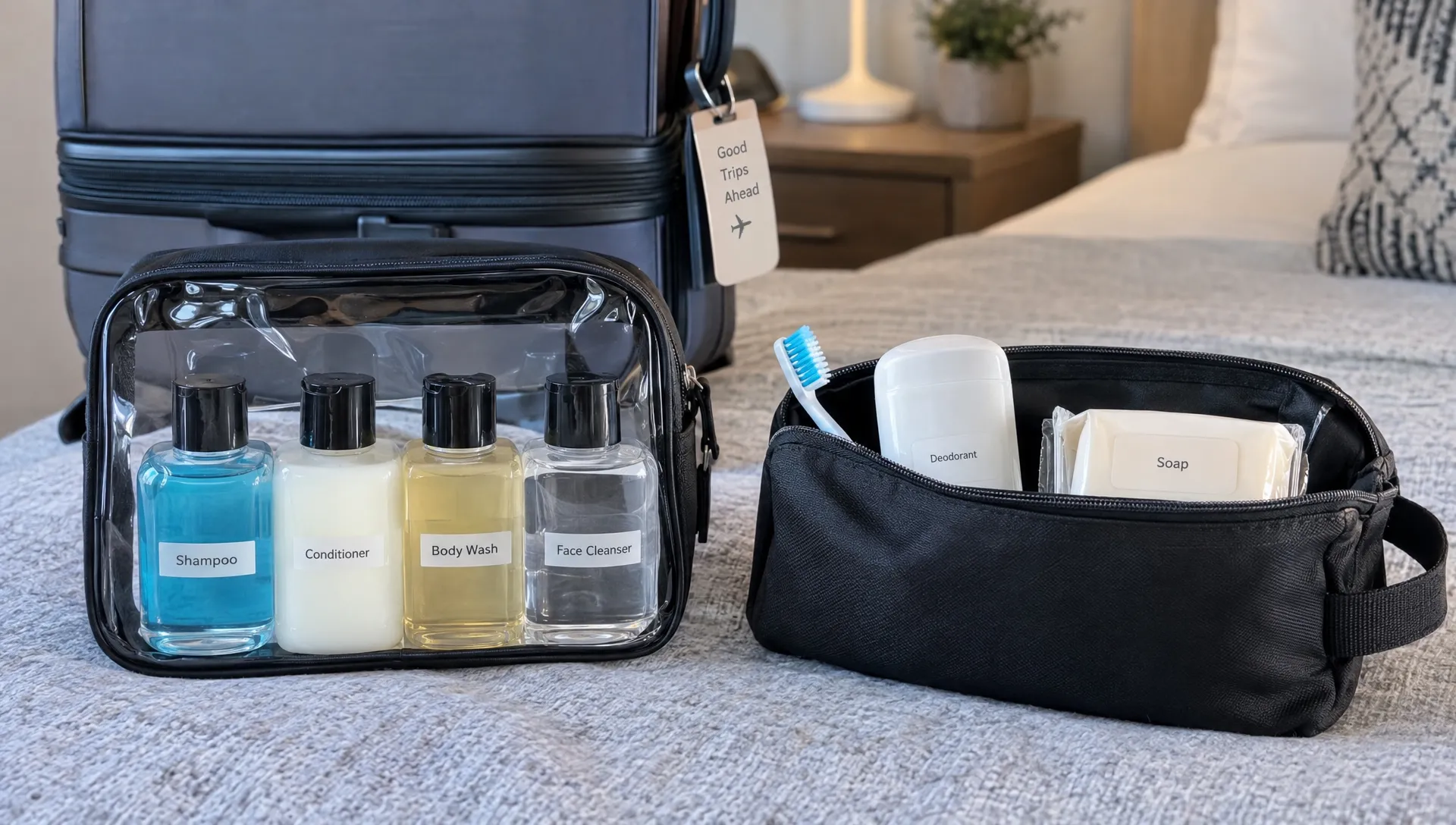
An airport toiletries bag works best when each item earns its space. The following is an illustrative selection, not a universal packing list or a promise that every pouch will accommodate it.
| Item | Example container capacity | Where to pack it under a standard liquids rule |
|---|---|---|
| Shampoo | 60ml | Inside the clear liquids pouch |
| Sunscreen lotion | 100ml | Inside the clear liquids pouch |
| Face moisturizer | 30ml | Inside the clear liquids pouch |
| Toothpaste | 25ml | Inside the clear liquids pouch |
| Solid stick deodorant | Not a liquid container | In the general wash bag |
| Toothbrush and dry comb | Not applicable | In the general wash bag |
Adjust the selection to your actual routine. If your accommodation provides a product you are happy to use, leaving your own bottle behind saves more space than squeezing it into another container.
Do not reduce necessary sunscreen use to make a small bottle last. Plan to buy more at your destination or carry a suitable supply in checked baggage, subject to applicable restrictions. Decanting everything into the smallest possible bottle is not useful if you run out halfway through the trip.
Keep medical exceptions separate from everyday cosmetics
Do not force medically necessary liquids into your ordinary toiletries allowance just to make everything fit one pouch.
At US checkpoints, TSA permits medically necessary liquids in reasonable quantities exceeding the usual limit, subject to additional screening. Tell the officer about them before screening begins and follow the instructions for presenting them separately.
For international travel, check the relevant authority’s rules on quantities, documentation and presentation. Do not assume an exception works identically in every country.
Keep these items accessible and clearly identifiable. Where practical, retain original labels and packaging. A prescription cream and a cosmetic face cream may look similar, but you should not treat a medical exception as spare capacity for unrelated cosmetics.
Other exceptions, including those for infant feeding, also have their own conditions. Check them separately rather than applying the ordinary toiletries checklist to everything you need.
Make the pouch easy to retrieve at security
Place your airport toiletries bag near the top of your carry-on or in an accessible compartment. Avoid burying it beneath shoes, tightly rolled clothing or electronics.
Before joining the queue, check that the pouch is closed and that no last-minute liquid has escaped the sorting process. Lip gloss in a handbag, hand cream in a jacket pocket and sanitizer attached to a backpack can all be overlooked.
At the checkpoint, follow the signs and staff instructions. Some screening arrangements require you to remove the liquids pouch; others allow it to remain inside your luggage. Permission to leave liquids packed does not, by itself, mean larger containers are allowed.
If staff need to inspect a product, having it labeled and easy to reach makes the process simpler. Allow time for additional screening even when you have packed carefully.
After screening, check that caps remain secure and return the pouch to an accessible position. You may need it again at a connecting airport, not just at your destination.
Frequently asked questions
Does an airport toiletries bag still need to be clear in 2026? For the standard TSA liquids allowance, use a clear, quart-size resealable bag. Other airports may have different arrangements. Follow the published rules for each checkpoint rather than assuming all airports have changed their requirements.
Can I use two liquids bags if they are both small? Under the standard TSA rule, each passenger is allowed one quart-size liquids bag across their carry-on belongings. Splitting toiletries between a suitcase and a personal item does not create a second allowance. Check separate conditions for exempt items.
Can I bring a half-empty bottle larger than 100ml? Not under a standard 100ml container limit for ordinary toiletries. Transfer the product into a suitable container of 100ml or less, leave it behind or pack it in checked baggage if permitted.
Should I put my passport or wallet loose in a TSA bin? Keep small valuables secured inside your carry-on when possible, rather than placing them loose in a tray where they are easier to overlook. Follow any specific instructions from screening staff. This is an organization precaution, not a liquids rule.
Check your route before you zip up
Once the pouch is packed, compare it with the requirements for your full itinerary. Check your trip with Liquid Limits to review airport liquid rules for both directions, with source links and last-checked dates.
If the rules are unclear, Liquid Limits defaults to the stricter 100ml rule. Pack to that fallback, keep your clear pouch accessible and recheck before departure rather than relying on what happened on a previous flight.