Packing toiletries on flights means planning for the journey home, not just the first security line. A shampoo bottle that passes your departure airport may be too large at your return airport. The same problem can affect sunscreen bought during your stay, hotel toiletries you decide to keep and a nearly empty deodorant can.
The simplest approach is to build a kit that meets the strictest confirmed requirements at every checkpoint where you will be screened. Then decide, before buying or refilling anything, how it will travel home.
That does not mean every traveler needs to buy miniature versions of everything. It means separating the products you need in the cabin from those you can check, use up or leave behind. A little planning also keeps you from paying for checked baggage solely to rescue a bottle you could have packed differently.
Why toiletries on flights need a checkpoint-by-checkpoint plan
Airport liquid restrictions apply when you pass through security. Permission at your outbound airport does not carry over to another airport, even when both flights are on the same booking or operated by the same airline.
For example, the TSA liquids rule generally allows liquids, gels and aerosols in containers of 3.4 ounces (100 milliliters) or less, packed in one quart-sized, clear, resealable bag per passenger. Exceptions apply to certain items, including medically necessary liquids.
Elsewhere, requirements can differ. The UK government's hand-luggage guidance explains that some airports allow containers holding up to 2 liters, while most apply a 100 ml container limit. You must check the airport's rules rather than assume a particular scanner means larger bottles are permitted.
Your route may also include a connection where you are screened again. This can happen after collecting baggage, changing terminals or following a transfer route that takes you through security. Check the actual connection arrangements, not just the flight itinerary.
A dependable plan for toiletries on flights therefore covers each screening point: departure, any connection requiring another check and the return journey. Record the container limit, liquids-bag requirement and any relevant exception separately. Permission to leave liquids inside your luggage does not necessarily mean permission to bring larger containers.
Give each bottle a job on the return journey
Instead of treating your wash bag as one item, decide what happens to each product after the trip. This is especially useful when you leave with checked baggage but return with cabin baggage only.
Use four possible outcomes: carry home, check home, finish during the stay or leave behind responsibly. A product without an assigned outcome is the one most likely to cause a last-minute problem.
Here is a hypothetical plan for a traveler whose return airport applies a 100 ml cabin-container limit:
| Product | Outbound arrangement | Return-trip decision |
|---|---|---|
| Shampoo | Small refillable bottle in the liquids bag | Bring home in the same compliant container |
| Full-size sunscreen | Packed in checked baggage | Check it again or transfer remaining product into a suitable compliant bottle |
| Liquid deodorant | Container of 100 ml or less | Keep space for it in the return liquids bag |
| Hotel shower gel | Supplied at the destination | Take only if the container and packed bag meet return rules |
| Newly purchased face cream | Bought during the stay | Check its labeled capacity before deciding how to bring it home |
When planning toiletries on flights, container capacity matters more than the amount left inside under a standard 100 ml rule. A 200 ml bottle containing only a little shampoo is still an oversized liquid container. Using half the product does not turn it into a travel-size bottle.
Keep capacity markings visible on refillable bottles. They make the size easier to establish than an unmarked container whose volume is difficult to judge.
Reserve space for destination purchases
A return liquids bag often contains more items than the outbound bag. You might buy moisturizer, collect hotel minis or replace a product that runs out. Each addition needs to fit within the applicable bag allowance, not just meet the individual container limit.
Leave some space when packing at home rather than starting with a bag that barely closes. If you expect to shop for skincare or perfume, decide whether those purchases will travel in checked baggage before you buy them.
Products bought after outbound security also need a return plan. An ordinary shop receipt does not make a large bottle exempt at a later checkpoint. Special arrangements for duty-free liquids depend on the route, sealed packaging and local rules, so do not assume every purchase is protected.
The useful shopping question for toiletries on flights is not simply whether you can buy a product at your destination. It is whether you have a compliant way to bring the remaining product home.
Use your stay to prepare the return bag
You can avoid much of the final-morning sorting by keeping cabin-safe products separate throughout the trip. Use one pouch for the items intended for your return liquids bag and another for larger bottles that must be checked or left behind.
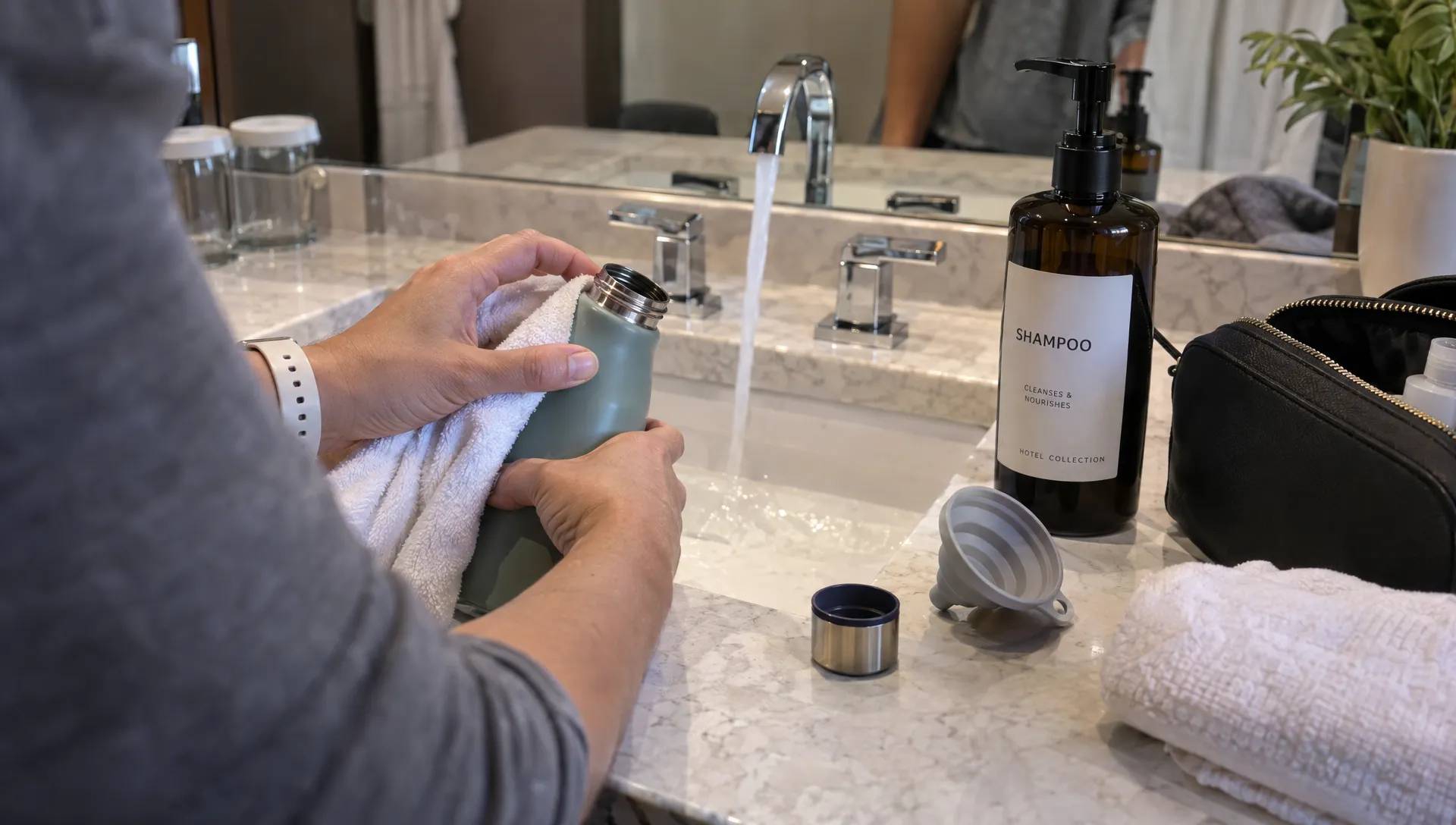
This makes replacements easier to manage. If your small conditioner bottle runs out, refill it during the stay rather than dropping a full-size replacement into your cabin bag. Wash and dry reusable containers appropriately between different products, and use bottles compatible with their contents.
Do not transfer products into unsuitable containers simply to save them. Thin liquids can leak from jars, some formulations require their original packaging and aerosols cannot be decanted like shampoo. Keep medication in packaging that supports identification, and check the relevant rules before changing it.
For a longer stay, reassess supplies a few days before departure. You may need enough sunscreen or toothpaste for the remaining days but not another large bottle. A smaller replacement can be the better purchase when the return flight is cabin-only.
Treat this as inventory management, not a reason to ration essential products. The aim is to have what you need during the trip and a sensible destination for whatever remains.
Choose what to decant, check or leave behind
Decant suitable liquids into compliant containers
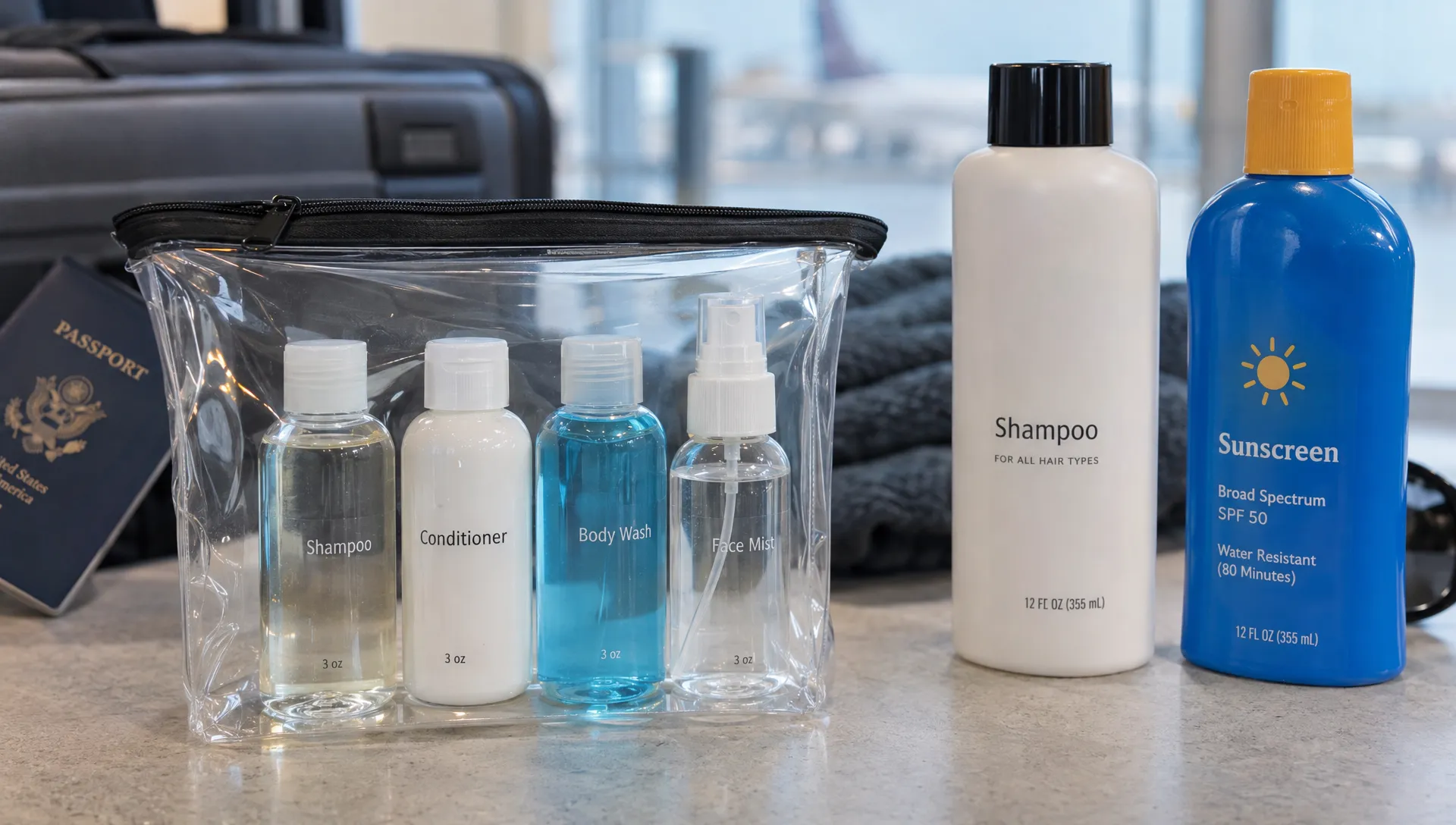
Transferring ordinary shampoo, conditioner or body wash can work when you have suitable travel bottles. Check each bottle's capacity and make sure the complete set fits the return airport's required liquids bag.
Label the contents so you do not confuse products. A 100 ml container limit is a ceiling, not a target: several smaller bottles may suit your routine better than filling every container to the maximum.
Decanting toiletries on flights is most useful when it solves both restrictions at once: the individual bottle limit and the overall bag requirement. Moving everything into smaller bottles will not help if you still have too many to fit.
Check larger products when your booking allows it
Checked baggage can provide a route home for larger toiletries, but it is not an unlimited allowance. Airline baggage conditions and dangerous-goods restrictions still apply, especially to aerosols and flammable products.
Keep lids secure and contain possible leaks separately from clothing. If your return fare does not include a checked bag, compare the baggage charge with the value of the products you want to keep before making a decision.
Different formulations need different treatment. Liquid roll-on deodorant, solid stick deodorant and aerosol deodorant are not interchangeable for packing purposes. Review the toiletries rules for aerosols, razors and gels when your kit includes more than ordinary bottled liquids.
Leave products behind responsibly
Sometimes the practical choice is not to bring a product home. Arrange this before reaching the airport: offer a usable item to a willing travel companion or ask your accommodation whether it can accept it. Do not assume hotels can redistribute opened toiletries.
Follow local disposal instructions for unwanted products, particularly pressurized containers. An airport security bin should be the last resort, not your planned disposal method.
Run a final check before leaving your accommodation
Your final check should use the bag you will actually carry through security. A plan made for a suitcase does not help if you later move its contents into a backpack.
For toiletries on flights, check both the products and the route again shortly before departure. Airport arrangements can change, and a replacement flight or connection may introduce a different screening point.
A short return-day check is enough:
- Confirm the checkpoint rules: Check the return airport and any connection where you will be screened again.
- Read container capacities: Look at the labeled size, not how full each bottle feels.
- Close the liquids bag: Make sure everything fits as required without adding a second bag for another cabin item.
- Separate exceptions: Check official guidance for medically necessary liquids and present them as instructed.
- Keep checked items out of the cabin bag: Repack before checking your suitcase, when you can still access it.
Remember products outside your usual wash bag. Hand sanitizer in a jacket, lip gloss in a handbag and toothpaste in an overnight pouch can all need to join the same liquids allowance.
If you are uncertain whether a product counts as a liquid, use this guide to toiletries in hand luggage by product type to review the item rather than guessing from its packaging.
Frequently asked questions
Can I take 200 ml of deodorant on a plane? A 200 ml liquid roll-on or aerosol deodorant generally cannot pass a checkpoint applying a 100 ml cabin-container limit, even if partly used. An airport with a confirmed larger allowance may permit it, subject to other restrictions. Checked baggage may be an option, but aerosol safety limits and airline conditions still apply. A solid deodorant stick is treated differently from liquid deodorant.
Does hand sanitizer count as a liquid under TSA rules? Yes. Ordinary hand sanitizer follows the standard TSA liquids allowance: a container of 3.4 ounces (100 ml) or less in your quart-sized liquids bag. Include the bottle you keep in a pocket when checking your return packing, and check local rules when departing outside the United States.
How much liquid can I bring in a personal item? A separate personal item does not create another TSA liquids allowance. The standard limit is one quart-sized liquids bag per passenger, not one per backpack, purse or carry-on suitcase. Other airports may specify different bag requirements, so check each departure point.
Can I bring powder on a plane? Usually, yes, but additional screening can apply. TSA's powder guidance says powder-like substances greater than 12 ounces (350 ml) must be placed separately for X-ray screening and may require additional checks or opening. TSA encourages packing nonessential powders above that amount in checked baggage. Powders do not automatically belong in the liquids bag, but your return airport may have its own requirements.
What if I cannot confirm the return airport's rules? For ordinary toiletries on flights, a conservative plan is containers no larger than 100 ml in a clear, resealable liquids bag, while also checking local bag-size requirements. Do not treat that fallback as a substitute for checking medication exceptions or dangerous-goods restrictions.
Check both directions before you pack
Use Liquid Limits to check your trip's liquid rules before choosing your bottles, then review the journey home before your return flight. The trip checker covers round trips, with source links and last-checked dates to help you inspect the guidance.
Liquid Limits updates rules daily and defaults to the stricter 100 ml rule when requirements are unclear. Save your trip so you can revisit it, and plan purchases around the strictest confirmed checkpoint. That gives every product a route home before it reaches your wash bag.