Taking toiletries through airport security involves two different checks: whether your products meet the checkpoint’s rules and whether security staff can clear them through screening. A correctly packed shampoo bottle can still need inspection, while a bottle that scans without concern can still exceed the permitted container size.
Your toiletry bag normally travels through a baggage scanner, not the body scanner you walk through. Depending on the equipment and local procedure, you may leave it inside your carry-on or place your liquids bag separately in a tray. Understanding what happens next makes an unexpected bag search less confusing and helps you prepare without assuming every airport works the same way.
How scanners examine toiletries through airport security
At the checkpoint, officers use images of your belongings to assess their contents and identify anything requiring further examination. Toiletries appear alongside the other objects in your bag, including electronics, clothing and accessories.
Conventional baggage X-ray systems provide projection images. Computed tomography, commonly called CT, produces three-dimensional images that officers can examine from different angles. The TSA’s explanation of CT screening describes how this technology helps officers assess carry-on contents and can allow liquids to remain inside bags at equipped checkpoints.
The scanner’s assessment and the liquid allowance are separate issues. Better imaging does not automatically mean that larger bottles are permitted.
Officers may need an additional check when the image does not provide enough information to clear an item. That does not mean your moisturizer is prohibited or that you packed incorrectly. Screening decisions depend on the contents of the bag, the equipment and the checkpoint’s procedures.
A scanner also does not replace a check of container capacity. Officers can inspect the bottle itself to determine whether it meets the applicable limit. A mostly empty oversized container is not equivalent to a smaller travel bottle.
How your toiletries are classified
Security rules use “liquids” more broadly than everyday conversation does. Toothpaste, shaving foam and hair gel generally belong in the same restricted category as shampoo, even though they do not pour like water.
Getting toiletries through airport security starts with classifying each product by its actual form, rather than by the name on its packaging.
| Toiletry | How it is generally treated for liquid restrictions | What to prepare |
|---|---|---|
| Shampoo, conditioner and mouthwash | Liquids | Containers within the checkpoint’s allowance |
| Toothpaste, moisturizer and hair gel | Pastes, creams or gels covered by liquid rules | Include them with restricted liquids where required |
| Shaving foam and spray deodorant | Aerosols covered by liquid rules | Check container limits and any separate aerosol restrictions |
| Solid soap and solid shampoo bars | Solids | Usually do not need space in the liquids bag |
| Solid stick deodorant | Generally treated as a solid | Confirm it is a solid stick, not a gel or spray |
A product’s format can change its treatment. Solid deodorant and aerosol deodorant are not interchangeable for packing purposes. For a fuller comparison, use the guide to toiletries in hand luggage by product type.
Non-liquid toiletries still undergo screening. Razors, scissors and other grooming tools have their own rules, so fitting something into a toiletry bag does not establish that it is permitted.
What happens when your bag reaches the tray
Before loading your belongings, follow the signs and instructions for your specific lane. Airports can have different screening equipment, and procedures may even differ between lanes in the same terminal.
Where separate presentation is required, remove the liquids bag from your carry-on and place it in the tray as directed. Where liquids may stay packed, leave them inside unless an officer asks you to remove them. Do not rely on what happened at a previous airport.
When taking toiletries through airport security, keeping the liquids bag accessible makes either procedure easier. You should be able to retrieve it without emptying your entire suitcase onto the preparation counter.
Once your bag enters the scanner, wait until staff release it. If it is diverted for inspection, let the officer retrieve and handle it according to local procedure. Tell them where the toiletries are and mention any item that needs special handling, such as a medically necessary liquid.
There is no need to open every bottle beforehand. Present your belongings as instructed, then respond to any request for closer examination.
What an additional toiletry check involves
Opening the bag and inspecting containers
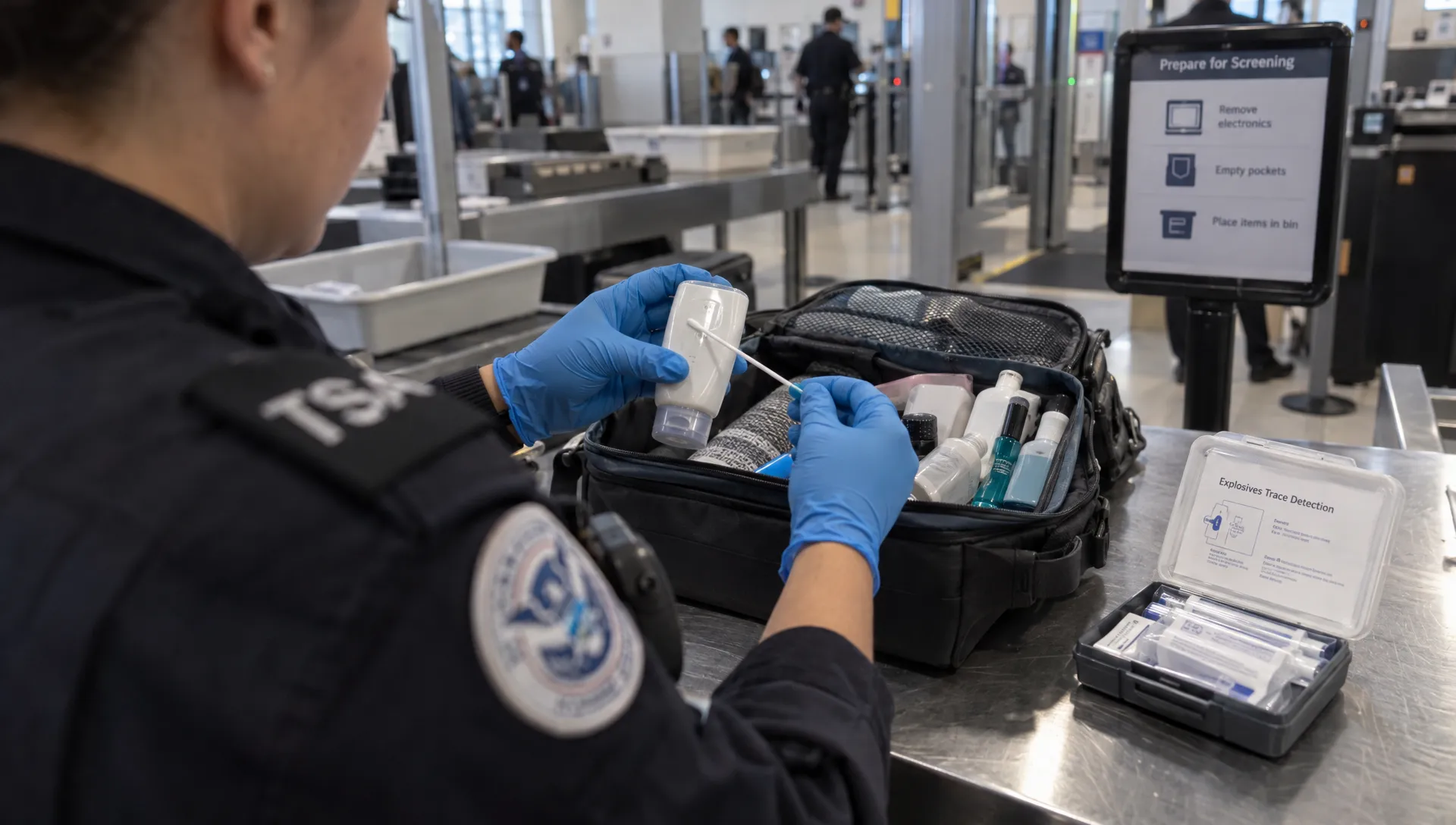
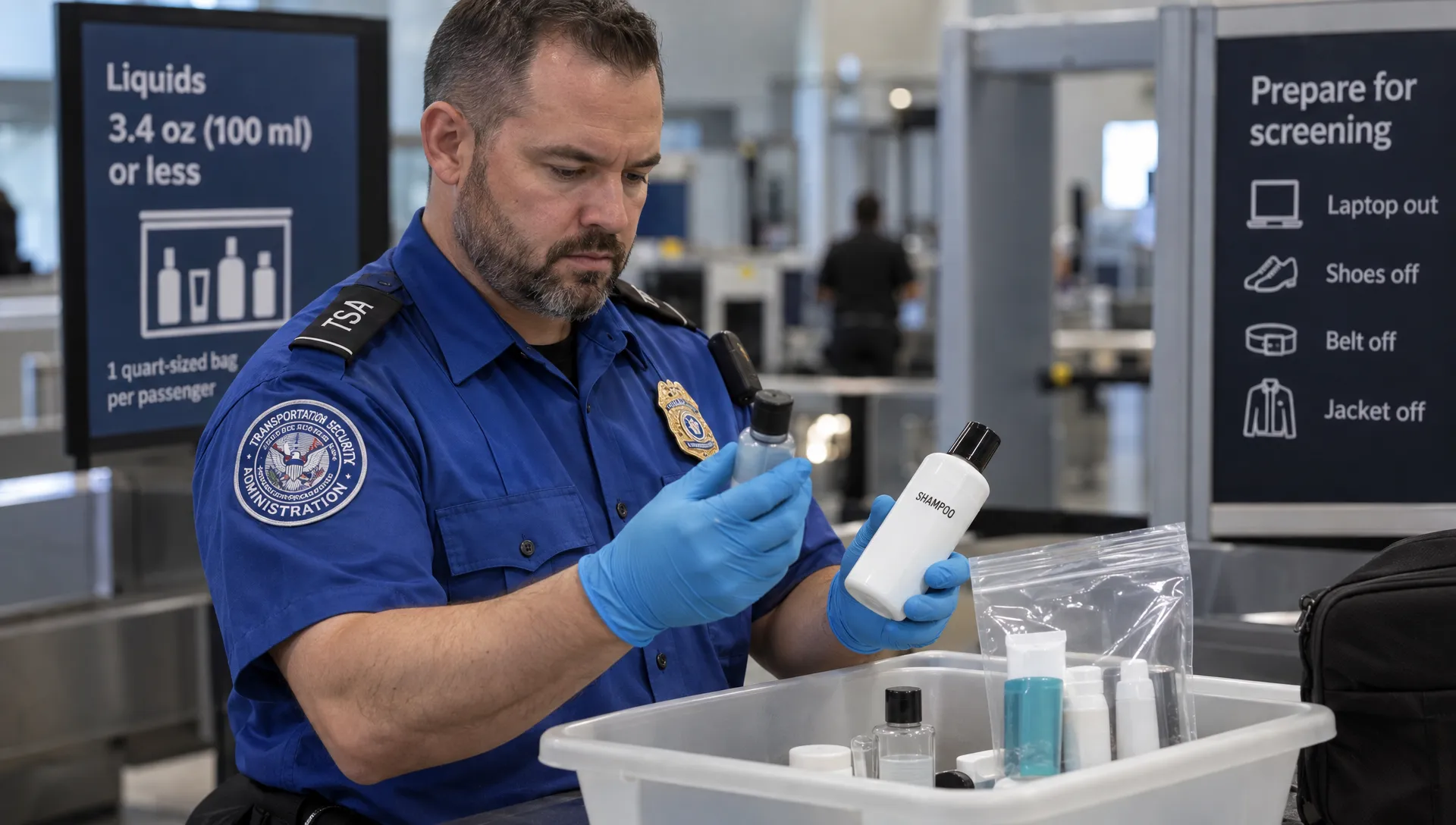
An officer may open your carry-on, remove the toiletry pouch and examine individual products. This can involve checking the container’s stated capacity, looking at the product or separating it from surrounding objects for another scan.
Several products packed tightly together can make assessment less straightforward. However, there is no packing arrangement that guarantees your bag will never be searched.
An extra check when taking toiletries through airport security is not automatically a sign that an item is banned. The officer may simply need more information before clearing it.
If a container exceeds the applicable allowance, explaining that it is only partly full generally will not solve the problem. Under a container-capacity rule, the bottle’s maximum capacity is what matters. Your options may include returning to check-in, giving the item to someone outside security or surrendering it, depending on the airport and how much time you have.
Swabs and other additional screening
Security staff may use a swab to collect a sample from an item or surface for explosives trace testing. This is a security check, not a routine analysis of your shampoo’s cosmetic ingredients.
Depending on the checkpoint and item, officers may also use other screening methods or ask to open a container. Do not assume every airport uses the same test or that every bottle inspection follows the same sequence.
If you are unsure what is being requested, ask before opening or moving anything. Calm, specific information about the product is more useful than trying to guess why it was selected. The guide to toiletries that get flagged at airport security covers common packing issues in more detail.
Why a newer scanner does not guarantee larger bottles
Two permissions are easy to confuse: permission to leave liquids inside your bag and permission to bring containers larger than 100 mL. They are not the same.
For US checkpoints, the TSA liquids rule sets the standard allowance at containers of 3.4 ounces (100 mL) or less, fitting inside one quart-sized bag per passenger, subject to specified exceptions. CT screening does not by itself remove that allowance.
Other airports may publish different limits or bag requirements. The UK government’s hand-luggage guidance, for example, directs travelers to check the airport’s rules because allowances and presentation requirements can vary.
Permission to take toiletries through airport security comes from the checkpoint’s published rules, not from the scanner’s appearance. A sign saying “leave liquids in your bag” is not permission to carry a full-size shampoo bottle.
Check your departure airport, any connection where you will be screened again and your return airport. A product allowed on the outward journey may not be allowed through the checkpoint on the way home. When the rule is unclear, packing within the stricter 100 mL allowance is the safer choice.
Medical liquids need a separate conversation
Some medically necessary liquids can qualify for exceptions to ordinary liquid limits. The exact requirements depend on the security authority, so check its guidance before traveling.
For TSA screening, medically necessary liquids may be allowed in reasonable quantities above the standard limit. Travelers should declare them to the officer for inspection, and they do not have to fit inside the ordinary quart-sized liquids bag.
Medical exceptions can change how you take toiletries through airport security, but an ordinary cosmetic does not become exempt simply because it is useful or expensive. A prescribed skin treatment and a routine moisturizer may require different handling.
Keep any relevant prescription information or supporting documentation accessible where applicable. Tell the officer about the item before screening rather than waiting for it to be discovered during a bag search. Additional inspection may still be required.
If you need a product to remain unopened or have another handling concern, explain that before the inspection begins and ask what screening options are available. Do not assume that a medical exception means the item bypasses security checks.
Frequently asked questions
Can I take unlabeled toiletries through airport security? An unlabeled travel bottle is not automatically prohibited under the TSA’s standard liquids rule. However, its capacity must meet the allowance, and officers may need to examine it further. Clearly marked container sizes make the capacity easier to verify.
Do I have to remove my toiletry bag at every airport? No. Some checkpoints require liquids to be presented separately, while others allow them to stay inside your carry-on. Follow the instructions for your lane, even if they differ from your last trip.
Can a half-full 200 mL shampoo bottle pass a 100 mL checkpoint? Generally, no. Ordinary liquid restrictions are based on container capacity, not the amount remaining. Transfer the product into a compliant container before traveling, put it in checked baggage if permitted or leave it behind.
Does a bag search mean my toiletries will be confiscated? No. An inspection may end with all your items being cleared. If a product is not permitted, staff will explain the available options. Whether you can return to check-in or leave security to make other arrangements depends on the airport and your schedule.
Check every checkpoint before packing
The most useful preparation is to separate three questions: what counts as a liquid, what container sizes are permitted and how the items must be presented for screening.
Use Liquid Limits to check your trip’s liquid rules, including the return flight. Its airport and route checks provide source links and last-checked dates, with a stricter 100 mL fallback when rules are unclear. Pack for the strictest checkpoint where you expect to be screened, then follow the lane’s instructions on arrival.