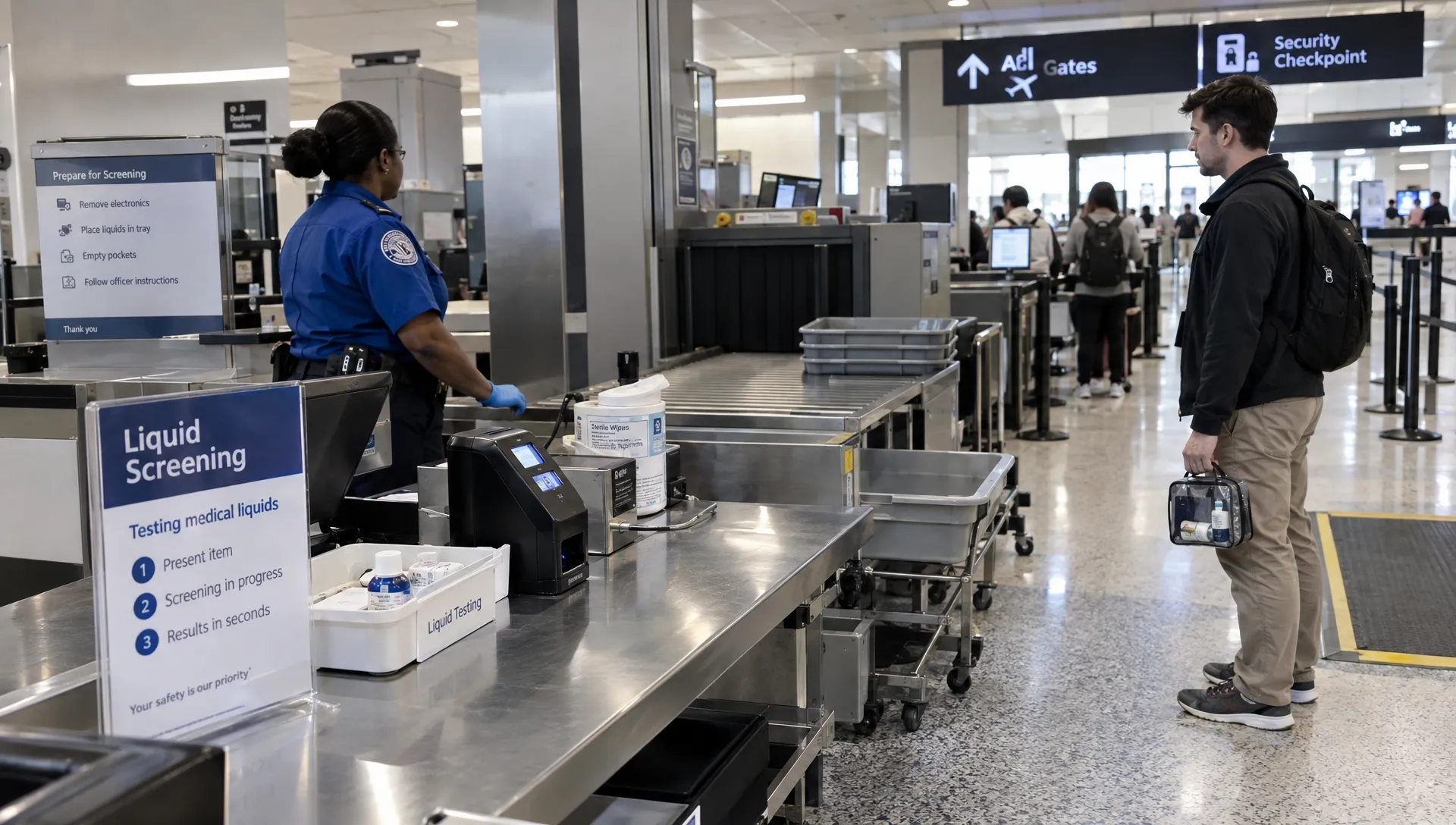
The requirements for liquids when flying are different for medically necessary items than for ordinary toiletries. Liquid medicines, prescribed creams and some cooling supplies can qualify for exceptions to standard cabin liquid limits, including containers larger than 100ml. That does not mean they bypass security screening or that every country handles them the same way.
For travelers carrying insulin, liquid pain relief, injectable treatments or medical nutrition, preparation has three parts: establishing the medical need, packing the supplies for inspection and checking every security checkpoint on the itinerary. Permission to pass airport security is also separate from permission to import a medicine into another country.
This guide focuses on those medical exceptions, including what to declare, which documents help and how to protect temperature-sensitive treatments during a round trip.
How medical exceptions change the requirements for liquids when flying
Where the standard 100ml cabin rule applies, the limit usually concerns container capacity, not the amount remaining inside. A half-empty 200ml bottle of ordinary shampoo does not become compliant. A medically necessary liquid in the same-sized container may qualify for an exemption.
Security authorities can still inspect, test or otherwise screen exempt items. An exemption is permission to carry a qualifying item under different conditions, not a promise that it can remain untouched in your bag.
Separate medically necessary supplies from ordinary toiletries. Sunscreen, cosmetics and routine drinks do not automatically qualify just because they are packed beside a prescription. For nonessential products, follow the airport’s normal carry-on liquid limits and bag requirements.
The requirements for liquids when flying with medical supplies depend on the checkpoint’s rules, the purpose of the item and any evidence the authority requests. A pharmacy label helps explain what you are carrying, but it does not replace checking local policy.
Medical liquid exemptions in the US, UK and EU
United States: declare liquid medication before screening
The Transportation Security Administration’s guidance on liquid medications allows medically necessary liquids in reasonable quantities above the usual carry-on liquid limit. These do not have to fit in the standard quart-sized liquids bag.
Tell the officer about them at the start of screening and make them available for separate inspection. Additional screening may be necessary, and you may be asked to open a container.
TSA does not require prescription medicines to be in prescription bottles, although state labeling laws may apply. Keeping the original labeled packaging remains useful, especially when continuing internationally. Do not interpret TSA permission as approval from a foreign customs authority.
United Kingdom: evidence matters for larger liquid medicines
The UK government’s guidance on essential medicines and medical equipment permits essential liquid medicines over 100ml in hand luggage, subject to screening.
It states that you need supporting evidence, such as a doctor’s letter or a copy of your prescription, when the medicine is both liquid and in a container larger than 100ml. Airport staff may need to open containers to screen their contents.
This is a useful example of why the requirements for liquids when flying should be checked by country: paperwork that is not routinely required by TSA may be necessary at a UK checkpoint.
European Union: medicines have an exception, but check local procedures
The EU’s hand-luggage guidance identifies medicines as an exception to the normal liquid restrictions. Security staff may ask you to demonstrate their authenticity.
Check the departure airport’s official instructions for presentation and supporting evidence. Do not assume a new scanner removes the need to declare medical liquids or that procedures will match those at your outbound airport.
What documents should you carry?
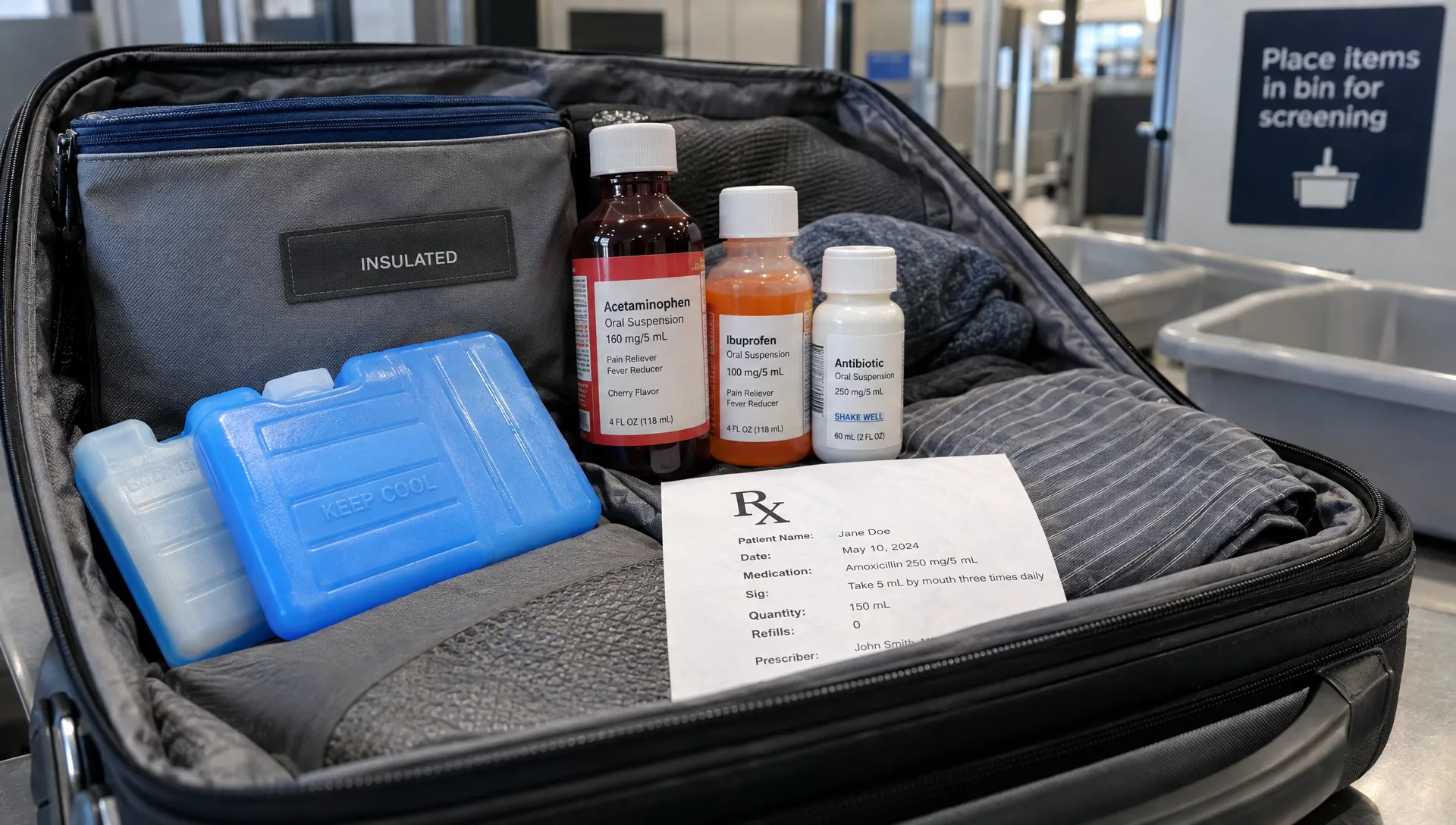
Carry enough information to explain what the medicine is, who it is for and why the quantity or equipment is needed. Original packaging is helpful because it connects the product with its name, strength and dispensing instructions.
A clinician’s letter is particularly useful for larger liquid containers, injectable medicines, temperature-sensitive treatments or substantial supplies. Where required, obtain it before departure rather than relying on a prescription app or a photograph of the packaging.
| Document or label | What it helps establish | Important limitation |
|---|---|---|
| Pharmacy label or original packaging | Medicine name, strength and intended patient where labeled | Does not establish permission to import the medicine |
| Prescription copy | Prescribed treatment and patient details | May not satisfy every country’s documentation rules |
| Clinician’s letter | Medical need, required supplies and storage needs | Does not guarantee exemption from screening |
| Import authorization, where required | Destination-specific permission for restricted medicine | Is separate from airport liquid screening |
A useful letter identifies the medicine by its generic name as well as the brand, explains the necessary supplies and describes relevant storage requirements. Ask the destination authority whether it needs a translation or a particular format.
Documentation supports the requirements for liquids when flying, but international medicine rules need a separate check. This is especially important for controlled medicines and products whose legal status differs between countries.
Keeping liquid medicine cold during travel
A medical liquid exemption does not solve temperature control. Before packing, ask a pharmacist or the manufacturer how long the treatment can remain outside its recommended temperature range and whether freezing would damage it.
An insulated pouch with cooling packs may be appropriate, but avoid placing medicine directly against a frozen pack unless its storage instructions permit that. Some treatments can be damaged by freezing as well as by heat.
For US screening, TSA’s guidance for travelers with medical conditions covers medically necessary liquids and associated supplies, including cooling packs. Medically necessary packs can be considered even when partially frozen or melted, although additional screening may apply. Declare their medical purpose rather than assuming the rule for an ordinary lunch-box ice pack applies.
Check the return airport’s policy too. You may leave home with solid packs and reach the return checkpoint with thawed ones. Build cooling time around transfers, queues and delays, not just the scheduled flight duration.
The requirements for liquids when flying with refrigerated treatment therefore involve both the medicine and its cooling accessories. If you plan to use dry ice, obtain the airline’s dangerous-goods instructions first; it is not interchangeable with a gel pack and must not be sealed in an airtight container.
What to do at the security checkpoint
Keep essential medicine in an accessible part of your cabin baggage. It is harder to explain and present supplies when they are buried beneath clothing or spread across several bags.
At the beginning of screening, tell the officer that you have medically necessary liquids and identify any associated cooling packs, syringes or equipment. A straightforward explanation is enough to start: “This is my liquid medication, and these packs keep it at its required temperature.”
Use this sequence:
- Identify the supplies: Explain which items are medically necessary before screening begins.
- Present them as instructed: Remove or separate them when the officer asks, keeping labels and documents available.
- Explain handling concerns: Say if a container must stay sealed or a device has manufacturer restrictions, then ask which screening options are available.
- Check everything afterward: Confirm that medicine, cooling supplies and equipment have been returned before leaving the area.
Extra screening does not necessarily mean an item is prohibited. If an officer questions a supply, calmly ask how the medical-liquid policy applies and whether a supervisor can clarify it.
Understanding the requirements for liquids when flying helps you prepare for inspection, but it cannot guarantee a particular screening method. Allow additional time rather than treating an exemption as a faster route through security.
Check connections, return flights and customs separately
Your outbound airport is only one part of the journey. A transfer can involve another security checkpoint, particularly when changing terminals or entering a country before continuing. The return airport may have different documentation or cooling-pack rules.
Review each airport where you expect to pass through security. The principle behind checking liquid rules for outbound and return trips still applies, but medical exceptions need their own verification. A stricter ordinary liquid limit does not automatically mean essential medicine must be reduced to 100ml containers.
Customs checks are a different issue. A medicine can be acceptable at airport security yet restricted at your destination. Check the destination’s official health, customs or embassy guidance for quantity limits, controlled substances and advance authorization. Check transit-country requirements where relevant too.
For a longer trip, discuss the necessary supply and a sensible delay allowance with your clinician. Ask the relevant authority how it treats that quantity instead of assuming either “one flight’s worth” or an unlimited supply is permitted.
The requirements for liquids when flying are only one layer of this planning. Security permission, lawful importation and safe medicine storage all need to be satisfied independently.
Syringes, devices and medical nutrition need their own checks
Injectable medicines and medical devices
Pack injection supplies with the corresponding medicine so their purpose is clear. In the US, TSA permits unused syringes when accompanied by injectable medication and requires them to be declared for inspection. Used needles should be contained safely in an appropriate sharps container.
For insulin pumps, continuous glucose monitors and other attached devices, check the manufacturer’s screening guidance before travel. Do not assume every device can pass through every scanner. Explain any restrictions to security staff and ask about the available screening procedure.
Liquid nutrition and specialized supplies
Enteral feeds, medically necessary nutritional drinks and other liquid treatments may require a medical exception. Explain their purpose and confirm the permitted quantity, evidence and screening arrangements with the departure authority.
Do not assume every supplement or protein shake qualifies. Medical necessity is different from dietary preference, and a large supply can require more explanation than a single container.
The requirements for liquids when flying also do not override airline dangerous-goods rules. Medical oxygen, specialized aerosols and some powered equipment need separate airline checks even when medically essential.
A practical pre-flight packing check
Keep essential treatments in your cabin bag where permitted, rather than checking them simply to avoid liquid screening. Checked baggage can be delayed or lost, and its conditions may not meet the medicine’s storage requirements.
Before leaving home, confirm the following:
- Airport policies: Check medical-liquid rules at departure, any transfer checkpoint and the return airport.
- Evidence: Pack required letters, prescription copies and clearly labeled containers.
- Cooling: Verify storage limits and how cooling packs will be handled throughout the journey.
- Entry rules: Obtain any required medicine import permission and check quantity restrictions.
- Access: Keep essential doses reachable and remove them if your cabin bag is unexpectedly gate-checked.
Avoid decanting medicine into unmarked travel bottles solely to meet the toiletries rule. That can remove useful identification, complicate dosing and introduce storage problems. Ask your pharmacist before changing the medicine’s container.
Frequently asked questions
Can I take liquid medicine larger than 100ml in hand luggage? Often, yes, when it qualifies as medically necessary under the departure authority’s policy. Declare it for screening and carry any required evidence. UK rules specifically require supporting documentation for liquid medicine in containers larger than 100ml.
Does liquid medicine have to go in my toiletries bag? TSA does not require medically necessary liquids to fit in the standard quart-sized bag. Other authorities may use different presentation procedures. Keeping medical supplies together and separate from toiletries makes inspection easier.
Do nonprescription medicines qualify for an exception? A product does not always need to be prescribed to be medically necessary, but local rules determine how the exception applies. The requirements for liquids when flying should be checked for the particular product, especially when carrying a container above the ordinary limit.
Can I carry water to take my tablets? Do not assume an ordinary water bottle qualifies because you take medication. Ask the departure authority about medically necessary water if you need it through screening. Otherwise, carry an empty bottle and fill it after security where facilities are available.
Will the airline refrigerate my medicine? Do not rely on onboard refrigeration without explicit confirmation from the airline. Arrange a storage method that meets the medicine’s instructions throughout the journey, including delays and ground transport.
Check your whole route before packing
Use Liquid Limits to compare airport liquid rules for your outward journey and return flight, with source links and last-checked dates. Then confirm the medical exemption, documentation and cooling-pack procedures with the relevant security authority. For specialized supplies, check airline handling rules and destination medicine restrictions separately.