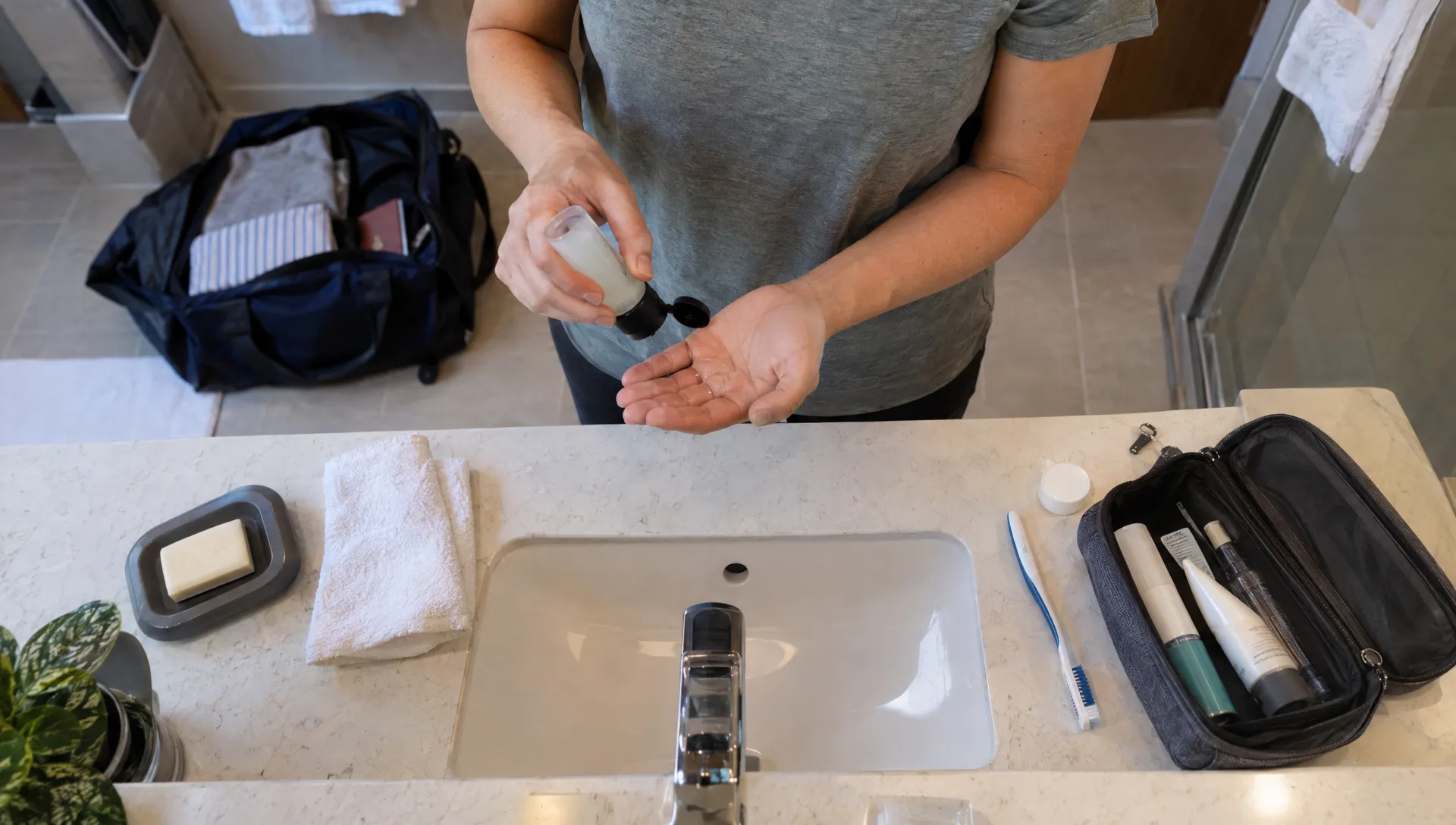
Searching for traveling with toiletries rules can turn up two different answers: one for your cabin bag and another for checked luggage. At airports using the standard liquid restriction, cabin toiletries must generally be in containers of 100 ml (3.4 fl oz) or less, packed together in the required clear liquids bag. Larger bottles usually belong in checked luggage, but aerosols and certain personal-care products still have safety limits.
The practical approach is to check three things separately: your container sizes, any dangerous-goods restrictions and the rules at every airport where you will pass through security.
Traveling with toiletries rules at a glance
This comparison uses the standard 100 ml cabin rule as a conservative packing baseline. An airport may explicitly permit larger cabin containers, but that permission does not automatically apply elsewhere on your trip.
| Toiletry | Cabin bag under the standard liquid rule | Checked bag |
|---|---|---|
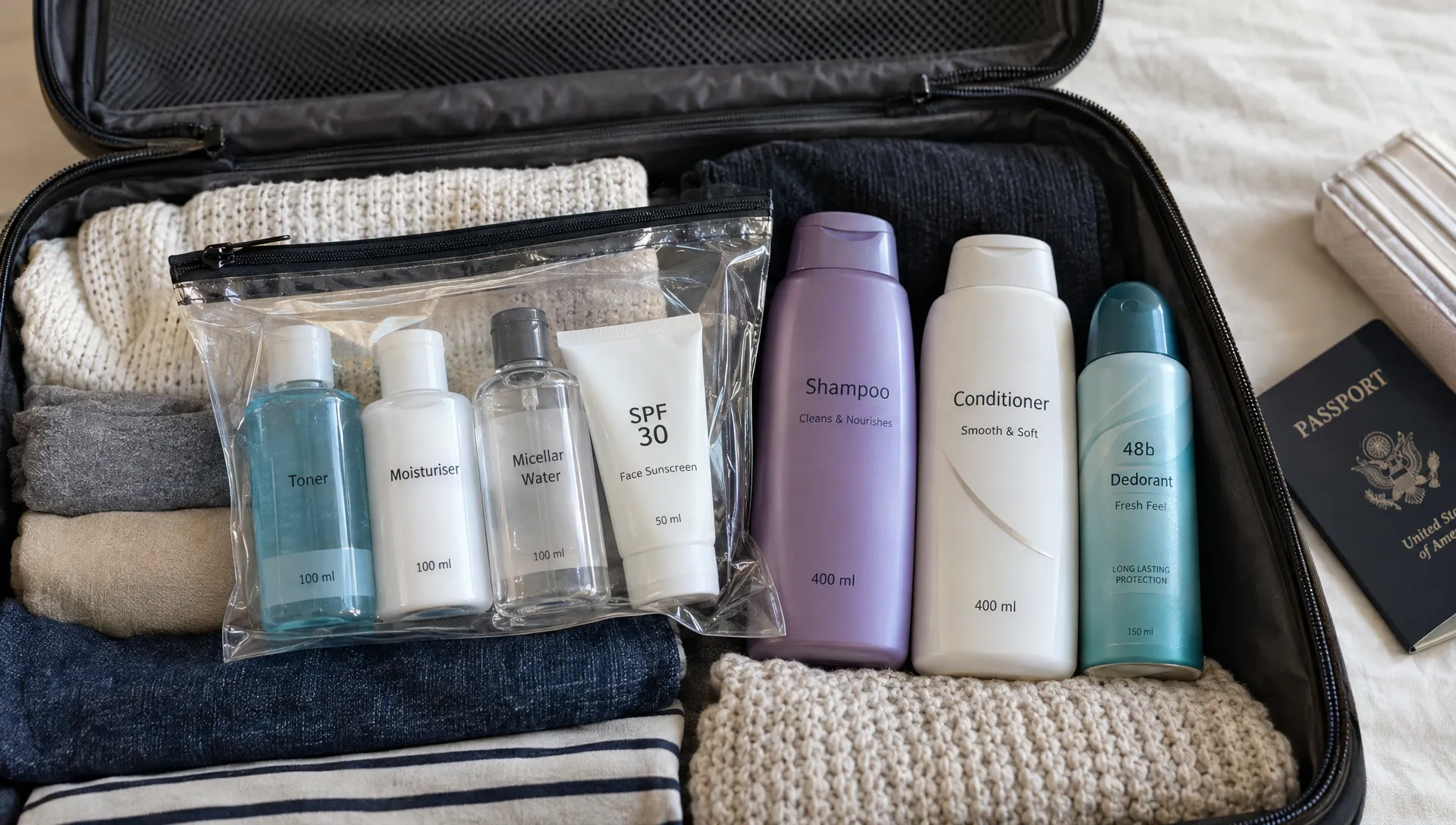
| Shampoo, conditioner and shower gel | Containers of 100 ml or less, inside the liquids bag | Larger containers generally permitted, subject to applicable safety limits |
| Toothpaste, face cream and sunscreen lotion | Count as liquids, gels or pastes, so the same container limit applies | Generally permitted, subject to applicable safety limits |
| Liquid or roll-on deodorant | Container of 100 ml or less, inside the liquids bag | Generally permitted |
| Aerosol deodorant or hairspray | Must meet both the cabin liquid limit and aerosol safety requirements | Permitted toiletry aerosols have container and aggregate limits |
| Solid soap, shampoo bars and genuinely solid stick deodorant | Generally outside the liquid restriction | Generally permitted |
| Perfume and cologne | Containers of 100 ml or less, inside the liquids bag | Permitted personal-use quantities are subject to safety limits |
A purse, backpack or other personal item is still cabin baggage. Putting an oversized liquid in a different carry-on bag does not avoid the screening rules.
Cabin bags: check the container, contents and liquids bag
Container capacity matters, not how much remains
For cabin baggage, rules for traveling with toiletries generally apply to the container’s capacity. A 200 ml shampoo bottle containing only 50 ml of shampoo is still a 200 ml container and will not meet a standard 100 ml limit.
Decant suitable products into clearly marked travel bottles, or buy smaller versions. Do not rely on the phrase “travel size” on a product listing: check the actual volume printed on the packaging.
For departures through US checkpoints, the TSA liquids rule permits containers of 3.4 ounces, or 100 ml, or less inside one quart-sized, clear resealable bag per passenger. Other airports commonly specify a one-liter bag instead. Follow the wording of the airport or security authority responsible for your checkpoint.
All the qualifying containers must fit inside the required bag, which must close properly. A collection of individually compliant bottles can still fail if it needs two liquids bags.
Creams, pastes and gels count too
The cabin restriction extends beyond products you would normally call liquids. Toothpaste, moisturizer, hair gel, liquid foundation and mascara belong with your liquid toiletries. Roll-on deodorant and spray sunscreen normally do too.
Solid alternatives can reduce pressure on your liquids bag. Bar soap, a solid shampoo bar and genuinely solid deodorant generally fall outside liquid-volume restrictions. A soft cream deodorant is not equivalent to a solid stick simply because both come in similar packaging.
These rules for traveling with toiletries also apply to cosmetics. If a product’s consistency makes its classification unclear, our guide to how airport toiletries rules vary by product type explains the distinctions in more detail.
Keep your liquids bag accessible. Some checkpoints require you to remove it, while others allow it to stay inside your luggage. Follow local signs and staff instructions rather than assuming every screening lane works the same way.
Checked bags: larger bottles, but not unlimited quantities
Ordinary bottles do not face the cabin liquids-bag test
Checked luggage generally accommodates toiletries that exceed the standard cabin container size. A 250 ml shower gel does not become unacceptable simply because it is larger than 100 ml, and checked toiletries do not need to fit into your cabin liquids bag.
That makes checked baggage useful for longer trips, shared toiletries and products you cannot conveniently decant. Keep enough essentials in compliant cabin containers to manage a baggage delay, rather than checking every item you need on arrival.
In checked baggage, rules for traveling with toiletries shift away from the familiar clear bag toward product-specific safety restrictions. Do not assume that every spray, solvent or pressurized product is allowed merely because it is sold for personal use.
Aerosols and some personal-care products have separate limits
The FAA guidance on medicinal and toiletry articles covers products such as permitted toiletry aerosols, perfume and nail polish. Under this allowance, the limits include:
| Safety requirement | FAA allowance for covered articles |
|---|---|
| Individual container | No more than 500 ml or 0.5 kg, as applicable |
| Combined quantity per person | No more than 2 L or 2 kg, as applicable, across covered articles |
| Aerosol release mechanism | Must be protected against accidental discharge, such as with a suitable cap |
The aggregate allowance is per person, not a separate allowance for each suitcase. Covered articles carried in different bags still contribute to the same total.
When comparing traveling with toiletries rules, keep these safety limits separate from cabin screening limits. A permitted 200 ml toiletry aerosol may fit the checked-baggage safety allowance but still exceed a standard 100 ml cabin restriction. Conversely, a small container does not make a prohibited substance acceptable.
The FAA guidance is a useful US reference. Check your operating airline and the relevant authorities for international travel, especially for unusual products or larger quantities.
International trips: check every security checkpoint
There is no single cabin liquid allowance that applies at every airport worldwide. Some airports explicitly permit containers larger than 100 ml, sometimes up to 2 L, while others retain the smaller limit. Bag and screening procedures can differ as well.
For example, the UK government’s liquid restrictions guidance directs travelers to check the rules at the airports they use. The presence of newer screening equipment alone is not enough to establish your allowance.
For a multi-airport journey, rules for traveling with toiletries need to work at every checkpoint you will actually pass through. Consider the outbound departure, any connection requiring rescreening and the return departure. Your destination airport’s arrival procedures are not necessarily the rules you will face when flying home.
A larger bottle accepted on the outbound flight may therefore need to be checked, replaced or left behind before your return. Our guide to planning toiletries for the return trip explains how to avoid that mismatch.
If any checkpoint’s allowance is unclear, pack to the standard 100 ml rule. Only rely on a larger allowance when the responsible airport or security authority confirms it applies to your journey.
Exceptions: medical liquids and duty-free purchases
Medically necessary liquids may have different allowances
At US checkpoints, TSA permits medically necessary liquids, gels and aerosols above the usual cabin limit in reasonable quantities for the trip. Tell the screening officer about them and present them for inspection as directed. Additional screening may be required.
Other countries have their own procedures and may require evidence of medical need. Check the relevant authority before departure, especially for prescription liquid medicines or specialist products that you cannot replace easily.
Medical exceptions are a separate part of the rules for traveling with toiletries. An ordinary moisturizer or shampoo does not automatically qualify just because you prefer a particular brand. Baby milk, formula and related supplies also have separate provisions, which should be checked for the itinerary involved.
Duty-free packaging does not guarantee passage everywhere
Liquids bought after security can sometimes be carried in larger containers, but another security checkpoint can change the situation. Transfer rules may depend on an approved sealed security bag, a visible receipt and the purchase location or timing.
Do not open a sealed duty-free security bag before completing any screening where it is required. Even intact packaging is not a universal guarantee that every connecting airport will accept the purchase.
A large perfume bottle bought airside is also not automatically exempt when you begin your return journey days later. Plan whether it will need to travel in checked baggage.
Pack toiletries for both screening and leaks
A compliant bottle can still make a mess. Separate the security task from the leak-prevention task: your clear cabin bag demonstrates compliance, while additional protective packaging helps contain spills.
Use this short packing check before closing your luggage:
- Separate essentials from bulk: Keep compliant amounts of daily necessities in your cabin bag and place suitable larger bottles in checked baggage.
- Check every label: Confirm container capacity, product type and any hazard warnings rather than judging by appearance.
- Secure closures: Tighten caps, close pumps using their designed lock and protect aerosol release mechanisms.
- Contain potential leaks: Put bottles in a leak-resistant pouch or separate sealed bag, away from clothing and documents.
- Leave room for the return: Avoid filling your allowance so tightly that an essential replacement or purchase creates a problem.
The easiest way to follow the rules for traveling with toiletries is to make those decisions at home. Repacking at the checkpoint gives you fewer options, particularly once your checked bag has already been accepted.
Frequently asked questions
What are the rules for travel-size toiletries? At airports using the standard cabin liquid restriction, each liquid, gel, cream or paste must be in a container of 100 ml or less and fit inside the required liquids bag. “Travel size” is a marketing description, not proof that a container complies.
Can I take 200 ml of deodorant on a plane? A 200 ml liquid, gel or aerosol deodorant will not meet a standard 100 ml cabin limit, even if partly used. A permitted 200 ml toiletry aerosol can generally go in checked baggage within the applicable safety allowance, with its release mechanism protected. Solid stick deodorant is treated differently.
Do airlines set the cabin liquid limit? Airport security authorities set checkpoint screening requirements. Airlines separately set cabin baggage dimensions, weight allowances and dangerous-goods conditions. You must satisfy both sets of requirements.
Can I put all my toiletries in checked luggage? Most ordinary toiletries can travel there, subject to product-specific restrictions, but it is sensible to keep essential items in compliant cabin quantities. Items that are prohibited as dangerous goods do not become acceptable simply because you check them.
Check your whole trip before packing
Use the Liquid Limits trip checker to compare airport liquid rules for your route, including the return flight. It provides source links and last-checked dates, with daily rule updates. When a rule is unclear, it defaults to the stricter 100 ml allowance.
Check your route before choosing bottle sizes, then confirm any aerosol or dangerous-goods restrictions with your airline. That gives you a packing plan for both your cabin bag and your checked suitcase.