
Airport security feels much easier when your liquids are already organized, sized correctly, and easy to explain. The challenge is that “travel liquids” does not only mean water bottles and shampoo. Security rules often treat gels, creams, pastes, aerosols, sprays, and semi-liquid foods as liquids too.
The safest approach is simple: pack for the strictest security checkpoint on your route, not the most relaxed one. That matters on round trips, connections, and itineraries where one airport has newer scanners while another still applies the standard 100 ml rule. If you are flying out and back through different airports, check both directions before you zip your bag.
This travel liquids checklist is designed to help you pack faster, avoid last-minute bin chaos, and reduce the risk of losing toiletries, skincare, medicine, or duty-free purchases at the checkpoint.
The golden rule: assume 100 ml unless you confirm otherwise
Many airport security checkpoints still follow the familiar carry-on liquid rule: containers must usually be 100 ml / 3.4 oz or smaller and fit into a clear, resealable liquids bag. In the United States, the TSA 3-1-1 liquids rule uses 3.4 oz containers in one quart-sized bag. In the UK, government hand luggage guidance also explains the 100 ml container rule for liquids carried through security.
Some airports have introduced newer screening technology that can allow larger quantities in cabin baggage, but this is not universal and can change. The airport you depart from, connect through, or return from may still enforce the stricter limit.
That is why the most stress-free packing rule is this: if you cannot verify a relaxed rule for every security checkpoint on your trip, pack your cabin liquids in 100 ml containers. For a deeper explanation of why return journeys can change what is allowed, see this guide to rules for liquids on flights and return trips.
Your pre-packing travel liquids checklist
Before you start filling toiletry bottles, separate everything you plan to bring into three groups: cabin liquids, checked-bag liquids, and exempt or special-case liquids. This avoids the common mistake of packing everything nicely, then realizing half of it needs to move.
| Packing question | Best action | Why it matters |
|---|---|---|
| Is the item a liquid, gel, cream, paste, aerosol, or spray? | Treat it as a liquid unless clearly solid | Borderline products are often screened as liquids |
| Is the container over 100 ml / 3.4 oz? | Put it in checked baggage or leave it behind | A half-empty 200 ml bottle can still be rejected |
| Do you need it during the flight or immediately after landing? | Keep only the essential amount in your carry-on | This keeps your liquids bag small and compliant |
| Is it medicine, baby milk, formula, or a medical necessity? | Pack it separately and be ready to present it | Exemptions may apply, but screening still happens |
| Are you buying duty-free liquids? | Keep receipts and sealed security bags intact | Transfers and return flights can complicate duty-free items |
| Are rules unclear for any airport on your route? | Follow the stricter 100 ml approach | It reduces the chance of confiscation |
This step is especially useful for travelers who pack skincare, contact lens solution, hair products, protein gels, or specialty foods. These items are easy to overlook because they do not always feel like “liquids” when you are packing at home.
What counts as travel liquids at security?
Security screening usually looks at the physical form of the product, not just the label. If it can pour, smear, spread, spray, squeeze, or flow, you should assume it may count as a liquid.
Common travel liquids include shampoo, conditioner, body wash, sunscreen, perfume, cologne, mouthwash, toothpaste, mascara, liquid foundation, moisturizer, shaving cream, deodorant sprays, hair gel, hand sanitizer, contact lens solution, and drinks.
Food can also create confusion. Yogurt, honey, jam, peanut butter, soft cheese, sauces, dips, soup, and spreads may be treated as liquids or gels in cabin baggage. If you are unsure whether an item belongs in your liquids bag, this overview of which liquids you can bring on a plane can help you think through common categories.
A helpful test is to ask: would this product hold its shape if removed from the container? If the answer is no, pack it as a liquid.
Carry-on liquids checklist
Your cabin liquids should be small, visible, and easy to remove if requested. Even at airports that do not require removal from the bag, a clean setup makes secondary screening less stressful.
Use this carry-on checklist before leaving for the airport:
- Choose containers that are 100 ml / 3.4 oz or smaller unless your full route clearly allows more.
- Check the container size, not the amount left inside the bottle.
- Place liquids together in a clear, resealable bag if your airport requires one.
- Keep medicine, baby supplies, and essential medical liquids separate from ordinary toiletries.
- Avoid bringing “just in case” full-size products in your cabin bag.
- Make sure lids are tight, bottles are not leaking, and aerosols have caps.
- Keep high-value liquids, such as prescription skincare or specialty contact lens solution, easy to identify.
The container-size point is one of the most important. A 150 ml bottle with only 50 ml of shampoo left can still fail the rule because the printed capacity is over the limit. If you want the product in your cabin bag, transfer it into a travel-size container before you go.
Checked baggage liquids checklist
Checked baggage is usually the better place for larger toiletries and nonessential liquids. It gives you more flexibility, but it does not mean you should pack carelessly. Leaks, pressure changes, fragile bottles, and aerosol restrictions can still cause problems.
Pack checked liquids with the same discipline you use for cabin liquids, especially if the item is expensive or hard to replace.
| Item type | Best place to pack it | Extra packing tip |
|---|---|---|
| Full-size shampoo or conditioner | Checked bag | Put bottles in a sealed plastic bag |
| Large sunscreen | Checked bag | Pack near the center of the suitcase |
| Perfume or cologne | Carry-on if small, checked if larger | Cushion glass bottles with clothing |
| Aerosol hairspray or deodorant | Usually checked if not needed onboard | Keep caps on and check airline limits |
| Contact lens solution | Small bottle in carry-on, backup in checked bag | Keep enough for delays in your cabin bag |
| Liquid makeup or skincare | Carry-on for essentials, checked for extras | Avoid packing irreplaceable items only in checked baggage |
| Food sauces or jars | Checked bag | Seal carefully and consider destination rules |
Checked baggage can be delayed, so do not place medically necessary liquids only in your checked suitcase. Keep what you need for the flight, delays, and your first day at destination in your carry-on, following the relevant exemption process where applicable.
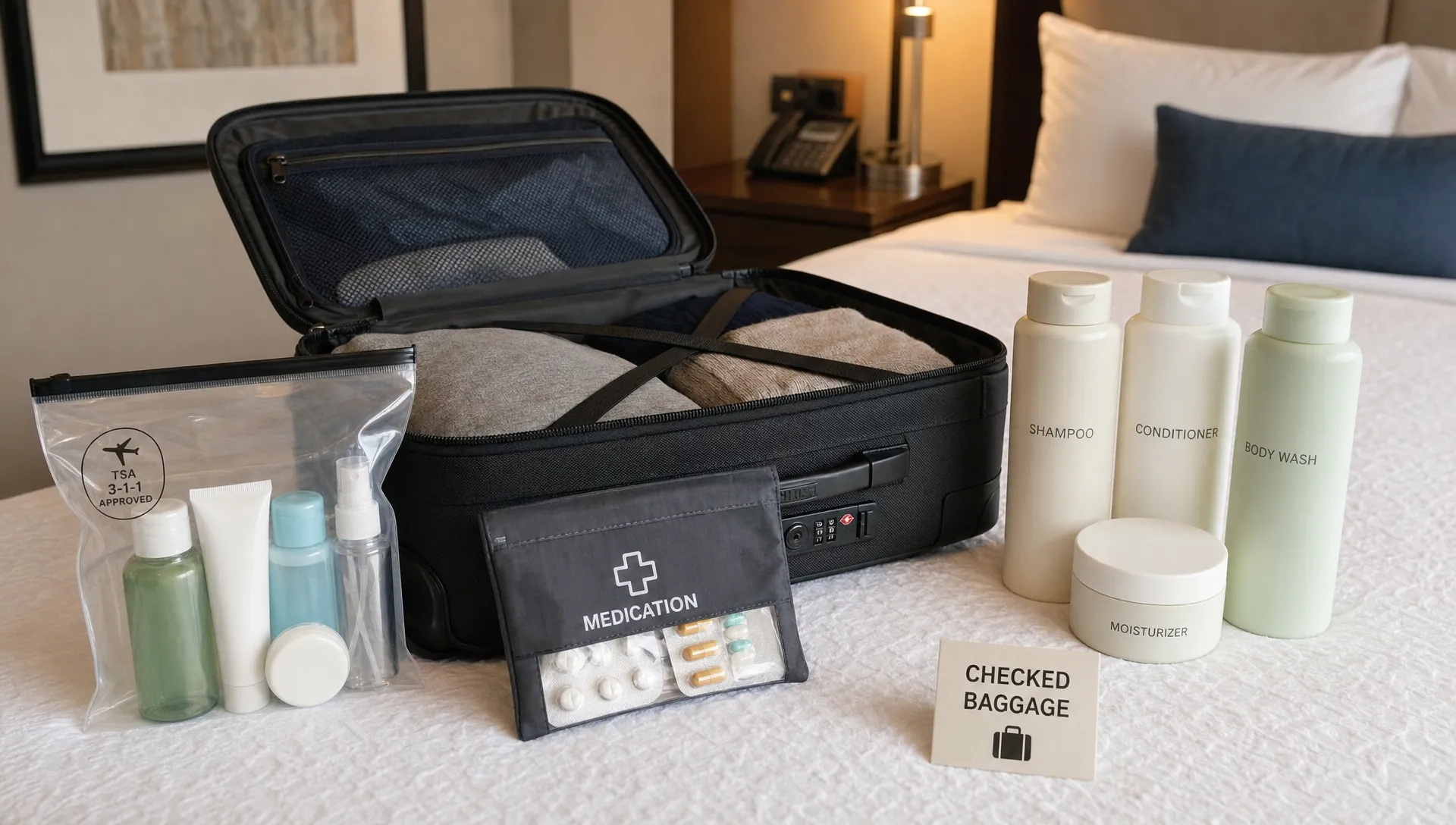
Medicine, baby supplies, and essential liquids
Some liquids are treated differently because they are necessary for health, infant care, or medical needs. This can include prescription liquid medicine, some over-the-counter liquid medicines, insulin and related supplies, baby formula, breast milk, baby food, and medically necessary nutrition.
Rules vary by country, but the practical security routine is similar: pack these items separately, keep labels or documentation where useful, and tell security staff before screening if required. Do not bury essential liquids under clothing or electronics. If officers need to inspect them, easy access saves time and reduces stress.
For medication, keep the original label when possible. For baby supplies, carry only what is reasonable for the journey, including delays. For medical liquids that must stay cool, prepare cooling packs in a way that matches airport rules for gels or ice packs. If anything is unusual, check the airport or security authority before travel.
Duty-free liquids checklist
Duty-free liquids can be convenient, but they are not automatically problem-free. Alcohol, perfume, cosmetics, and other duty-free liquids may be allowed through certain parts of your journey if they remain sealed in the correct security tamper-evident bag, often with the receipt inside.
The risk appears when you have a connecting flight, change airports, pass through security again, or fly home from a different country. A bottle that was allowed after one checkpoint may not be accepted at the next if the seal is broken, the receipt is missing, or the local rules differ.
Before buying duty-free liquids, ask yourself whether you will pass through another security checkpoint before reaching your final destination. If yes, keep the bag sealed until you arrive. If you are not sure, consider buying at the final airport or packing liquids in checked baggage when permitted.
Route checklist: check every airport, not just your first flight
Travelers often check the rules for their departure airport and stop there. That works for simple one-way trips with no connections, but it can fail for more complex itineraries.
Check liquid rules for:
- Your outbound departure airport.
- Any connecting airport where you may clear security again.
- Your return departure airport.
- Any airport where you change terminals, airlines, or tickets.
- The rules for specific items you care about, such as medicine, cosmetics, baby food, or duty-free purchases.
This is where a route-based check saves time. Liquid Limits lets you compare airport and route guidance, including return flights, so you can identify the strictest rule before you pack. If a rule is unclear, the tool defaults to the safer 100 ml assumption rather than encouraging you to gamble at security.
The night-before security checklist
The night before your flight is the best time to fix liquid problems. At 5 a.m. in the airport line, your options are usually limited to surrendering the item, checking a bag, or rushing to repack.
Lay out your liquids and do one final pass. Check bottle sizes. Confirm that your liquids bag closes. Move full-size products to checked luggage. Separate medicines and baby supplies. Put duty-free receipts somewhere accessible if you already bought liquids on a previous leg.
Also think about your arrival. If you land late, have a long transfer, or need medication immediately, pack essentials in your personal item rather than deep inside your roller bag. The goal is not just to pass security, but to have what you need during the journey.
At the airport: how to move through security smoothly
Once you reach security, follow the local instructions even if they differ from what you expected. Some airports ask travelers to remove liquids from bags. Others using newer scanners may ask you to leave items inside. Staff instructions at the checkpoint are what matter in the moment.
Keep your liquids setup simple. Avoid loose mini bottles scattered through multiple pockets. Do not argue that an oversized bottle is “almost empty.” If you are carrying exempt liquids, calmly declare or present them according to local procedure.
If you are selected for extra screening, stay patient. Liquids often need additional checks, especially medical liquids, baby supplies, powders, or unusual food items. A clear, organized bag makes it easier for officers to inspect items without disrupting your whole carry-on.
Common travel liquids mistakes to avoid
The most common mistakes are small, but they can be expensive. Travelers lose full-size sunscreen, luxury perfume, unopened skincare, sauces, and gifts because they packed based on habit instead of checking the current route.
Avoid these pitfalls:
- Packing a large container that is only partly full.
- Forgetting that toothpaste, mascara, lip gloss, and creams can count as liquids.
- Assuming the return airport has the same rules as the outbound airport.
- Opening a sealed duty-free bag before a connection.
- Packing all medicine in checked baggage.
- Relying on old information from a previous trip.
Liquid rules can change as airports update equipment, pause new procedures, or apply temporary restrictions. A quick check before each trip is better than relying on what worked last year.
Frequently Asked Questions
Do travel liquids have to be in bottles of 100 ml or less? At many airport security checkpoints, cabin liquids must be in containers of 100 ml / 3.4 oz or less. Some airports may allow more with newer scanners, but you should confirm the rule for every security checkpoint on your trip.
Does a half-empty full-size bottle count as over the limit? Yes, usually the printed container capacity matters. A 200 ml bottle with only a small amount left can still be rejected at a 100 ml checkpoint.
Are solid toiletries better for flying? Often, yes. Solid shampoo bars, soap bars, solid deodorant, and some balm-style products can reduce the number of liquids in your cabin bag. However, if an item is soft, spreadable, or gel-like, it may still be treated as a liquid.
Can I bring liquid medicine through airport security? Many security authorities allow medically necessary liquids in quantities above the standard limit, but they may require separate screening. Keep medicine accessible, labeled when possible, and check the rules for your airport before flying.
Should I check liquid rules for my return flight? Yes. Your return airport may apply different liquid limits than your outbound airport. This is especially important if you plan to buy toiletries, cosmetics, alcohol, or duty-free items during your trip.
What should I do if I cannot confirm the rule for an airport? Use the stricter 100 ml approach for cabin liquids. It is the safest fallback when rules are unclear, inconsistent, or changing.
Check your travel liquids before you pack
A stress-free security experience starts before you leave home. Pack essentials in compliant containers, move full-size products to checked baggage, separate special-case liquids, and check every airport on your route, including the return.
For a faster way to verify your route, use Liquid Limits to check airport liquid rules, item-specific guidance, and route details side by side. It includes daily updates, source links, and last-checked dates, so you can pack with less guesswork and fewer surprises at security.