The travel rules for toiletries bought after security depend on what happens after you leave the shop. A full-size shampoo bought in the secure departure area can generally travel with you on a direct flight, provided it meets airline and dangerous-goods rules. That same bottle may be refused if you encounter another security checkpoint during a connection or on your return journey.
Buying after security does not give a product permanent clearance. Ordinary airport shopping bags and approved sealed duty-free bags are treated differently, so check your remaining checkpoints before paying for a larger bottle.
Can you take full-size toiletries bought after security onto the plane?
Usually, yes, if you buy them in the secure departure area and go directly to your flight without further screening. The familiar cabin liquid limit controls what you take through a security checkpoint. It is not a blanket ban on every larger liquid container aboard an aircraft.
For example, a 250ml bottle of ordinary shower gel bought near your departure gate can generally accompany you on a direct flight. A bottle bought in the airport’s public arrivals hall or before the checkpoint still has to meet the applicable screening rules.
The travel rules for toiletries also leave airline baggage policies intact. A retailer’s carrier bag is not automatically an extra cabin bag your airline will accept for free.
| Purchase and itinerary | What to expect |
|---|---|
| Full-size shampoo bought after the final checkpoint | Generally permitted aboard, subject to airline restrictions |
| The same shampoo carried through another checkpoint | Must meet that checkpoint’s rules unless an accepted exception applies |
| Duty-free perfume in an approved sealed security bag | May qualify for an exception, depending on the route and screening authority |
| A large bottle in an ordinary sealed shopping bag | The shopping bag does not create a liquid-limit exception |
| An opened airport purchase brought back next week | Usually assessed under the normal return-airport rules |
A departure gate can also have additional checks. If your itinerary includes gate screening, confirm whether your purchase will be accepted there rather than assuming the main terminal checkpoint was the last one.
A duty-free security bag is not an ordinary shopping bag
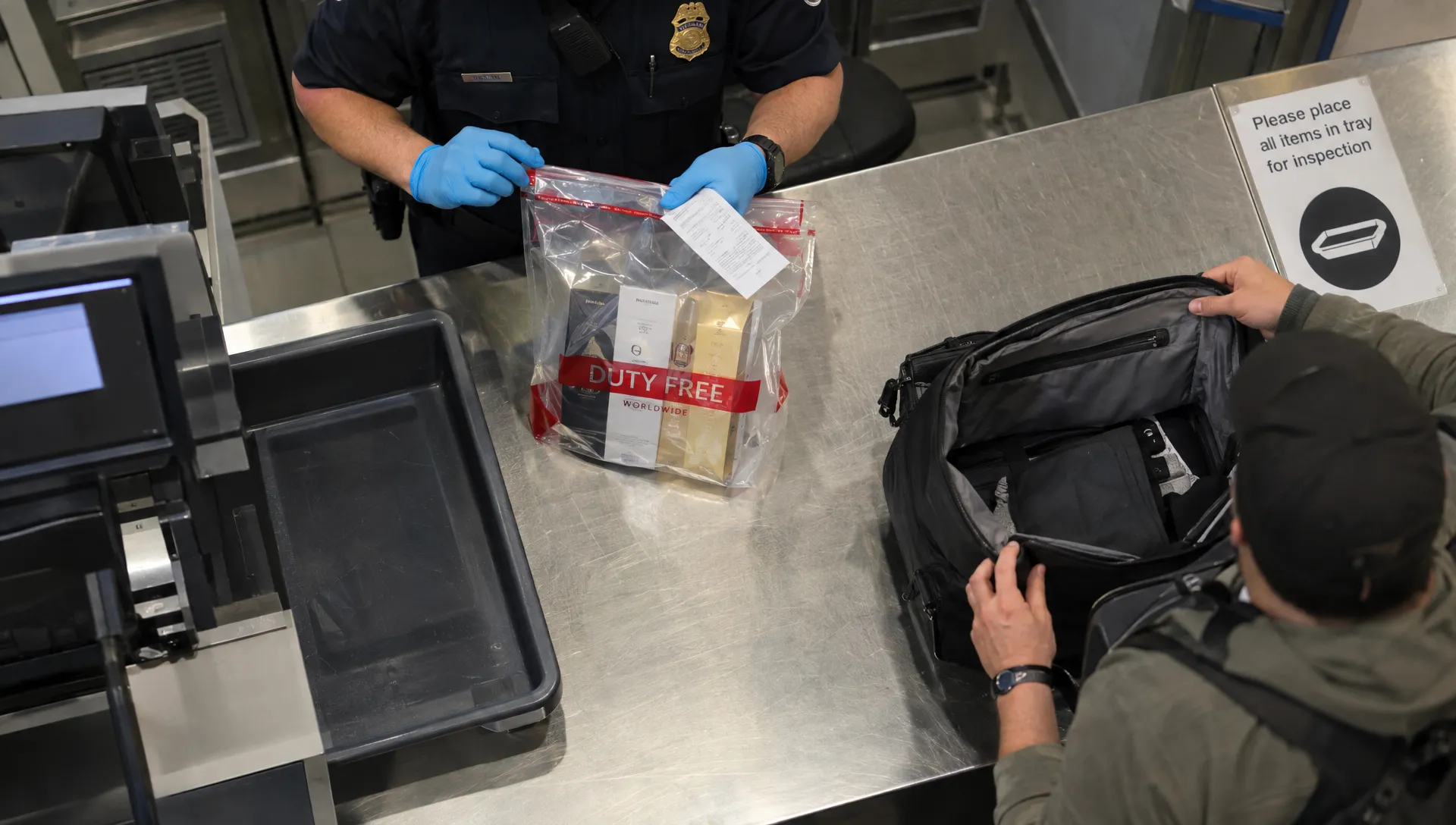
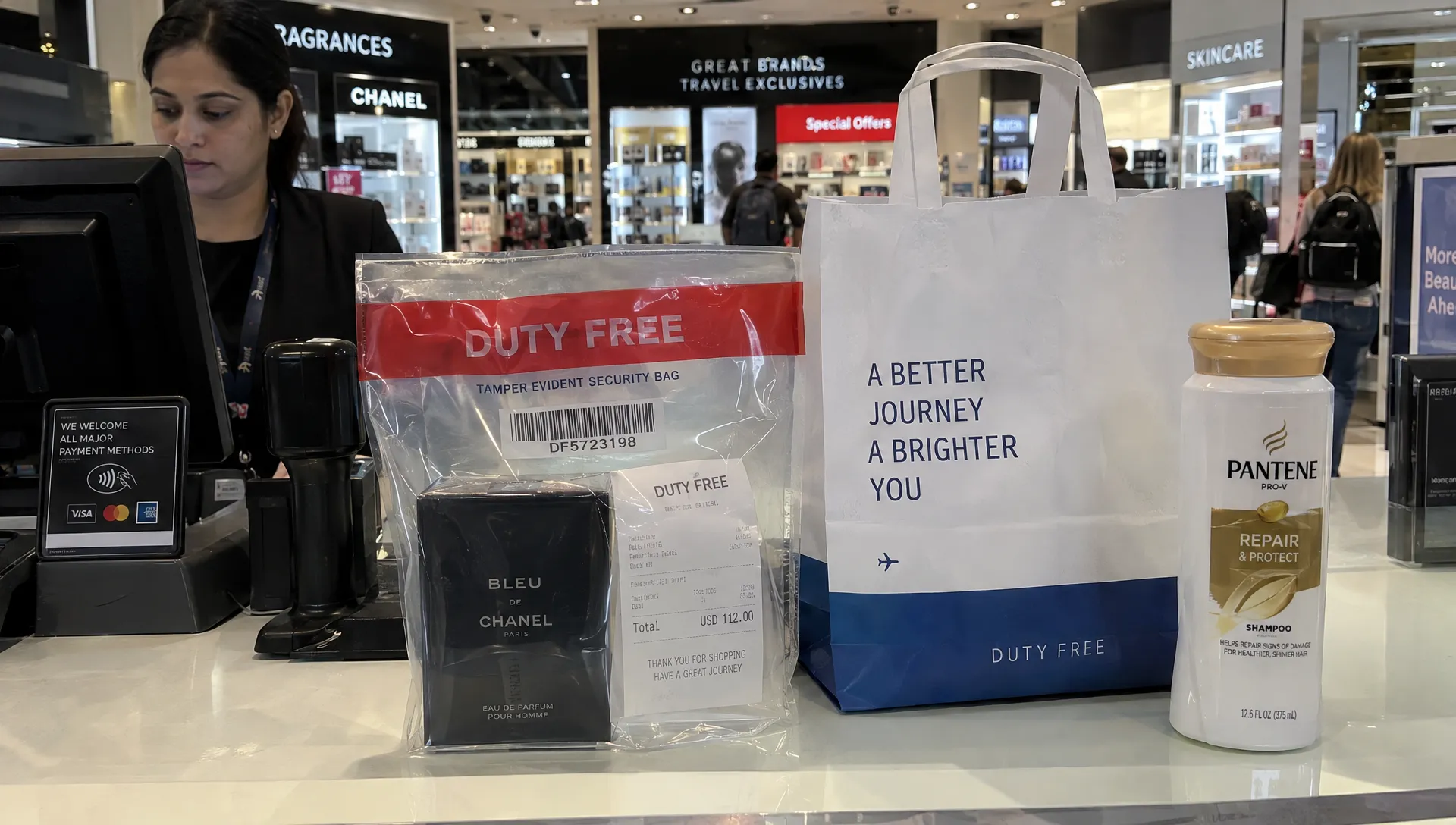
An approved security tamper-evident bag, often called a STEB, can allow eligible liquids above the normal container limit through certain later checkpoints. These bags are designed to show whether they have been opened. The purchase receipt is normally enclosed with the products.
A stapled paper bag, a zip-top liquids bag or a retailer’s standard plastic carrier is not equivalent. Nor can you create an accepted duty-free exception by sealing a bottle yourself.
Before buying perfume, skincare or another liquid for a connecting journey, ask the retailer whether the purchase qualifies for an approved security bag and whether it is suitable for your route. Not every outlet offers this service, and a shop cannot guarantee another country’s screening decision.
Under the EU’s hand-luggage guidance, duty-free liquids can be carried when the item and receipt remain sealed inside the security bag provided at purchase. Security staff may need to open it for screening. Tell them about an onward connection so they can advise on resealing it.
For sealed purchases, the travel rules for toiletries depend on both the packaging and the checkpoint accepting it. Keep the bag unopened until your final destination, retain the receipt and allow time for inspection. A seal is evidence of an eligible purchase, not a promise that screening will be waived.
The U.S. exception for international duty-free liquids
The TSA liquids rule describes a specific exception for duty-free liquids over 3.4 ounces or 100ml when you are traveling internationally to the United States with a connecting flight.
TSA’s conditions include the following:
- The duty-free liquids were purchased internationally.
- The retailer packed them in a transparent, secure, tamper-evident bag that shows no signs of tampering.
- You have the original receipt showing the purchase was made within the previous 48 hours.
- The items can be screened and cleared by security.
This is not a general allowance for any large toiletry purchased at any airport. A loose 200ml lotion bottle with a till receipt does not satisfy the sealed-bag conditions.
TSA can still refuse an item that alarms or cannot be cleared. Where you have access to checked baggage before it is handed back to the airline, placing a permitted larger liquid there can avoid relying on the cabin exception.
The travel rules for toiletries on a U.S. connection therefore require more than proof that you paid in an airport. Keep the original receipt, preserve the security seal and check whether you will pass through TSA screening after arrival.
How travel rules for toiletries change on a connection
A through-ticket does not guarantee a journey without further screening. Neither does having both boarding passes issued at the start of your trip.
Some connections keep you within a secure transfer area. Others require another checkpoint because of the arrival procedure, terminal layout or transfer route. Separate-ticket connections and transfers between airports deserve particular attention because you may have to exit and re-enter security.
Consider three different purchases:
A 250ml shampoo in a normal shopping bag: It may be fine for the first flight but fail the ordinary 100ml container rule at a later checkpoint.
A 100ml moisturizer: It is easier to carry through another checkpoint, but it must still fit within that airport’s liquids-bag or quantity requirements where those apply.
A 150ml perfume in an approved security bag: It may qualify for a duty-free exception, but acceptance depends on the checkpoint, receipt and condition of the seal.
Check the official transfer instructions for your connecting airport and itinerary. An airport allowing larger containers at departure does not mean every later airport will do the same.
When applying the travel rules for toiletries, plan around the strictest checkpoint you must actually cross. If the transfer rules are unclear, a container of 100ml or less is the safer purchase, though you still need to meet any applicable bag limits.
Aerosols and other restrictions still apply after security
Buying airside does not override dangerous-goods restrictions. This matters particularly for aerosol deodorant, hairspray and other pressurized personal-care products.
For toiletry aerosols covered by U.S. rules, the FAA’s medicinal and toiletry article guidance sets a maximum of 500ml or 500g per container. The combined allowance for articles covered by that provision is 2L or 2kg per person across carry-on and checked baggage. Aerosol release devices must be protected against accidental discharge, such as with a suitable cap.
Those limits are separate from checkpoint liquid restrictions. A 200ml aerosol deodorant can be within the FAA container limit but still exceed an ordinary 100ml checkpoint allowance.
Airlines and other jurisdictions can impose additional requirements. Our guide to airport toiletries rules for aerosols, razors and gels explains why the product’s form matters as well as its size.
The travel rules for toiletries bought after screening therefore involve two separate checks: whether the item can pass any remaining checkpoint and whether it is permitted aboard the aircraft. A shop selling an item does not remove either responsibility.
What to check before paying at the airport shop
Start with your itinerary, not the bottle. Identify whether you will face another checkpoint before reaching your destination. Include transfers between terminals, airport changes and any known gate screening.
Next, look at the container’s labeled capacity. Under an ordinary 100ml rule, a half-empty 200ml bottle remains a 200ml container. Using some of the product before your connection does not make the packaging compliant.
If a larger purchase needs a duty-free exception, ask the retailer about approved security packaging before completing the sale. Confirm that the original receipt will be included as required, and do not open the bag to test the perfume or use the cream during the journey.
Keep the sealed purchase accessible for inspection rather than burying it beneath other belongings. If security staff open it, explain that you have a further connection and ask what needs to happen before you continue.
Finally, check your airline’s cabin-bag allowance. A bulky gift set may be acceptable to security but still need to fit inside your permitted baggage.
This order makes the travel rules for toiletries easier to apply: establish the remaining screening requirements, check the product and packaging, then confirm how you will carry it. If you cannot establish that a larger bottle will be accepted, choose a smaller size or buy it at your destination.
Your return flight is a new screening decision
An airport purchase does not keep its outbound status throughout your vacation. Once you open the security bag and use the product, you should normally plan to carry it home under the return airport’s standard rules.
A larger bottle might be allowed at the airport where you bought it but exceed the limit where your trip home begins. A receipt from the outbound journey is not a general exemption, and a week-old purchase would not meet TSA’s 48-hour condition for the international duty-free exception described above.
If you have checked baggage, pack permitted larger toiletries there before checking in, while observing any aerosol or dangerous-goods limits. If you travel cabin-only, consider buying only what you will use at your destination or choosing compliant travel-size containers.
A return-trip plan for toiletries is especially useful when departure and return airports apply different limits. The travel rules for toiletries must work for the journey home, not just the flight on which you bought them.
Frequently asked questions
Can I buy a 200ml deodorant after security and take it on the plane? Generally, yes, if it is a permitted personal-care product, you face no further screening and it meets the airline’s requirements. Aerosols have separate safety limits. At another checkpoint, a 200ml liquid, gel or aerosol may exceed the ordinary container allowance unless an accepted exception applies.
Does an airport receipt let me take large toiletries through security? Not by itself. An ordinary receipt does not exempt a large bottle from liquid restrictions. Duty-free exceptions can require an approved tamper-evident bag, the original receipt and other conditions specific to the screening authority.
Can I open my sealed duty-free toiletries during the flight? If you still have a connection, leave the bag sealed until your final destination. Opening it can invalidate the packaging condition needed at your next checkpoint. Follow crew instructions about using products aboard.
Are toiletries bought after security exempt on the return flight? No general exemption applies simply because you bought them airside. The travel rules for toiletries on your return depend on that airport’s current screening requirements and any exception your purchase still qualifies for.
Check the whole route before you shop
Use Liquid Limits’ trip liquid checker to compare the rules for your departure, connections and return journey before buying full-size toiletries. It provides source links and last-checked dates, with a stricter 100ml fallback when a rule is unclear.
Check the screening authority’s conditions for sealed duty-free purchases and your airline’s baggage policy separately. If a larger bottle depends on an exception you cannot confirm, buying a smaller size is the simpler option.