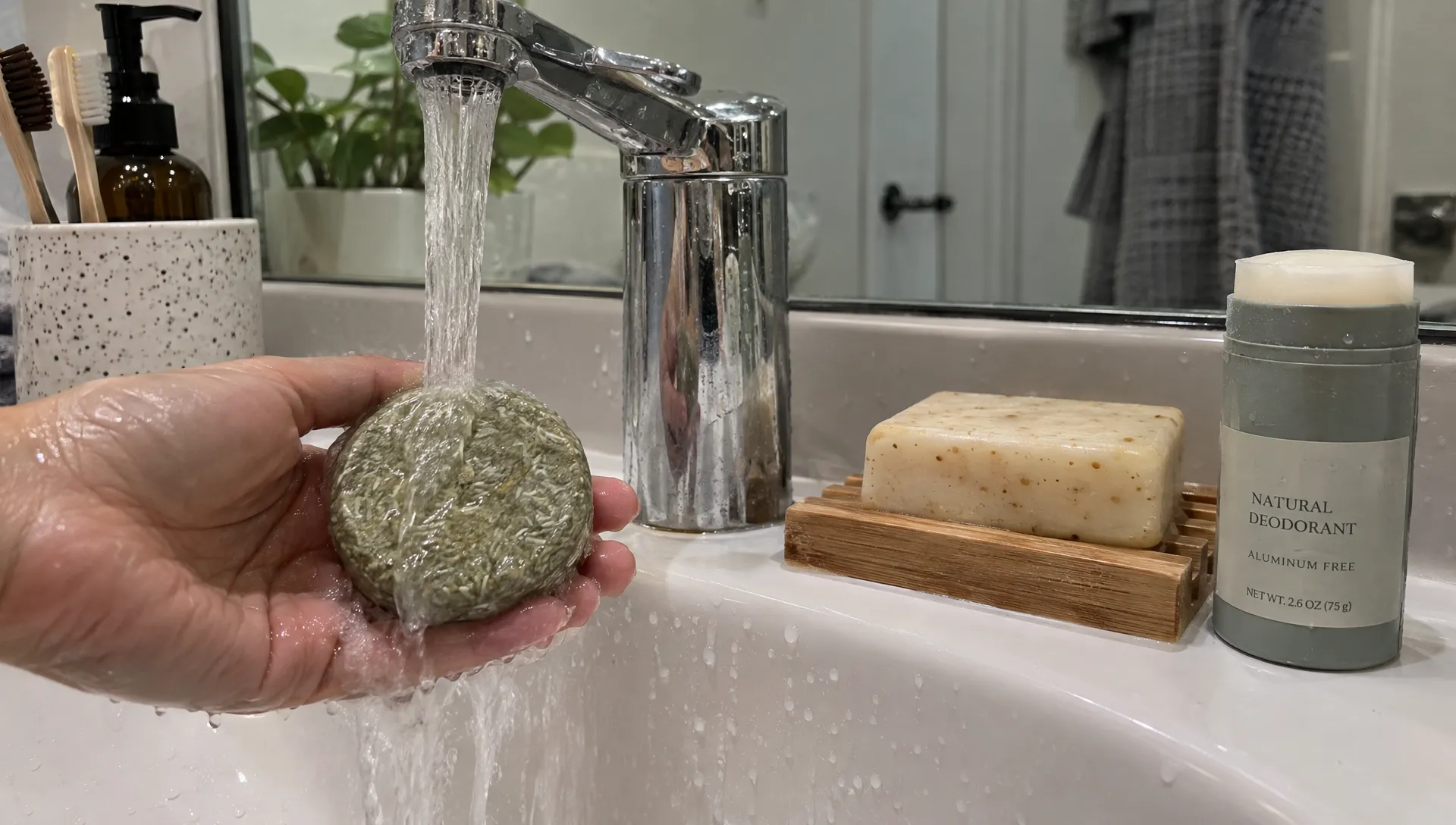
The simplest way to follow travel toiletries rules is to check two things: what form the product takes and which restrictions apply at each airport on your trip. Shampoo, shaving foam and a solid deodorant stick may belong in the same bathroom cabinet, but they do not necessarily belong in the same part of your cabin bag.
Liquids, gels and pastes usually share one security allowance. Aerosols must also meet dangerous-goods requirements. Genuine solids generally sit outside the liquids allowance, although they still pass through screening.
This guide separates those checks so you can pack everyday toiletries without assuming that “travel size,” “solid” or “allowed in checked baggage” tells the whole story.
Separate airport security from aircraft safety
Airport security rules determine which liquids you can carry through a checkpoint and how to present them. Dangerous-goods rules determine whether certain products can travel on the aircraft at all, in what quantities and with what protective packaging.
A small aerosol can satisfy the checkpoint’s liquid-container limit but still need a protective cap. Conversely, a larger permitted toiletry aerosol may be suitable for checked baggage but too large for a cabin bag at a 100 mL checkpoint.
Passing one check does not automatically mean passing the other. Your airline may also impose restrictions, so check its dangerous-goods guidance when carrying aerosols or unusual personal-care products.
Which travel toiletries rules apply to each product?
Classify the product inside the packaging, not its marketing name. “Stick,” “balm” and “dry” can describe products with quite different consistencies.
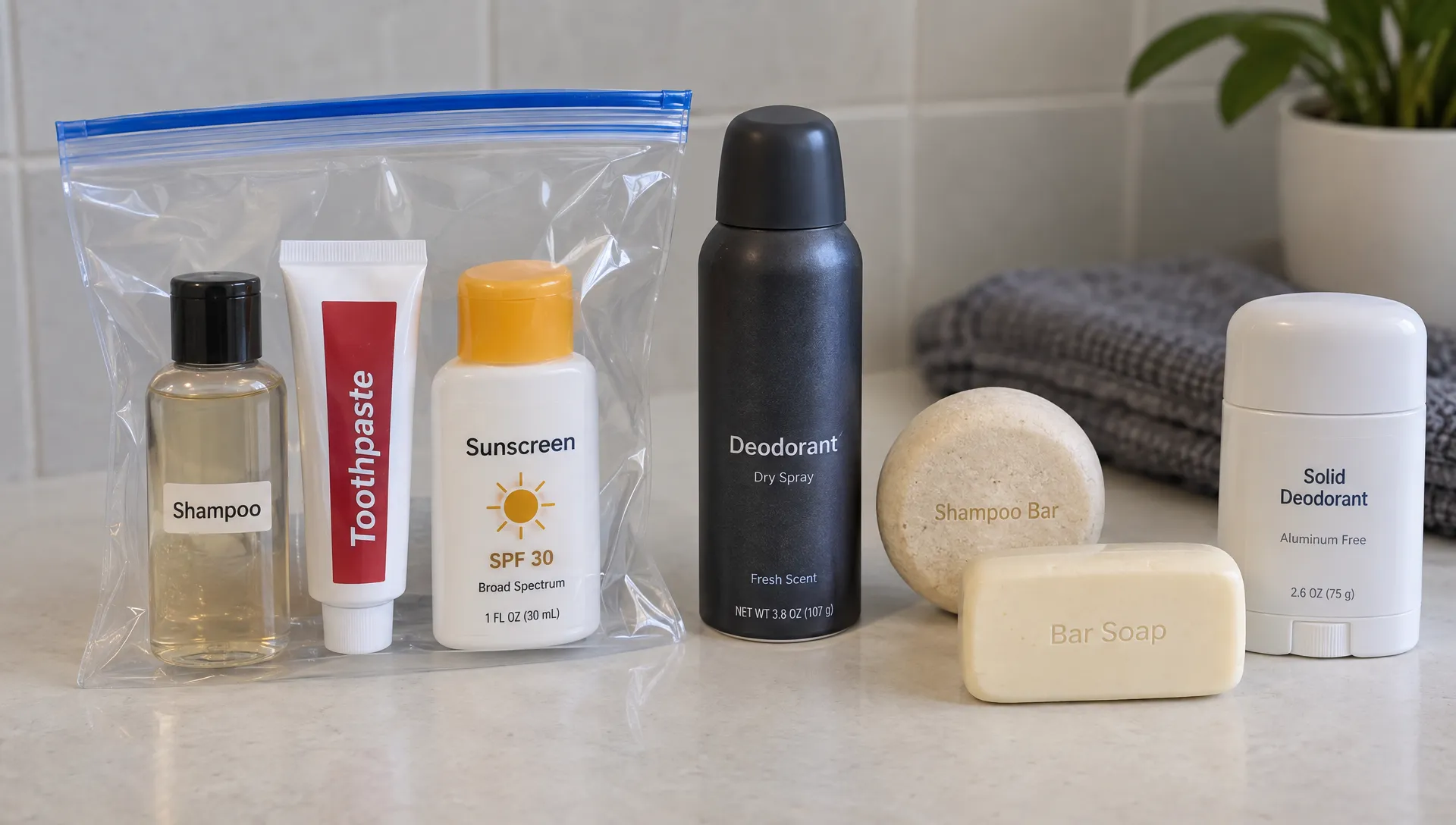
| Product and form | Usual security category | Packing implication at a 100 mL checkpoint |
|---|---|---|
| Shampoo, conditioner or body wash in a bottle | Liquid or gel | Use containers with a capacity of 100 mL or less and include them in the liquids bag |
| Toothpaste or creamy deodorant | Paste or cream | Include in the liquids allowance |
| Pump-spray sunscreen or perfume | Liquid | Include in the liquids allowance, even without a pressurized can |
| Aerosol shaving foam, hairspray or deodorant | Aerosol | Meet the liquids limit and the separate aerosol safety requirements |
| Bar soap or a genuine solid shampoo bar | Solid | Usually outside the liquids allowance |
| Solid deodorant stick or solid lipstick | Solid | Usually outside the liquids allowance; cream and gel versions differ |
| Loose face powder or powder dry shampoo | Powder | Usually outside the liquids allowance, but additional screening may apply |
A product that spreads as a cream or squeezes out as a paste should not be treated as a solid merely because it holds its shape in the container. If classification remains unclear, packing it within the stricter liquid allowance is the safer approach.
Container capacity matters more than what remains
For checkpoints using the standard 100 mL restriction, travel toiletries rules apply to the container’s capacity, not just the amount left inside it. A mostly empty 250 mL shampoo bottle is still a 250 mL container.
The TSA liquids rule allows liquids, aerosols, gels, creams and pastes in containers of 3.4 ounces, or 100 mL, or less in carry-on baggage. These must fit in one quart-sized, clear resealable bag per passenger, subject to applicable exceptions.
Other jurisdictions commonly specify a transparent resealable bag with a capacity of one liter. A quart and a liter are close in size, but follow the wording published for your departure airport rather than assuming the requirements are identical.
Make refillable bottles easy to assess
Choose refillable containers with a clearly marked capacity and secure closures. Labels identifying the contents are useful, especially when several identical bottles contain different products, but a handwritten label does not change the container’s actual capacity.
The liquids bag should close properly without being stretched around oversized bottles. Keep it accessible and follow checkpoint instructions about whether to remove it from your cabin bag. Newer scanners do not, by themselves, establish which liquid limits apply.
Aerosols need an additional safety check
For aerosols, travel toiletries rules involve both the product’s purpose and the way the can is packed. Ordinary personal-care aerosols, such as deodorant, hairspray and shaving foam, can fall within permitted toiletry allowances. That does not make every pressurized spray acceptable.
Under the US FAA PackSafe guidance, covered medicinal and toiletry articles are generally limited to 0.5 kg or 500 mL per container, with a combined allowance of 2 kg or 2 L per person. The combined allowance applies across carry-on and checked baggage, not separately to each suitcase. Airline restrictions may be stricter.
For a cabin bag passing through a standard 100 mL checkpoint, the smaller security limit still applies. A 300 mL hairspray can does not become cabin-compliant simply because it falls below the dangerous-goods limit.
Protect the nozzle and identify the spray
A permitted aerosol’s release mechanism must be protected against accidental discharge, usually with a cap or another suitable protective measure. Pack the can so other items cannot press against its actuator.
A pump spray is not an aerosol because it is not a pressurized container, although its contents still count as liquid at security. Conversely, fuel cartridges, aerosol refills and industrial sprays should not be treated as ordinary toiletries. Check the exact product rather than relying on the presence of a familiar-looking spray nozzle.
Solids reduce liquid-bag pressure, but form matters
Switching selected products to genuine solids can make travel toiletries rules easier to manage without abandoning your usual routine. Bar soap, solid shampoo and solid deodorant can free space for products that are harder to replace, such as contact lens solution or a particular sunscreen.
The distinction is physical, not promotional. A shampoo bar is different from shampoo gel in a tube. Solid lipstick is different from liquid lip color, while a deodorant stick containing a gel remains a gel for screening purposes.
Powders usually fall outside the liquids allowance, but that is not a promise of screening without questions. Larger quantities of powder can require extra examination, particularly under US screening procedures. Keep containers accessible and identifiable.
Choose replacements you have already tried at home. A leaking refill bottle is inconvenient, but discovering that your new shampoo bar does not suit your hair halfway through a trip is not much better. Let wet bars dry before sealing them away to avoid turning the rest of your wash bag damp.
Checked baggage changes the size limit, not every restriction
Moving a larger shampoo bottle into checked baggage avoids the cabin checkpoint’s standard 100 mL restriction. It does not mean every liquid or aerosol becomes unrestricted.
For checked baggage, travel toiletries rules still require you to distinguish ordinary products from dangerous goods. Permitted toiletry aerosols remain subject to applicable quantity limits and protection against accidental release. Flammable or pressurized products need particular attention, even when they are sold for personal use.
Pack ordinary liquids against leakage: tighten closures, place bottles in a leak-resistant pouch and cushion them against crushing. A protective pouch helps contain a spill, but it does not make a prohibited product permissible.
Keep essentials available during the flight
If you check most toiletries, retain a small cabin-compatible set for delays or an overnight disruption. That might include toothpaste, a toothbrush, solid deodorant and any permitted essential skin-care products.
Necessary liquid medicines may qualify for exceptions to the ordinary liquids limit. Keep them accessible, declare them as instructed and check the relevant airport’s requirements for supporting documentation. Do not assume that every cosmetic or personal-care product qualifies for a medical exception.
Check the whole journey, not just the outbound airport
An airport allowing larger liquid containers on departure does not establish the rules for your return journey. Transfer screening can also introduce another checkpoint with different restrictions.
The UK government’s hand-luggage liquids guidance directs travelers to check the airports involved because container limits and screening procedures can differ. The same trip-planning principle applies beyond the UK.
For a round trip, travel toiletries rules are easiest to follow when you pack for the strictest checkpoint you expect to encounter. If one airport permits larger containers but another applies a 100 mL limit, a small-container kit avoids having to replace or discard products before returning home.
Consider an outbound journey through an airport that explicitly permits a larger shampoo bottle. You use only a little during your stay, then return through a 100 mL checkpoint. The remaining amount does not solve the problem because the bottle’s capacity is still too large.
Our guide to airport liquid rules across outbound and return flights explains this route-planning issue in more detail. Recheck published guidance shortly before departure, especially if you intend to rely on an allowance above 100 mL.
Build a wash bag around the strictest checkpoint
Start with the products you actually need for the trip, then choose the appropriate form and container. A short stay rarely requires full-size versions of every bathroom product.
A practical packing sequence is:
- Separate by form: Put liquids, creams, gels and pastes in one group, aerosols in another and genuine solids or powders in a third.
- Check containers: For a standard 100 mL route, use compliant containers that fit comfortably in the required liquids bag.
- Check aerosol safety: Confirm that the product is permitted, its quantity is within the applicable allowance and its release mechanism is protected.
- Check every screening point: Review departure, transfer screening and return airports before deciding which larger products to carry.
This approach turns travel toiletries rules into a few repeatable packing decisions rather than a separate puzzle for every brand. A product’s form, container capacity and safety classification usually matter more than its price or whether its packaging says “travel.”
Before closing your suitcase, use the travel liquids packing checklist to review the liquid items you are keeping in your cabin bag. Leave enough room for the bag to close properly and keep it where you can retrieve it without unpacking everything.
Frequently asked questions
Does toothpaste count as a liquid at airport security? Toothpaste is a paste and normally falls within the cabin liquids allowance. At a standard 100 mL checkpoint, use a tube with a capacity of 100 mL or less and place it in the required liquids bag.
Can I bring aerosol deodorant in my carry-on? Usually, permitted personal-care aerosol deodorant can travel in a cabin bag if it meets the checkpoint’s container limit and applicable dangerous-goods requirements. Protect the nozzle against accidental discharge and check your airline’s guidance.
Do solid toiletries need to go in the liquids bag? Genuine solids, such as bar soap and solid deodorant, generally do not. Cream, gel and paste versions of similar products normally do, so check the actual formulation.
Can a half-empty large bottle pass a 100 mL checkpoint? No. Standard travel toiletries rules use the container’s capacity, not the amount remaining. Transfer ordinary toiletries into compliant smaller containers before traveling or place permitted larger bottles in checked baggage.
Does a newer airport scanner mean I can pack larger toiletries? Not necessarily. Use the airport’s published allowance rather than the scanner’s appearance, and check any later screening points on your route.
Check your trip before you pack
Use Liquid Limits to compare airport liquid rules across your trip, including the return flight. Its trip checker, item-specific guidance and verified source links help you review the rules that affect your wash bag.
Check the last-checked dates and linked airport guidance before relying on a larger-container allowance. When a rule is unclear, Liquid Limits defaults to the stricter 100 mL rule, giving you a conservative basis for packing.