
UK airports liquids rules are straightforward once you separate three things: the national carry-on liquid limit, the airport security checkpoint you actually pass through, and any different rule that may apply on your return journey.
For most travelers, the safest packing rule for UK airports is still simple: put liquids in containers of 100ml or less, place them in one clear resealable plastic bag, and be ready to show that bag at security if asked. Larger containers usually belong in checked baggage unless they fall under a recognized exemption, such as essential medicine or baby supplies.
That sounds easy, but it becomes confusing when you see airport websites discussing new scanners, 2L allowances, or no need to remove liquids from bags. This guide focuses on what matters when you are packing a carry-on bag for a UK airport, including round trips and connections.
Quick answer: the UK carry-on liquid rule
At UK airport security, liquids in cabin baggage are generally expected to follow the 100ml container rule. Each liquid container should be 100ml or smaller, and those containers should fit comfortably inside a single transparent, resealable plastic bag that holds no more than about 1 litre.
The official GOV.UK hand luggage restrictions explain the core rules, including the 100ml container limit, the clear bag requirement, and common exemptions.
The key detail many passengers miss is that the rule is about the container size, not how much liquid remains inside. A 200ml shampoo bottle with only 50ml left can still be refused because the container itself is over the limit.
If you are flying carry-on only, it is worth checking your exact airport and route before you pack. Liquid Limits lets you check the strictest liquid rule for your route, including the return flight, so you are not relying on outdated airport scanner information.
Why UK airport liquid rules can feel inconsistent
The UK has been rolling out newer airport security scanners, sometimes called CT scanners or next-generation security scanners. These systems can change how security teams screen bags and, in some circumstances, may allow different liquid handling than older lanes.
However, scanner technology does not automatically mean every passenger can bring large bottles through security. The rules depend on current government restrictions, airport implementation, terminal setup, and the specific security lane in use. Operational changes can also happen with little notice.
That is why travelers may hear mixed messages. One airport may advertise upgraded security lanes, another may ask passengers to remove liquids, and a third may have different instructions depending on the terminal or time of travel.
For stress-free packing, assume that the 100ml rule applies unless your exact airport, terminal, and current official source clearly say otherwise. Even then, consider your return airport and any connection where you may need to clear security again.
The UK 100ml rule in practice
Here is how the standard UK carry-on liquid rule works when you are packing toiletries, cosmetics, drinks, and similar items.
| Rule | What it means | Practical packing move |
|---|---|---|
| 100ml maximum per container | Each bottle, tube, pot, or aerosol must be 100ml or less | Decant products into travel-size containers before you leave home |
| One clear resealable bag | Liquids should fit in a transparent bag of about 20cm x 20cm, holding no more than 1 litre | Use one airport-style liquids bag and make sure it closes fully |
| One liquids bag per passenger | You cannot spread toiletries across several bags in your cabin luggage | Prioritize essentials and put extras in checked baggage |
| Container size matters | Oversized containers may be rejected even if nearly empty | Check the printed capacity on bottles and tubes |
| Security can inspect items | Staff may ask you to remove the bag or test exempt liquids | Pack the liquids bag near the top of your carry-on |
If you are not sure whether an item counts, treat it as a liquid. Security officers usually focus on whether the item is pourable, spreadable, squeezable, sprayable, or gel-like.
What counts as a liquid at UK airports?
UK airport liquid rules cover more than water, perfume, and shampoo. The category usually includes liquids, gels, creams, pastes, aerosols, and similar substances.
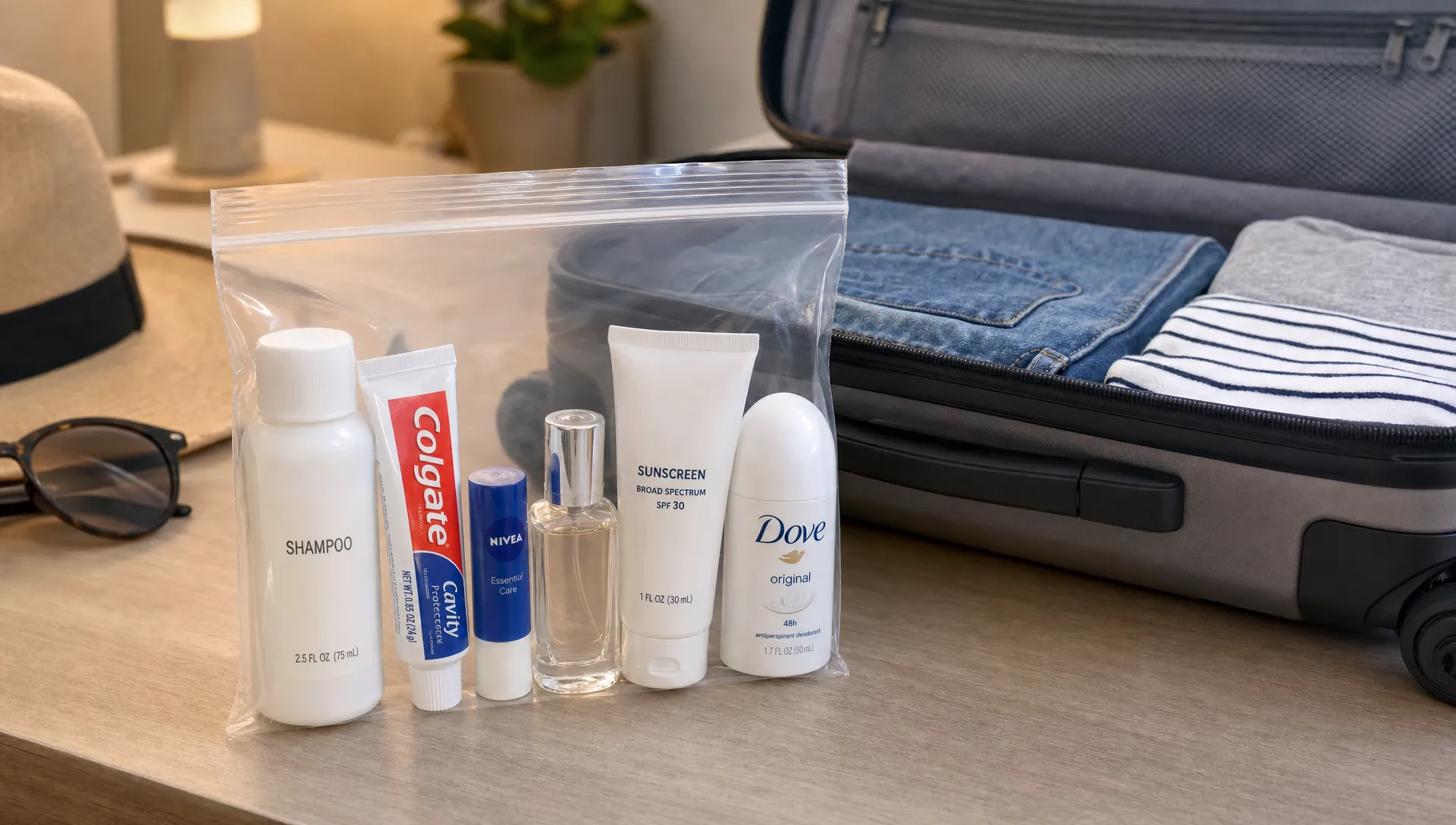
Common items that should go in your liquids bag include shampoo, conditioner, shower gel, toothpaste, mouthwash, perfume, aftershave, liquid foundation, mascara, lip gloss, hair gel, sunscreen, moisturiser, deodorant sprays, roll-on deodorant, shaving foam, and contact lens solution.
Food can also cause surprises. Honey, jam, chocolate spread, peanut butter, hummus, soft cheese, sauces, chutneys, and similar spreadable foods may be treated as liquids or pastes. If you want to bring them through security in your cabin bag, use 100ml containers or buy them after security where possible.
Solid items are usually easier. A bar of soap, solid deodorant stick, powder makeup, and solid lip balm are generally less likely to be treated as liquids, although security staff always have the final say at the checkpoint.
For a broader plain-English overview of carry-on toiletries and borderline items, see this plain-English hand luggage liquids guide.
Which rule matters on a UK trip?
The liquid rule that matters is the rule at each airport security checkpoint you pass through, not just the rule in the country where your airline is based.
| Trip situation | Which liquid rule matters most |
|---|---|
| Departing from a UK airport | The UK airport security rule at your departure terminal |
| Connecting through a UK airport and clearing security again | The UK transfer security rule at that airport |
| Arriving in the UK without another security check | The departure airport rule at your origin, plus airline and customs requirements |
| Flying out from the UK but returning from another country | The UK rule for the outbound flight and the return airport rule for the way home |
| Buying duty-free before a connection | The connection airport rule, especially if you must pass through security again |
This is especially important for round trips. You might depart from a UK airport that uses one process, then return from an airport abroad that uses a stricter or different process. If you are traveling with only a cabin bag, pack for the strictest checkpoint on the whole journey.
Exceptions: medicine, baby supplies, and special needs
Some liquids may be allowed in cabin baggage in quantities above 100ml, but they are not treated like ordinary toiletries. They should be packed separately, declared when needed, and available for inspection.
Essential medicines can often exceed the 100ml limit if they are needed for your journey. Keep them in original packaging where possible, and carry supporting documentation such as a prescription or doctor’s letter if the item is unusual, large, or medically important.
Baby milk, formula, sterilised water, and baby food needed for the journey may also be exempt from the standard 100ml container rule. Security may still screen these items, and rules can be more specific for breast milk or frozen items, so it is sensible to check current guidance before flying.
Special dietary liquids needed for the journey may be allowed in larger amounts, but do not assume that ordinary snacks, sauces, or drinks qualify. If it is not medically or practically necessary for the trip, pack it within the standard 100ml rule or place it in checked luggage.
Duty-free liquids are a separate case. Liquids bought after security or on board may be allowed if they remain sealed in a tamper-evident security bag with the receipt visible. Do not open the sealed bag before your final security checkpoint, especially if you have a connection.
How to pack liquids for a UK carry-on bag
The easiest strategy is to pack your liquids bag before you leave for the airport, rather than trying to reorganize at security. This helps you spot oversized containers, remove unnecessary items, and avoid holding up the queue.
Use this simple approach:
- Choose travel-size containers marked 100ml or less.
- Put all toiletries, cosmetics, gels, sprays, and pastes in one clear resealable bag.
- Make sure the bag closes without forcing it.
- Keep essential medicines and baby supplies separate from ordinary toiletries.
- Pack the liquids bag near the top of your carry-on in case security asks to see it.
- Put full-size toiletries, large aerosols, and spare products in checked baggage if you have it.
A good test is to ask whether you would be comfortable losing the item at security. If the answer is no, check the rule before you travel or pack it in hold luggage.
Can you bring 2L liquids through UK airports with new scanners?
Sometimes, but you should not assume it. Newer airport scanners are designed to make screening easier and may support larger liquid allowances when approved and implemented. The problem is that airport rules are not always uniform across the UK, across terminals, or across time.
A traveler’s practical question is not whether an airport owns new scanners. The real question is whether your exact security checkpoint currently allows larger containers in cabin baggage. If that information is unclear, pack to the 100ml rule.
There is also the return-trip problem. Even if one airport allows larger liquids, your return airport, connection airport, or destination security checkpoint may not. A full-size bottle that gets through one airport can become a problem later in the journey.
For an up-to-date planning mindset, our guide to airport liquid limits for carry-ons in 2026 explains why scanner upgrades do not always mean the same rule everywhere.
Common mistakes that get liquids stopped at UK security
Most problems happen because passengers pack based on habit, not the current checkpoint rule. These are the mistakes to avoid.
| Mistake | Why it causes problems | Better choice |
|---|---|---|
| Bringing a half-empty full-size bottle | Security checks container capacity, not remaining volume | Use a 100ml travel bottle |
| Forgetting that toothpaste counts | Pastes are treated like liquids | Put toothpaste in the liquids bag |
| Packing multiple clear bags | UK rules usually allow one liquids bag per passenger | Consolidate essentials into one bag |
| Assuming new scanners mean 2L | Scanner rules can vary or change | Check the exact airport rule before travel |
| Opening duty-free before a connection | Opened liquids may not be protected for transfer screening | Keep duty-free sealed with the receipt visible |
| Packing sauces or spreads as souvenirs | Spreadable foods can count as liquids or pastes | Buy after security or put them in checked luggage |
Frequently Asked Questions
What is the liquid limit at UK airports for carry-on bags? The safest standard is containers of 100ml or less, packed in one clear resealable plastic bag of about 1 litre capacity. Larger liquids usually need to go in checked baggage unless they qualify for an exemption.
Do all UK airports use the same liquids rule? UK airports follow national security requirements, but the passenger experience can vary by airport, terminal, scanner setup, and current operating instructions. Always check your exact airport close to travel.
Does toothpaste count as a liquid at UK airport security? Yes. Toothpaste is a paste, so it should be treated as a liquid for carry-on screening and packed in a container of 100ml or less inside your liquids bag.
Can I take medicine over 100ml in my hand luggage? Essential medicine needed for your journey may be allowed above 100ml, but it can be inspected. Keep it separate, in original packaging where possible, and bring supporting documentation if appropriate.
Can I bring baby milk or baby food through UK airport security? Baby milk, formula, sterilised water, and baby food needed for the journey may be allowed in quantities above 100ml. Security may screen them, and specific rules can apply, so check current guidance before flying.
What if my return airport has different liquid rules? Pack for the strictest security checkpoint on your whole trip. If your UK departure, overseas return, or connecting airport applies the 100ml rule, full-size liquids can still cause problems even if another airport was more relaxed.
Check your UK airport liquid rule before you pack
UK airports liquids rules are easy to follow when you pack for the strictest checkpoint, but they are risky to guess from old posts or scanner rumors.
Before you zip your carry-on, use Liquid Limits to check your airport, item, route, and return flight. You will see verified guidance, source links, and last-checked dates so you can pack with fewer surprises at security.