
If you have flown recently, you may have noticed something confusing: some airports talk about newer scanners and larger liquid allowances, while many others still ask you to put tiny bottles in a clear bag. The result is a patchwork of 100ml airports, 2L airports, temporary exceptions, and route-specific surprises.
So why is the 100ml rule still around? The short answer is that airport liquid rules are not updated just because a scanner exists. They change only when security agencies, airport operators, screening staff, equipment certifications, and international transfer rules all line up. In aviation security, a rule that is simple, conservative, and globally understood is often kept until every weak link has been addressed.
That does not make the rule convenient, but it explains why it has lasted far longer than many travelers expected.
The 100ml rule was created for a specific security risk
The 100ml liquid rule is not about preventing spills, reducing cabin clutter, or forcing travelers to buy products after security. It was introduced in response to a real aviation security concern: the possibility of liquid explosives being carried onto aircraft in everyday-looking containers.
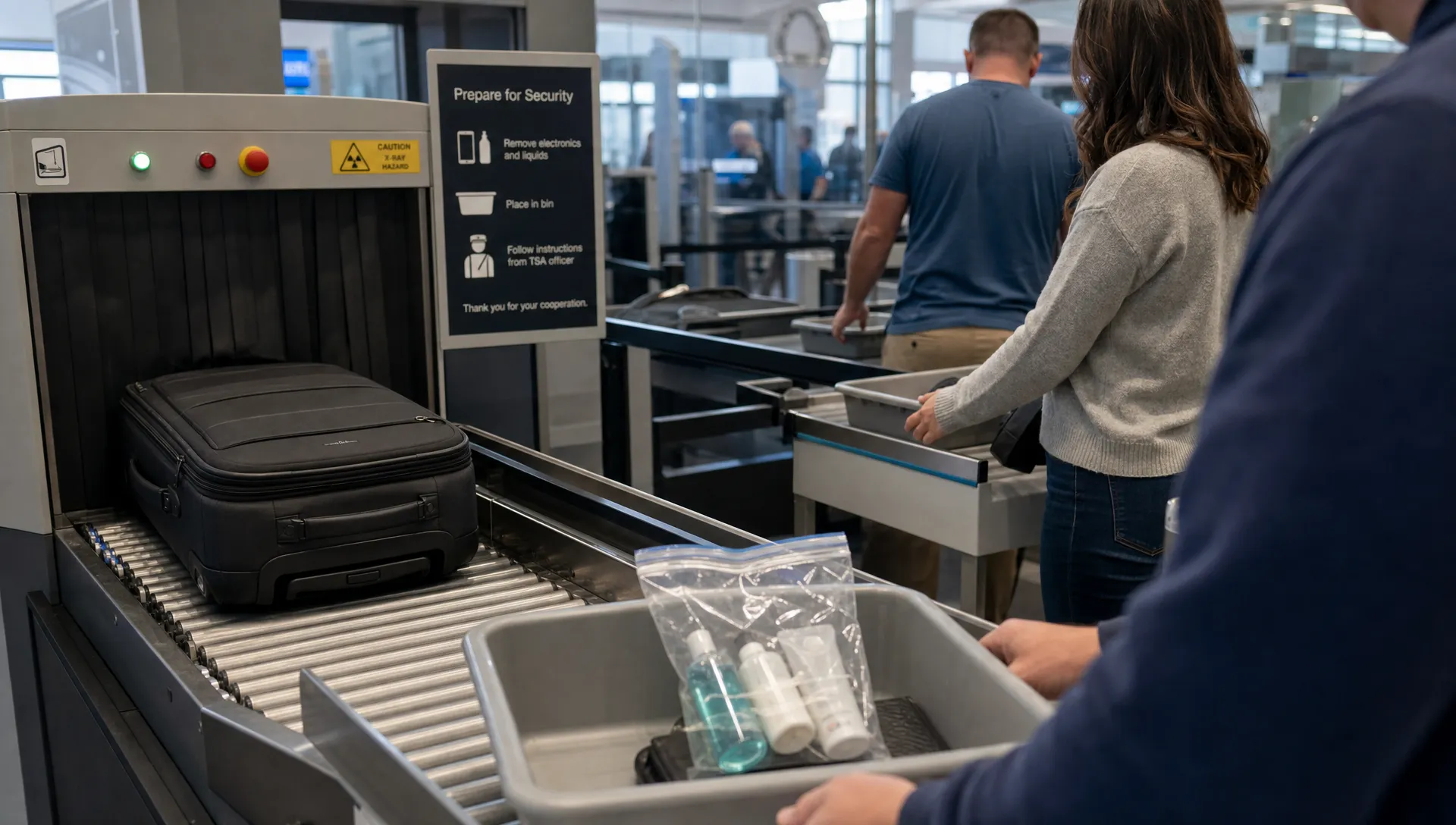
After the 2006 transatlantic aircraft plot, governments introduced strict limits on liquids, aerosols, and gels in cabin bags. The rule became familiar across many countries: each container must usually be 100ml or less, and those containers must fit inside a resealable transparent bag. In the United States, the TSA’s 3-1-1 liquids rule uses the equivalent 3.4 oz container limit.
The key point is that the rule was designed as a risk-control shortcut. Instead of asking every checkpoint to identify every possible liquid threat in any size container, regulators limited the amount that could be carried in a single container. Smaller containers reduce the risk that a dangerous quantity could be brought through undetected.
That original logic still matters at airports that rely on older screening equipment.
Why older airport scanners still need simple liquid limits
Traditional airport X-ray scanners show security officers a two-dimensional image of your bag. Officers can identify shapes, density differences, and suspicious objects, but the system is not designed to reliably analyze the chemical composition of every liquid inside every bottle.
That limitation is why the 100ml rule remains useful. A shampoo bottle, a sports drink, a gel deodorant, and a liquid cosmetic may look ordinary on a scanner image. If an airport cannot reliably verify the contents of larger liquid containers at speed, it needs a rule that keeps risk within an acceptable boundary.
The 100ml rule is also easy to enforce under pressure. Security checkpoints process thousands of passengers daily. A screener can quickly reject a 250ml bottle of lotion, even if it is half empty, because the container size is visible. A more flexible rule would require more judgment calls, more secondary inspections, and more delays.
For a deeper breakdown of how these rules are applied at checkpoints, Liquid Limits has a guide to how the liquid rule at the airport really works, including container limits, bags, exemptions, and duty-free handling.
New scanners help, but they do not automatically remove the rule
The major reason travelers expected the 100ml rule to disappear is the rollout of computed tomography scanners, often called CT scanners or next-generation security scanners. These machines create detailed 3D images of bags and can help screeners assess items more accurately than older X-ray systems.
In theory, this makes larger liquid containers easier to screen. In practice, removing the 100ml rule depends on far more than installing a machine.
An airport usually needs the right equipment, approved software, regulator sign-off, trained staff, updated checkpoint layouts, and clear operating procedures. If any part of that chain is incomplete, the airport may continue using the 100ml rule even if some new scanners are already present.
| Factor | Why it matters for liquid rules |
|---|---|
| Scanner type | Older X-ray systems are less capable of assessing liquids than CT scanners. |
| Regulatory approval | Airports generally cannot change liquid limits without approval from the relevant authority. |
| Software performance | Detection algorithms may need updates, testing, or restrictions before larger liquids are allowed. |
| Staff training | Screeners need consistent procedures for reviewing flagged liquids and resolving alarms. |
| Checkpoint coverage | If only some lanes have new scanners, the airport may keep one rule for everyone. |
| International connections | Passengers may still face 100ml limits at transfer or return airports. |
This is why two airports in the same country can have different rules, and why one airport’s rule can change more than once.
Why regulators move slowly on liquid restrictions
Aviation security is designed around layers of protection. When a rule is removed, regulators need confidence that another layer can carry the risk reliably, not just on a good day, but at scale, across busy holiday periods, equipment outages, staff changes, and unusual passenger items.
This creates a conservative decision-making process. Regulators may ask questions such as:
- Can the scanner detect the relevant threat materials inside different bottle shapes and bag arrangements?
- What happens if the scanner flags a liquid during peak travel periods?
- Are all checkpoint lanes using the same approved equipment and software?
- Can passengers transfer through other airports without losing items at the next security check?
- Is there a fallback rule if equipment is unavailable or performance concerns appear?
That last point is important. Security rules can move backward as well as forward. If a technical issue, certification concern, or policy review arises, airports may reinstate the 100ml rule even after allowing larger liquids for a period.
From the traveler’s perspective, that feels inconsistent. From the regulator’s perspective, it is risk management.
The rule survives because air travel is international
If every passenger flew from one airport to another with no connections and no return trip, liquid rules would be easier to modernize. Real travel is messier.
A traveler might depart from an airport that allows larger liquids, connect through an airport that still enforces 100ml, and fly home from a third airport with different rules again. Duty-free purchases may also be treated differently depending on whether they are sealed in a security tamper-evident bag and whether the next airport recognizes the procedure.
That is why the strictest checkpoint on your journey matters more than the most relaxed one. If your outbound airport allows a 500ml bottle but your return airport does not, you may still lose it on the way home. If your first airport has CT scanners but your connecting airport requires standard liquid bags, you may need to repack or surrender items during transfer screening.
This is one reason Liquid Limits focuses on whole trips rather than just one departure point. If you are planning an itinerary, checking airport liquid limits for carry-ons in 2026 can help you understand why the rule may differ by airport, route, and date.
Why “100ml per container” still matters, even if the bottle is half empty
One of the most frustrating parts of the rule is that it is based on container capacity, not the amount of liquid left inside. A 200ml bottle with only 50ml of product remaining is still usually treated as a 200ml container.
That may seem unreasonable, but it makes enforcement faster and more consistent. Security officers cannot spend time estimating the remaining volume inside every container, especially when bottles are opaque, irregularly shaped, or poorly labeled. The printed capacity gives officers a clear, objective standard.
This is also why decanting products into travel-size bottles remains the safest packing strategy at 100ml airports. If the container label says 100ml or less, and the item fits with your other liquids in the required bag, it is much less likely to cause a problem.
Why airports do not all switch at once
Travelers often ask why airports cannot simply agree on one modern rule. The answer is that airports are not identical systems. They differ in passenger volume, funding, terminal layout, procurement timelines, security authority, and national regulations.
A large hub may need hundreds of new scanners, redesigned security lanes, and extensive staff training before it can change liquid rules. A smaller airport may upgrade faster, but still be limited by national policy. Some airports may have new scanners in one terminal but not another. Others may be waiting for final approval before changing passenger instructions.
There is also a communication problem. If only some passengers can use relaxed liquid rules, confusion increases. Airports may choose to keep the 100ml rule until they can apply a consistent instruction across all passengers and lanes.
In security operations, a clear rule that everyone understands can be safer than a flexible rule that passengers and staff interpret differently.
What travelers should do while the rule is still changing
The practical answer is simple: do not assume the relaxed rule applies unless you have checked your specific airport and route close to departure. Liquid rules can change by country, airport, terminal, scanner availability, and date.
A cautious packing approach still works best for most trips:
- Pack cabin liquids in containers of 100ml or less unless you have confirmed a larger allowance.
- Remember that gels, pastes, creams, aerosols, liquid cosmetics, and some foods may count as liquids.
- Check both outbound and return airports, not just the airport where your trip starts.
- Treat connecting airports as potential second security checks.
- Keep medicines, baby food, and special dietary items separate and ready for inspection, since exemptions may require screening.
If you want to compare rules before you pack, the airport liquid rules directory lists airports with liquid limits, source references, and last-checked dates.
Will the 100ml rule eventually disappear?
In some places, yes. The long-term direction is toward better screening technology and fewer blanket restrictions. As more airports install approved CT scanners and regulators gain confidence in their performance, larger liquid allowances may become more common.
But “eventually” does not mean “everywhere at once.” The 100ml rule will likely remain part of air travel until older equipment is replaced, security authorities align on standards, and international transfer problems become easier to manage.
Even then, travelers may still see exceptions. High-risk routes, temporary alerts, equipment problems, or local policy decisions can bring stricter rules back. Aviation security rarely moves in a straight line.
The best expectation is not that the 100ml rule will vanish overnight, but that liquid rules will continue to vary for a while. That makes checking current rules more important, not less.
Frequently Asked Questions
Why do airports still use the 100ml rule? Airports still use the 100ml rule because older screening equipment cannot reliably assess all larger liquids at checkpoint speed. The rule also provides a simple, consistent way to reduce security risk while airports upgrade technology and regulators approve new procedures.
Do CT scanners mean I can bring liquids over 100ml? Not always. CT scanners can support larger liquid allowances, but the airport must also have regulatory approval, trained staff, approved software, and consistent checkpoint procedures. Always check the airport’s current rule before packing larger containers.
Why is the rule based on bottle size instead of the amount left inside? The rule is based on container capacity because it is faster and more objective to enforce. A 200ml bottle is usually not allowed in a 100ml checkpoint even if it is nearly empty.
Can liquid rules be different on my return flight? Yes. Your return airport may follow a different rule from your departure airport. You may also face different rules at connecting airports, so it is safest to check the full route before you travel.
Are medicines and baby food limited to 100ml? Many airports allow exemptions for essential medicines, baby food, and special dietary items, but they may need to be declared and screened separately. The exact process can vary by airport and country.
Check before you pack
The 100ml rule is still used because aviation security depends on proven systems, not assumptions. New scanners are changing what is possible, but airport rules remain uneven across routes, terminals, and countries.
Before your next trip, use Liquid Limits to check the strictest cabin liquid rule for your whole journey, including the return flight. It is the easiest way to see whether your route is still 100ml or allows a larger limit before your toiletries end up in the security bin.