
Packing for airport security is easier when you know which everyday products count as liquids before they reach the tray. The tricky part is that airport security liquid limits do not apply only to obvious drinks. They can also apply to gels, creams, pastes, aerosols, spreads, foams, and some foods that look solid until a security officer checks them.
For many travelers, the safest default is still the familiar 100 ml / 3.4 oz container rule for cabin bags. In some airports or lanes with newer screening equipment, larger containers may be allowed, often up to 2 liters. But that does not mean every checkpoint on your route follows the same rule. Your departure airport, connecting airport, and return airport can all matter.
This guide breaks down common items by category, so you can decide what belongs in your carry-on, what should go in checked luggage, and what needs a route-specific check before you pack.
The short version: what counts as a liquid at airport security?
Airport security usually treats an item as a liquid if it can be poured, squeezed, sprayed, spread, smeared, or pumped. That is why toothpaste, peanut butter, mascara, sunscreen, hair gel, and yogurt can fall under liquid rules even though they do not look like a bottle of water.
Under the standard carry-on rule used in many countries, each liquid container must be 100 ml / 3.4 oz or smaller and fit inside a clear resealable liquids bag. The container size matters, not how much product is left inside. A half-empty 200 ml shampoo bottle can still be refused because the container is over the limit.
The TSA liquids rule describes this as the 3-1-1 rule for U.S. screening, while the U.K. government explains similar restrictions on its hand luggage rules page. Exact bag size, wording, and exceptions vary by country, so always check the airport and route you are actually using.
If you need a deeper explanation of how the container limit works, this guide to what counts as 100ml of liquid at security covers the rule in more detail.
Common items and how airport security usually treats them
Use this table as a practical packing reference. It is intentionally conservative because the strictest checkpoint on your trip is the one that decides whether an item stays with you.
| Common item | Usually treated as a liquid? | Carry-on packing advice |
|---|---|---|
| Shampoo and conditioner | Yes | Use containers of 100 ml / 3.4 oz or less unless your whole route allows larger containers. |
| Body wash and shower gel | Yes | Pack travel-size bottles in your liquids bag. |
| Toothpaste | Yes | Even thick toothpaste is usually treated as a paste or gel. |
| Sunscreen | Yes | Lotion, spray, gel, and cream sunscreen usually count. |
| Perfume and cologne | Yes | Small bottles are allowed if they meet the container limit and fit in the liquids bag. |
| Mascara | Yes | Pack with other liquids, gels, and creams. |
| Liquid foundation and concealer | Yes | Cream and liquid makeup usually count. Powder makeup usually does not. |
| Lip gloss | Yes | Glosses and liquid lip products usually count. Solid lipstick usually does not. |
| Gel, spray, and roll-on deodorant | Yes | Put these in the liquids bag. Solid stick deodorant is usually not a liquid. |
| Hairspray and dry shampoo aerosols | Yes | Must meet liquid size rules and airline hazardous goods limits. |
| Shaving foam or gel | Yes | Travel-size cans or tubes are safest for cabin bags. |
| Contact lens solution | Usually yes | Small bottles follow the liquid rule, while medically necessary amounts may qualify for an exception. |
| Eye drops and liquid medicine | Exception may apply | Declare or separate medically necessary liquids if over the standard limit. |
| Hand sanitizer | Yes | Pack 100 ml / 3.4 oz or less unless a specific airport exception applies. |
| Baby formula, breast milk, and baby food | Exception may apply | Often allowed in larger reasonable quantities, but expect extra screening. |
| Yogurt, pudding, and custard | Yes | Pack 100 ml / 3.4 oz or less or place in checked luggage. |
| Peanut butter, jam, honey, and hummus | Yes | These are spreadable, so they usually count as liquids or gels. |
| Sauces, dips, and salad dressing | Yes | Small containers only in cabin bags unless local rules allow more. |
| Soup and canned foods with liquid | Yes | Better in checked luggage because they can exceed limits and may be hard to screen. |
| Water, soda, juice, and coffee | Yes | Empty or finish before security, then refill or buy after screening. |
| Duty-free perfume or alcohol | Special rules | Keep sealed in the security tamper-evident bag with receipt, especially for connections. |
| Snow globes | Usually yes | Small ones may be allowed if they meet local liquid rules. Larger ones should be checked. |
| Vape liquid and e-liquid | Yes | Follow liquid limits, while vape devices with lithium batteries usually belong in carry-on, not checked luggage. |
| Gel ice packs | Depends | Fully frozen packs may be treated differently from melted or slushy packs, but rules vary. |
This table is a starting point, not a substitute for checking your exact airport. If an item is expensive, medically important, or hard to replace, verify it before you leave home.
Toiletries: the category most travelers get wrong
Toiletries are the most common source of liquid limit problems because they often come in containers that are just slightly too large. A 125 ml toothpaste tube, a 150 ml face wash, or a 200 ml sunscreen bottle can all be an issue at a 100 ml checkpoint, even if they are nearly empty.
The safest approach is to decant nonessential products into clearly labeled travel-size containers or buy travel-size versions. Make sure the container itself shows the volume when possible. Security officers do not have to accept your estimate if the size is unclear.
Be especially careful with aerosol toiletries. Spray deodorant, hairspray, dry shampoo, and shaving foam are not just liquids for screening purposes. They can also be subject to airline and hazardous materials rules because they are pressurized. Keep caps on, avoid damaged cans, and check airline guidance if you are carrying more than a small personal-use amount.
Solid alternatives can reduce the number of items in your liquids bag. Solid shampoo bars, stick deodorant, powder cleanser, toothpaste tablets, and balm-style products may help, although security officers can still inspect anything that looks unusual.
Food and drinks: the surprise liquid category
Food causes confusion because travelers often think of liquids as beverages only. In practice, many soft or spreadable foods are treated like liquids, gels, or pastes.
Peanut butter, chocolate spread, hummus, cream cheese, salsa, jam, honey, maple syrup, yogurt, pudding, dips, soup, and sauces are common examples. They may be delicious, but if they are over 100 ml / 3.4 oz and your airport uses the standard rule, they are likely to be refused in a cabin bag.
Solid foods are usually easier. Sandwiches, fruit, crackers, chocolate bars, pastries, and hard cheese are not normally liquids. However, destination customs and agriculture rules are a separate issue. An item might pass airport security but still be restricted on arrival, especially for meat, dairy, fruit, seeds, or fresh produce.
If you are bringing food gifts, choose dry, sealed, shelf-stable items when possible. For jars and sauces, checked luggage is usually safer, provided the product is allowed at your destination and packed to prevent leaks.
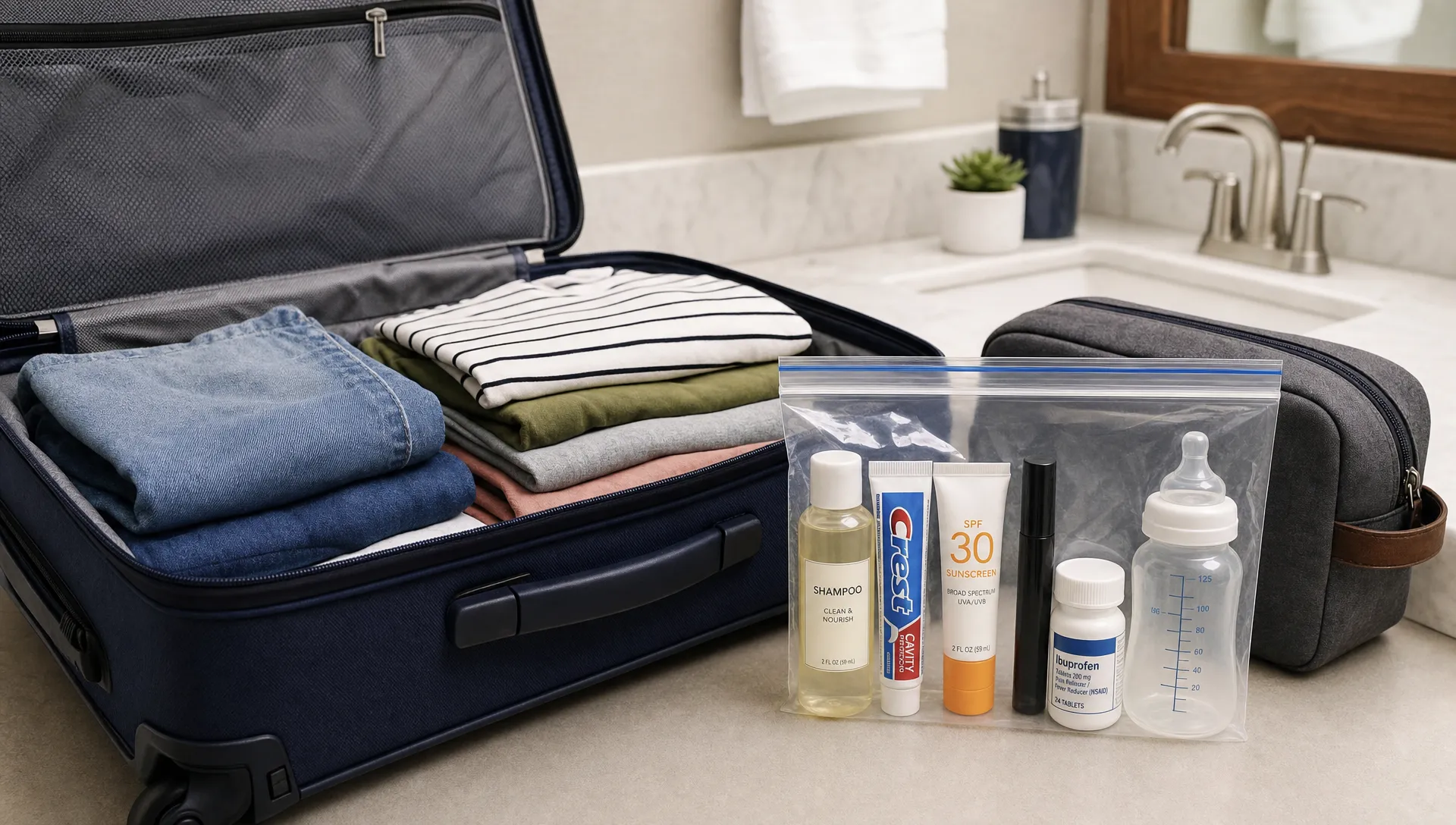
Medicines, baby items, and accessibility needs
Most major security systems make allowances for medically necessary liquids and baby-related items, but these exceptions do not mean you can pack them casually.
Liquid medicines, insulin, eye drops, antiseptic solutions, nutritional drinks, cooling gels, and medically required creams may be allowed above the standard 100 ml / 3.4 oz limit when they are necessary for the journey. Security may ask you to remove them from your bag, declare them, or allow additional screening. A prescription, pharmacy label, or doctor letter can help, especially for international travel, although requirements vary.
Baby formula, breast milk, sterilized water for infants, baby food, and toddler drinks are also commonly treated as exceptions in reasonable quantities. The word reasonable matters. A small amount for the journey is easier to justify than a suitcase full of liquid baby food in your cabin bag.
If you rely on a medical or baby-item exception, do not bury the item at the bottom of your luggage. Keep it accessible and allow extra time at security. If you are connecting through another country, check the connection airport too, not just your first departure airport.
Duty-free liquids: allowed does not always mean safe for connections
Duty-free liquids are one of the biggest traps for international travelers. You may be able to buy a large bottle of perfume, liquor, skincare, or cosmetics after security at your departure airport. The problem appears later if you have a connecting flight and must pass through another security checkpoint.
Many airports use security tamper-evident bags for duty-free liquids. These bags are usually sealed by the store and include proof of purchase. If you open the bag, lose the receipt, or travel through an airport that applies different rules, the item may still be challenged.
For simple nonstop flights, duty-free liquids are usually less complicated. For connections, multi-country trips, and return flights, check the entire route. If you cannot confirm the rules, consider buying duty-free on the final leg or packing the item in checked luggage where permitted.
New scanners and the 2L question
Some airports have introduced newer cabin baggage scanners that can change how liquids are screened. In certain locations, travelers may be allowed to keep liquids and electronics inside the bag, and larger liquid containers may be accepted.
The catch is that these rules are not universal. They can vary by country, airport, terminal, lane, date, and equipment status. An airport may have both newer and older screening lanes operating at the same time. A rule can also change temporarily due to equipment testing, government instructions, or staffing.
That is why a 2L allowance at one checkpoint does not guarantee a 2L allowance for your return flight. If your outbound airport allows larger liquids but your destination airport still applies 100 ml on the way home, your full-size products may become a problem later.
For a broader look at how these changing rules work, see airport liquid limits for carry-ons in 2026. When in doubt, plan for the stricter rule or check your specific route before packing.
A practical packing system for common liquid items
The easiest way to avoid confiscation is to sort your bag by risk, not by category. Before you zip your carry-on, place every liquid-like item on a table and ask whether it can pour, spread, spray, squeeze, smear, foam, or melt.
For most trips, this simple system works well:
- Put essential travel-size liquids in one clear resealable bag.
- Move nonessential full-size liquids to checked luggage.
- Keep medicines and baby items separate and easy to inspect.
- Choose solid alternatives when they genuinely work for your trip.
- Avoid large jars of spreads, sauces, and soft foods in cabin bags.
- Check the return airport and connection airport, not only the first departure airport.
This last point is especially important. Airport security liquid limits are enforced at checkpoints, not across your trip as one single rule. If you pass through three checkpoints, you need to satisfy the strictest one.
If you want to check by airport, item, or route, Liquid Limits helps you compare rules before you pack, including round trips where the return airport may be stricter. The tool also shows source links and last-checked dates, and when a rule is unclear, it defaults to the safer 100 ml guidance.
Common mistakes that lead to confiscation
The first mistake is assuming that a nearly empty large bottle is acceptable. Security usually looks at the container capacity printed on the bottle, not the remaining amount inside.
The second mistake is forgetting about creamy foods. A jar of local honey, a gourmet sauce, or a tub of hummus may feel like a food souvenir, but it can still be treated as a liquid or gel.
The third mistake is relying on rules from a previous trip. Liquid screening is changing as airports update equipment, but adoption is uneven. A rule that applied last summer, or even on your outbound flight, may not apply at your next checkpoint.
The fourth mistake is packing duty-free liquids without thinking about transfers. A sealed bag and receipt help, but they are not a universal guarantee across every airport and route.
For a more detailed look at problem items, Liquid Limits also explains which liquids at airport security are most likely to get flagged.
Frequently Asked Questions
Does toothpaste count as a liquid at airport security? Yes. Toothpaste is usually treated as a paste or gel, so it must follow the airport liquid limit for carry-on bags unless a specific airport rule allows larger containers.
Can I bring a 200 ml bottle if it is half empty? Usually no at a 100 ml checkpoint. The rule normally applies to the container size, not the amount left inside.
Are solid toiletries better for avoiding liquid limits? Often, yes. Solid deodorant, shampoo bars, toothpaste tablets, and powder products can reduce your liquids bag, although security can still inspect them.
Do medicines have to be under 100 ml? Medically necessary liquids may be allowed in larger reasonable quantities, but you should separate them, declare them if required, and carry supporting documentation when possible.
Can I bring peanut butter, jam, or hummus in my carry-on? Only in small containers that meet the liquid limit at standard checkpoints. Spreadable foods are commonly treated as liquids, gels, or pastes.
Why should I check my return airport? Your return airport may use different equipment or apply a stricter rule than your departure airport. If the return checkpoint uses 100 ml limits, full-size liquids bought or packed earlier may not be allowed in your cabin bag.
Check your items before you pack
The safest packing decision is the one based on your actual route, not a general memory of the rules. Before you leave for the airport, check your departure, connection, and return checkpoints, especially if you are carrying full-size toiletries, food gifts, medicine, baby items, or duty-free purchases.
Use Liquid Limits to check airport security liquid limits by airport, item, or route, then pack for the strictest rule you will face on the trip.