
Hand luggage liquid restrictions are easier to follow when you stop thinking about the product and start thinking like airport security. Officers usually care about three things: the container size, whether the item behaves like a liquid, gel, paste, cream, aerosol, or spread, and which checkpoint you will actually pass through on your trip.
That last point matters. The rule at your departure airport may not be the rule at your connecting airport or your return airport. Some airports have newer scanners, some still apply the classic 100 ml rule, and some may temporarily return to stricter limits even after equipment upgrades.
This guide explains the rules clearly, including what counts as a liquid, what exceptions are common, and how to pack so you are not forced to throw away toiletries, cosmetics, drinks, or gifts at security.
The basic rule most travelers should assume
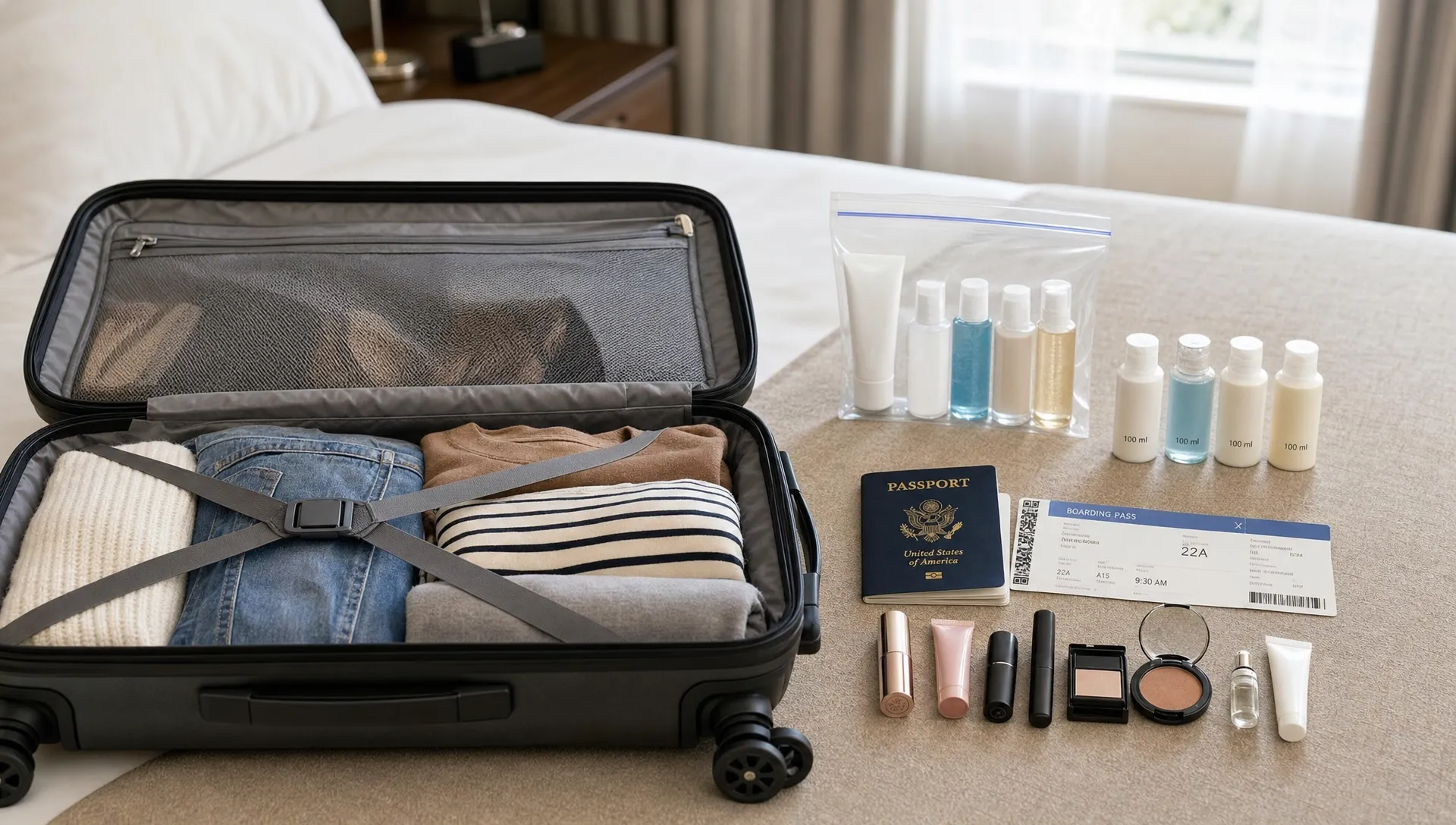
For most international trips, the safest assumption is simple: liquids in hand luggage must be in containers of 100 ml, or 3.4 oz, or less. Those containers usually need to fit inside one clear, resealable plastic bag.
In the United States, the Transportation Security Administration describes this as the 3-1-1 liquids rule: containers of 3.4 oz or less, placed in one quart-sized bag, with one bag per passenger. In the UK, official government guidance also centers on containers of 100 ml or less in a clear plastic bag, with separate rules for exemptions such as medicines and baby food.
The most important detail is that container size matters more than the amount left inside. A 200 ml shampoo bottle that is half empty is still usually treated as a 200 ml container. If the airport is enforcing the 100 ml rule, it can be refused.
That means the easiest compliant packing strategy is to use travel-size containers labeled 100 ml or less, then put them together before you reach security.
What counts as a liquid in hand luggage?
Airport liquid rules cover more than water, perfume, and shampoo. Many items that feel solid at home are treated as liquids at security because they can be poured, squeezed, sprayed, smeared, or spread.
| Item type | Common examples | Usually treated as a liquid? |
|---|---|---|
| Drinks and watery liquids | Water, juice, coffee, soup | Yes |
| Toiletries | Shampoo, conditioner, shower gel, mouthwash | Yes |
| Creams and lotions | Moisturizer, sunscreen, hand cream | Yes |
| Gels | Hair gel, aloe gel, toothpaste | Yes |
| Pastes and spreads | Peanut butter, jam, soft cheese, hummus | Often yes |
| Aerosols | Deodorant spray, dry shampoo, shaving foam | Yes |
| Cosmetics | Mascara, liquid foundation, lip gloss | Usually yes |
| Medical liquids | Prescription liquid medicine, saline solution | Often exempt, but must be screened |
| Baby supplies | Baby milk, formula, sterilized water | Often exempt when traveling with a child |
If you can squeeze it, spray it, pour it, pump it, or spread it, pack it as if it is a liquid unless you have checked a specific rule for your airport and item.
For a broader plain-English breakdown of examples, Liquid Limits also has a guide to what is allowed in liquids in carry-on luggage that can help with borderline items.
Why the rules are not always the same everywhere
The confusing part is that hand luggage liquid restrictions are not only about aviation safety policy. They also depend on the screening technology used at the airport and how local authorities are applying the rule at that time.
Some airports have installed advanced CT scanners that can screen liquids differently. In some places, this has allowed passengers to keep liquids and electronics inside bags or carry larger liquid containers. However, this is not universal, and rules can change quickly.
That is why travelers get caught out. One airport may advertise relaxed liquid screening, while another airport on the same trip still requires 100 ml containers. Your return flight may depart from an airport with stricter rules than the one you originally left from.
A practical rule of thumb is this: pack for the strictest airport security checkpoint on your whole journey, not the most relaxed one.
This is especially important for:
- Round trips where the return airport is in a different country
- Connecting flights where you may need to clear security again
- Multi-city trips with separate tickets
- Duty-free purchases that need to pass through a second checkpoint
- Airports that recently changed scanner policies
If you are traveling through the UK, it is particularly worth checking before you leave because rules have changed during scanner rollouts. Liquid Limits keeps a dedicated guide to UK airports liquids rules for carry-on bags for travelers who need a country-specific starting point.
The clearest way to decide what to pack
Use this quick decision process before you close your bag.
- Will it go in your hand luggage? If yes, continue. If it is going in checked baggage, the 100 ml cabin liquids rule usually does not apply, though airline and dangerous goods limits may still matter.
- Is it liquid-like? If it pours, spreads, sprays, smears, gels, foams, or squeezes out, treat it as a liquid.
- Is the container 100 ml or 3.4 oz or less? If not, move it to checked baggage, buy a smaller size, or leave it at home.
- Does it fit in the required clear bag? If the airport uses the classic rule, your liquids normally need to fit in one clear resealable bag.
- Is it medically necessary or for a baby? If yes, check the exemption rules and be ready to present it separately.
- Will you connect or return through another airport? If yes, check those checkpoints too.
- Are you relying on a relaxed scanner rule? If yes, verify it close to departure and have a backup plan.
This process is intentionally conservative. It helps prevent the most common mistake: packing based on what was allowed at one airport last year, then discovering that a different airport on the return trip is stricter today.
Common exceptions, and how to handle them
Liquid restrictions usually include exceptions for essential medical needs and baby supplies. But an exception does not mean the item can stay hidden in your bag or skip screening. It usually means the item can exceed the standard container limit if it is reasonable for the journey and presented properly.
| Exception | What may be allowed | How to reduce problems at security |
|---|---|---|
| Prescription liquid medicine | Larger quantities may be allowed when needed for the trip | Keep it in original packaging where possible and carry supporting documentation if relevant |
| Non-prescription medical liquids | Items such as cough syrup or saline may be allowed if medically needed | Separate them for screening and bring only a reasonable amount |
| Baby milk and formula | Larger amounts may be allowed when traveling with a baby | Present them separately and expect additional screening |
| Baby food and sterilized water | Usually allowed in reasonable quantities for the journey | Keep containers accessible and declare them if asked |
| Special dietary liquids | May be allowed when medically necessary | Bring documentation if the need is not obvious |
| Duty-free liquids | Often allowed if sealed in an approved security bag with receipt | Do not open the sealed bag before your final destination |
Rules for exemptions vary by country, so do not assume the same treatment everywhere. If the item is essential, check the airport or government source before traveling and allow extra time at security.
Duty-free liquids are not automatically safe on connecting flights
Duty-free is one of the biggest sources of liquid-rule surprises. You may be allowed to buy a full-size bottle of perfume, alcohol, or cosmetics after security at your departure airport. But if you have a connecting flight and must pass through security again, that purchase may be checked under the next airport’s rules.
Many airports allow duty-free liquids over 100 ml if they are packed in a sealed, tamper-evident security bag with the receipt visible. The problem is that not every route handles this the same way, and some transfers involve leaving the secure area.
To protect your purchase:
- Ask the duty-free staff to seal the item in an approved security bag
- Keep the receipt inside the sealed bag
- Do not open the bag until after your final airport security checkpoint
- Check connection rules before buying expensive liquids
- Put liquids in checked baggage if you collect bags and recheck them before another flight
If you are unsure, wait until your final airport or destination city to buy full-size liquids.
Hand luggage vs checked luggage: different rules, different risks
The 100 ml rule is a cabin baggage security rule. It does not usually apply to liquids packed in checked luggage. That means full-size shampoo, sunscreen, perfume, and other toiletries can often go in checked bags, as long as they are not prohibited or restricted as dangerous goods.
However, checked baggage is not a free-for-all. Aerosols, flammable liquids, high-proof alcohol, and certain chemicals may be limited or banned. Airlines and aviation authorities may apply separate safety rules for items such as fuel, solvents, camping gas, lighter fluid, and some cleaning products.
For ordinary toiletries, checked luggage is often the simplest solution if you need full-size containers. Use sealed plastic bags or leak-proof pouches, especially for pressure changes in the aircraft hold. Placing liquids inside shoes or wrapping them in clothing can reduce mess, but it is not a substitute for a properly sealed container.
Borderline items that often cause confusion
Some items are easy to classify. Water is a liquid. Shampoo is a liquid. But others are less obvious.
Peanut butter, hummus, jam, honey, and soft cheese may seem like food rather than liquids, but they are often treated as spreads or pastes. Toothpaste is almost always treated as a liquid or gel. Mascara and liquid eyeliner are usually included. Lip balm may pass as a solid in many places, while lip gloss is more likely to be treated as a liquid.
Powders are a separate category. They are not usually part of the 100 ml liquids rule, but some countries apply additional screening or limits for powders in cabin baggage. If you are carrying large quantities of protein powder, cosmetics powder, spices, or powdered supplements, check the rules for your destination and transit points.
Frozen liquids can also be tricky. Some security authorities allow fully frozen items if they are solid when screened, but partially melted items may be treated as liquids. Unless you have verified the rule for your airport, do not rely on freezing as a workaround.
Airport-day habits that make liquid screening easier
Good packing is only half the job. The other half is moving through security without delays.
Before you leave for the airport, place your liquids bag where you can reach it quickly. Do not bury it under shoes, chargers, or jackets. If you have medical liquids, baby supplies, or duty-free items, keep those separate too.
If you are traveling to a busy airport, build in extra time. A delay at security is easier to manage when your ground transport is predictable, especially for early departures or business trips. For travelers who prefer a scheduled premium pickup, a professional nationwide airport car service can help reduce one stressful variable before the screening process even begins.
At the checkpoint, follow the instructions in front of you, not what you remember from your last trip. Some airports ask you to remove liquids from your bag. Others using newer scanners may ask you to leave them inside. The signs and officers at that checkpoint are what matter.
How to check restrictions for your exact trip
The safest way to handle hand luggage liquid restrictions is to check the actual airports and route you are flying, including the return. This matters because your trip may involve multiple rule sets.
Liquid Limits is built for that exact problem. You can check liquid rules by airport, item, or route, including round trips where the return airport may be stricter than the outbound airport. The site provides verified guidance, source links, and last-checked dates, and it defaults to the stricter 100 ml rule when the rule is unclear.
For a route-based overview, you can start with Liquid Limits’ guide to limits on liquids on flights, then use the main trip checker when you need airport-specific guidance.
This is the approach that avoids most surprises: identify the strictest checkpoint, pack to that rule, and treat relaxed scanner policies as a bonus rather than a guarantee.
A simple packing example
Imagine you are flying from New York to London, then returning from a different UK airport. Your departure airport may follow the TSA 3-1-1 format. Your return airport may use UK-style liquid bag rules. A connecting airport could add another screening point.
For that trip, a low-risk packing setup would be:
- Travel-size shampoo, conditioner, toothpaste, sunscreen, and moisturizer in containers of 100 ml or less
- All liquid-like toiletries inside one clear resealable bag
- Prescription liquid medicine kept separately in original packaging
- No full-size drinks or spreads in hand luggage before security
- Any duty-free liquids kept sealed with receipt until the final destination
This may feel stricter than necessary at some airports, but it works because it is built around the most widely accepted rule. If an airport allows more, you lose nothing. If it does not, you are still prepared.
Frequently Asked Questions
Can I bring a 150 ml bottle if it only has 50 ml left? Usually no. Security normally checks the container size, not the amount remaining inside. Use a container labeled 100 ml or 3.4 oz or less.
Does toothpaste count as a liquid in hand luggage? Yes. Toothpaste is generally treated as a gel or paste, so it should follow the cabin liquids rule unless a specific airport says otherwise.
Can I bring water through airport security? In most airports applying the standard liquid rule, you cannot bring a full-size water bottle containing liquid through security. You can usually bring an empty bottle and refill it after screening.
Are liquid medicines limited to 100 ml? Often, medically necessary liquids can exceed the standard limit, but they must be screened and may need to be declared. Carry documentation when possible, especially for larger quantities.
Do newer airport scanners mean I can bring 2 liter liquids? Not always. Some airports with newer scanners may allow larger liquids, but not all do, and policies can change. Check your exact airport and date before relying on relaxed limits.
Do liquid rules apply to checked baggage? The standard 100 ml cabin rule is for hand luggage, not checked bags. However, checked baggage still has safety restrictions for aerosols, flammable liquids, chemicals, and other regulated items.
Check before you pack
Hand luggage liquid restrictions are not difficult once you apply the strictest-rule mindset. Use 100 ml containers when in doubt, keep liquid-like items together, treat exceptions as items that still need screening, and check every airport where you may pass through security.
Before your next trip, use Liquid Limits to compare the rules for your airports, items, and route so you know what to pack in hand luggage and what belongs in checked baggage.