
Airport security confiscation is frustrating because it usually happens late, fast, and in public. By the time a screener says a bottle cannot go through, your options may be limited to surrendering it, running back to check a bag, mailing it if the airport offers that service, or throwing it away.
The good news is that most problems with liquids and travel are preventable. Confiscation usually comes down to one of four issues: the container is too large, the item counts as a liquid even though you did not think of it that way, the airport on your route has stricter rules than expected, or an exemption was not packed clearly enough for screening.
This guide focuses on avoiding that moment at the tray table. It is not just a recap of the 100 ml rule. It is a practical way to think like airport security before you zip your carry-on.
Why liquids get confiscated at airport security
Security officers do not judge liquids only by how much product is left inside. They usually judge the size of the container, the type of item, and the rules in force at that specific checkpoint. That is why a half-empty 150 ml shampoo bottle can still be refused, while several smaller 100 ml bottles may be allowed if packed correctly.
Many travelers also underestimate what counts as a liquid. Airport rules often cover liquids, aerosols, gels, creams, and pastes. That can include toothpaste, mascara, lip gloss, peanut butter, hummus, hair gel, sunscreen, snow globes, liquid deodorant, and some spreadable foods.
Confiscation is more likely when you assume the rule is the same everywhere. Some airports have newer scanners and may allow larger liquid containers on certain routes, but others still enforce the standard 100 ml limit. Even within the same trip, your departure airport, connecting airport, and return airport may not all use the same rule.
For a deeper explanation of the checkpoint logic, see our guide to how the liquid rule at the airport really works.
The safest mindset: pack for the strictest checkpoint
The simplest way to avoid confiscation is to pack as if every airport on your trip applies the classic 100 ml, or 3.4 oz, cabin liquid rule unless you have verified otherwise.
In the United States, the TSA describes this as the 3-1-1 liquids rule: containers must be 3.4 oz or less and fit in one quart-sized clear bag. UK government guidance similarly explains that liquids in hand luggage are generally limited to containers of 100 ml or less and must fit in a transparent resealable bag, unless an exception applies.
The exact wording and bag requirements can vary by country, but the practical lesson is the same: when in doubt, small containers win. If a rule is unclear, assume the stricter 100 ml limit rather than hoping a screener will make an exception.
| Packing choice | Confiscation risk | Why it matters |
|---|---|---|
| 100 ml or smaller containers in a clear resealable bag | Low | Matches the most common cabin liquid rule |
| A 150 ml bottle that is half full | High | Container size usually matters, not remaining liquid |
| Full-size toiletries in checked baggage | Low | Checked baggage is not screened under the same cabin liquid limit |
| Unlabeled cream or gel in a random pot | Medium | It may be harder for security to identify and clear |
| Duty-free liquid in a sealed tamper-evident bag with receipt | Lower, but route-dependent | Transfer screening can still apply rules differently |
| Large liquid bought before security | High | It must pass the checkpoint like any other cabin liquid |
A five-minute packing audit before you leave home
Before every flight, do a quick liquid audit. This is especially useful if you are packing in a hurry, traveling with children, carrying medication, or returning with souvenirs.
- Put every liquid-like item on one surface: Include toiletries, cosmetics, sprays, gels, creams, pastes, food, drinks, medicines, and gifts. If it can spill, smear, spray, squeeze, pour, or spread, treat it as a possible liquid.
- Separate cabin essentials from checked-bag items: Keep only what you truly need during the airport and flight in your carry-on. Full-size shampoo, perfume, sunscreen, wine, olive oil, sauces, and souvenir jars are usually safer in checked baggage if allowed by airline and safety rules.
- Check the container size, not the remaining amount: A 200 ml bottle with only a little product left is still a 200 ml container. Decant it into a travel-size bottle if you need it in the cabin.
- Check your whole route: Look at the departure airport, connecting airports where you must pass security again, and the return airport. The strictest checkpoint should decide how you pack.
- Prepare exceptions separately: Medicines, baby milk, formula, and special dietary liquids may be allowed above 100 ml in many places, but they should be easy to remove, identify, and explain.
This audit is faster than repacking at the security belt. It also helps you spot expensive or sentimental items that should not be risked in cabin baggage.
How to pack high-risk liquid categories
Some items cause more checkpoint problems than others because they sit in a gray area. The safest approach is to treat borderline products as liquids unless an official source says otherwise.
Toiletries and cosmetics
Toiletries are the classic confiscation category. Shampoo, conditioner, shower gel, face wash, sunscreen, toothpaste, perfume, moisturizer, shaving gel, and liquid makeup should be in 100 ml or smaller containers if they are going in your cabin bag under the standard rule.
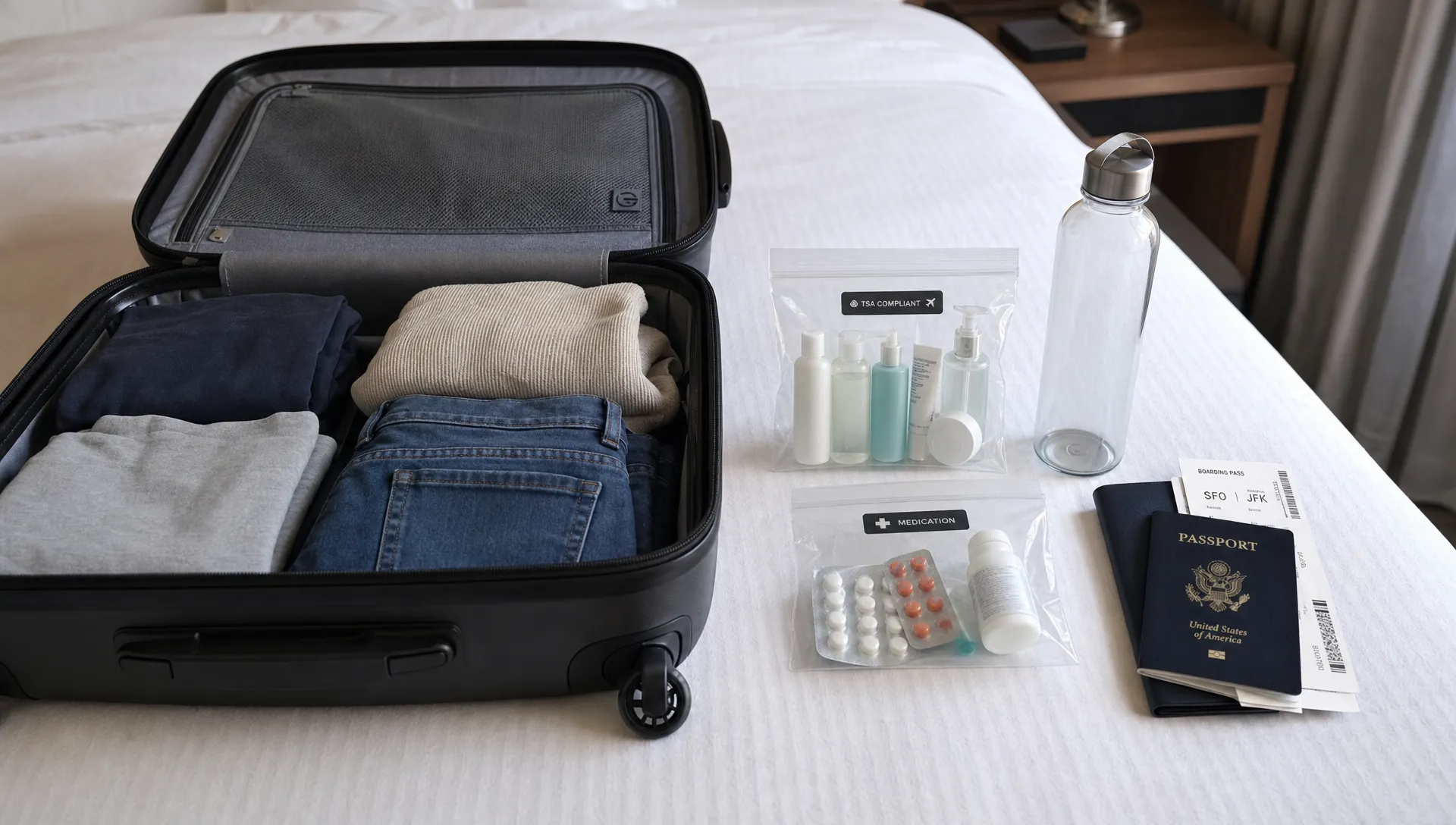
Small travel bottles are useful, but only if they seal well and are clearly under the limit. Avoid mystery jars when possible. If you decant a product, use a clean container with a tight lid and label it, especially for creams or medical products.
Solid swaps can reduce risk. Bar soap, solid shampoo, solid conditioner, powder dry shampoo, and stick deodorant are often easier to pack than liquid versions. They also free space in your liquids bag for items you cannot replace.
Food, drinks, sauces, and spreads
Food is where many travelers get surprised. Water, coffee, juice, soup, yogurt, honey, jam, nut butter, hummus, sauces, oils, vinegar, and soft cheeses can all raise liquid-rule issues in cabin baggage.
The safest habit is simple: bring an empty water bottle through security, then fill it after screening. If you are carrying edible gifts, pack liquids and spreads in checked baggage when possible, making sure they are sealed, cushioned, and allowed by customs rules at your destination.
Medicines and medical liquids
Many security authorities allow medically necessary liquids above the standard cabin limit, but they usually need additional screening. TSA guidance, for example, says medically necessary liquids should be declared to officers for inspection.
Keep prescription labels, pharmacy packaging, or a doctor’s note where available, especially for larger quantities, injectables, liquid nutrition, cooling packs, or specialized medical items. Do not bury these items at the bottom of your bag. Put them in a separate pouch so you can present them calmly.
Baby and child items
Formula, breast milk, baby food, and toddler drinks may be treated as exceptions at many airports, but they are not invisible to security. Expect them to be screened separately, and carry only reasonable quantities for the journey.
Pack baby liquids together and make them easy to remove. If you are traveling with ice packs or cooling bags, check the airport’s rules in advance, since screening requirements can differ.
Duty-free liquids
Duty-free is not a universal shortcut around liquid rules. Liquids bought after security are usually allowed onto that flight, but connecting flights can create problems if you pass through another security checkpoint.
If you buy perfume, alcohol, cosmetics, or other liquids at duty-free, keep them sealed in the tamper-evident bag, keep the receipt inside or attached, and do not open the bag before your final security screening. If you have a connection, check whether your next airport accepts sealed duty-free liquids from your origin.
Aerosols and pressurized products
Aerosols add another layer because they can be subject to both liquid limits and hazardous materials rules. Travel-size deodorant sprays, hairspray, and shaving foam may be allowed in cabin baggage if they meet the liquid container limit and fit in the liquids bag, but larger or highly flammable products can be restricted.
For checked baggage, do not assume “anything goes.” The FAA’s PackSafe guidance is a useful reference for aerosols and hazardous items, especially if you are packing sprays, fuel, solvents, or specialty products.
Do not forget return flights and connections
A common mistake is checking only the outbound airport. You may fly from an airport with relaxed liquid screening, then return from one that still enforces 100 ml. Or you may buy a large liquid abroad and discover that your connecting airport requires another security check.
This matters most for round trips, multi-city itineraries, self-transfers, and international connections. If you leave the secure transit area, change terminals, collect and recheck bags, or pass immigration, you may have to go through security again.
Before buying liquids during your trip, ask yourself one question: will this item survive every checkpoint between here and home? Our guide to rules for liquids on flights and return trips explains why the return journey can be the part that catches travelers out.
At security: reduce the chance of a borderline decision
Even perfect packing can be slowed down by unclear presentation. Your goal at the checkpoint is to make the screener’s job easy.
Keep your liquids bag near the top of your carry-on. If the airport asks passengers to remove liquids, you will be ready. If the airport uses scanners that allow liquids to stay inside bags, follow the local instruction rather than assuming last year’s process still applies.
Put exceptions in a separate pouch, not mixed with regular toiletries. When you reach the officer, say clearly what the item is: “This is prescribed liquid medication,” or “This is formula for the flight.” A calm, specific explanation is more effective than waiting for the officer to discover it during screening.
If an item is refused, ask politely what your options are. Depending on the airport and your timing, you may be able to return to the check-in desk, place the item in checked baggage, use a mailing service, hand it to a non-traveling companion, or surrender it. Once you are deep in the security process, however, you may have few choices.
What to do with liquids that are too large
If a liquid matters to you, do not gamble with it. Choose a safer plan before you reach the airport.
| Situation | Best option | Why it avoids confiscation |
|---|---|---|
| Full-size shampoo or skincare | Pack it in checked baggage | It avoids the cabin container limit |
| Expensive perfume | Use a 100 ml or smaller bottle, or check it carefully wrapped | Perfume is often too valuable to risk at the checkpoint |
| Sauce, jam, honey, or olive oil gift | Check it, ship it, or buy after final security | Spreads and pourable foods often count as liquids |
| Water or coffee | Finish it before security and refill after | Drinks are one of the easiest items to lose |
| Large sunscreen for a beach trip | Check the full-size bottle and carry a small backup | You keep enough product without risking cabin refusal |
| Liquid souvenir on a connecting itinerary | Confirm transfer rules before buying | Sealed duty-free bags are not accepted equally everywhere |
When in doubt, checked baggage is usually the better place for nonessential liquids. Just remember that checked bags have their own restrictions for dangerous goods, leakage, weight, customs, and airline policies.
The simple “will security take this?” test
Before you leave for the airport, run any questionable item through this quick test.
| Question | If the answer is yes | Safer move |
|---|---|---|
| Is the container over 100 ml? | It may be refused under standard cabin rules | Decant, check it, or leave it |
| Can it pour, spread, smear, spray, or squeeze? | It may be treated as a liquid, gel, cream, paste, or aerosol | Put it in the liquids bag or check it |
| Is it needed for medical, baby, or dietary reasons? | It may qualify for an exception | Pack it separately and bring supporting information |
| Will you pass security again on a connection or return trip? | A later checkpoint may apply stricter rules | Pack for the strictest airport on the route |
| Would you be upset if it were thrown away? | It is not worth gambling with | Check it, ship it, or choose a travel-size version |
This test is intentionally conservative. Airport security is not the place to argue about technicalities, especially when rules are changing unevenly across airports.
Frequently Asked Questions
Can I bring a 150 ml bottle if it is half empty? Usually no under the standard cabin liquid rule. Security typically looks at the container size, not the amount left inside. Use a 100 ml or smaller container instead.
Are liquid rules the same in every airport? No. Many airports still use the 100 ml rule, while some checkpoints may allow larger containers when approved screening equipment and local rules permit it. Always check the airports on your actual route.
Do new airport scanners mean I can bring 2 liters of liquid? Not automatically. Some airports with newer scanners may allow larger liquids, but rules can differ by terminal, route, and date. If you cannot verify the rule, pack to the stricter 100 ml limit.
Can medicines be over 100 ml in hand luggage? Often yes, if they are medically necessary and presented for screening, but rules and documentation expectations vary. Keep medicines separate, labeled, and easy to explain.
What happens if security confiscates my liquid? In most cases, you must surrender it for disposal. If you have enough time and the airport allows it, you may be able to return to check-in, place it in checked baggage, mail it, or give it to someone not traveling.
Is toothpaste considered a liquid for flying? Yes, toothpaste is generally treated as a paste or gel, so it should follow cabin liquid rules unless packed in checked baggage.
Check before you zip the bag
Avoiding confiscation is less about memorizing every airport rule and more about checking the right rule for your exact trip. The safest approach is to verify your departure, connection, and return airports, then pack for the strictest checkpoint you will face.
Liquid Limits helps you check airport liquid rules before you pack, including round trips where the return airport may be different. You can look up airports, routes, and specific items, with verified source links and last-checked dates. If a rule is unclear, the tool defaults to the stricter 100 ml guidance so you are not left guessing at security.
If you want a broader pre-flight packing reference, keep our travel liquids checklist for stress-free security handy before your next trip. A few minutes of checking at home can save your toiletries, gifts, medicine, and time at the airport.